Early childhood is one of the most important stages in a person’s life. During these early years, children develop the foundational skills, habits, and relationships that influence how they learn, communicate, solve problems, and interact with others. The experiences children have at home and in educational settings can shape their development long after they enter primary school.
Understanding the benefits of early childhood education helps parents and caregivers make informed decisions about their children’s learning and development. Quality early education offers more than preparation for school. It creates opportunities for children to explore new ideas, build confidence, develop friendships, and discover their abilities in a safe and supportive environment.
From improving language skills to encouraging emotional resilience, early childhood education can make a meaningful difference in a child’s future. In this guide, we explore how early learning supports children’s development, what makes an effective early education program, and how parents can encourage learning at home.
What Is Early Childhood Education?
Early childhood education refers to structured and informal learning experiences designed to support young children’s development before and during their early school years. Depending on the education system and program, these experiences may include childcare centers, preschool programs, nursery schools, kindergarten, and other early learning environments.
The main goal is to help children develop age-appropriate skills through play, exploration, communication, and guided activities.
Early childhood education commonly supports several areas of development:
- Cognitive development: Thinking, reasoning, memory, attention, and problem-solving.
- Language development: Listening, speaking, understanding words, and beginning literacy.
- Social development: Sharing, cooperating, building friendships, and respecting others.
- Emotional development: Recognizing feelings, managing frustration, and developing confidence.
- Physical development: Improving coordination, balance, movement, and fine motor skills.
- Creative development: Exploring imagination through music, art, storytelling, and pretend play.
These areas are closely connected. For example, a child participating in a group storytelling activity may improve listening skills, learn new vocabulary, practice taking turns, and develop imagination at the same time.
10 Important Benefits of Early Childhood Education
The benefits of early childhood education extend beyond learning letters and numbers. A high-quality program supports the whole child and helps build a strong foundation for future learning.
1. Builds Strong Cognitive Skills
Young children naturally explore their surroundings by asking questions, observing objects, testing ideas, and experimenting with new activities. Early education provides opportunities to turn this curiosity into meaningful learning.
Activities such as puzzles, sorting games, building blocks, counting exercises, and simple science experiments help children recognize patterns and develop problem-solving abilities.
For example, when children build a tower with blocks, they discover concepts such as balance, size, shape, and cause and effect. If the tower falls, they can try a different arrangement and learn from the result.
These experiences encourage children to think independently rather than simply memorize information.
2. Improves Language and Communication Skills
Language is essential for learning, building relationships, and expressing needs. Early childhood education creates regular opportunities for children to listen, speak, ask questions, and communicate with adults and other children.
Teachers can support language development through:
- Reading picture books aloud.
- Encouraging children to describe their experiences.
- Introducing new words during everyday activities.
- Singing songs and reciting rhymes.
- Asking open-ended questions.
- Giving children time to explain their ideas.
For example, after reading a story, a teacher might ask a child what they think will happen next. This simple activity encourages vocabulary development, comprehension, imagination, and independent thinking.
Children who speak more than one language can also benefit from an environment that respects and supports their home language while helping them learn additional languages.
3. Develops Social Skills and Cooperation
Learning to interact with other people is an important part of childhood development. In an early learning environment, children meet peers with different personalities, preferences, and ideas.
Group activities teach children how to cooperate, share materials, take turns, listen to others, and participate in common tasks.
Consider a group art project in which children work together to create a large picture. They must decide who will use different materials, discuss their ideas, and learn to respect each other’s contributions.
These everyday experiences help children practice the social skills they will need in school, friendships, and later life.
4. Strengthens Emotional Development
Children experience a wide range of emotions, including happiness, excitement, disappointment, fear, and frustration. Learning how to understand and manage these feelings takes time and support.
A caring early childhood educator can help children identify their emotions and respond to challenging situations in healthy ways.
For example, if a child becomes upset because another child is using a favorite toy, the teacher can help them describe their feelings, wait for a turn, or choose another activity.
Over time, these experiences can support emotional regulation, patience, resilience, and empathy.
A supportive environment also helps children feel safe asking for help, trying unfamiliar tasks, and recovering from small setbacks.
5. Prepares Children for Primary School
School readiness involves more than knowing the alphabet or counting to ten. Children also need to develop attention, communication, independence, curiosity, and the ability to participate in group activities.
Early education can introduce children to classroom routines and learning expectations in an age-appropriate way.
Common school-readiness activities include:
- Recognizing letters, sounds, numbers, and basic shapes.
- Listening to instructions and following simple routines.
- Using books and classroom materials appropriately.
- Completing short tasks with guidance.
- Asking questions and expressing needs.
- Working alongside other children.
These experiences can make the transition to primary school more familiar and manageable.
Importantly, effective early education does not require children to master formal academic subjects too early. The focus should be on building foundational skills through engaging, developmentally appropriate activities.
6. Encourages Creativity and Imagination
Creativity allows children to explore possibilities, communicate ideas, and approach problems in different ways. Early childhood education supports creativity through drawing, painting, music, storytelling, construction, movement, and imaginative play.
When children use everyday objects to create a pretend shop, for instance, they may take on different roles, invent conversations, count pretend money, and develop their own stories.
These activities combine imagination with practical learning.
Educators can encourage creativity by providing open-ended materials and allowing children to make choices. Rather than expecting every child to produce the same result, they can value individual ideas and different approaches.
7. Promotes Independence and Confidence
Young children gradually learn to complete everyday tasks with less assistance. Early education provides a structured environment in which they can practice making choices, solving simple problems, and taking responsibility for their belongings.
Age-appropriate responsibilities might include putting away toys, choosing a book, washing hands, organizing art supplies, or asking for help when needed.
When children successfully complete these tasks, they gain opportunities to develop confidence in their abilities.
Teachers can support this process by offering encouragement, demonstrating unfamiliar tasks, and allowing children enough time to try independently.
The goal is not to expect perfection. It is to help children understand that learning takes practice and that mistakes are a normal part of development.
8. Supports Physical Development and Healthy Habits
Physical development is another important part of early learning. Children need opportunities to move, explore, practice coordination, and develop control over their bodies.
Outdoor play, dancing, running, climbing on age-appropriate equipment, and simple movement games support gross motor development. Activities such as drawing, threading large beads, building with blocks, and handling child-safe tools help develop fine motor skills.
Early education can also reinforce everyday habits related to hygiene, nutrition, rest, and personal safety.
For example, teachers can encourage children to wash their hands before meals and explain why keeping shared spaces clean matters.
These experiences help children develop practical skills while supporting their overall well-being.
9. Creates Opportunities for Early Support
Children do not all develop at the same pace. Some may need additional support with communication, movement, social interaction, attention, or other developmental skills.
Regular interaction with trained educators can create opportunities to notice areas where a child may benefit from extra help.
Educators can communicate observations to families and, when appropriate, recommend discussing concerns with a qualified healthcare professional or child development specialist.
Early identification does not mean labeling a child or assuming that every difference indicates a problem. Instead, it helps families understand a child’s individual needs and explore suitable support.
Inclusive early education programs should aim to make learning accessible to children with different abilities, backgrounds, languages, and learning preferences.
10. Builds a Foundation for Lifelong Learning
One of the most valuable benefits of early childhood education is that it can help children develop a positive relationship with learning.
When children are encouraged to ask questions, explore interests, experiment with ideas, and receive supportive feedback, they can begin to see learning as an enjoyable process.
This foundation may help them approach future challenges with greater curiosity and persistence.
For example, a child who is encouraged to investigate how plants grow may develop an ongoing interest in nature and science. Another child who enjoys storytelling may become interested in reading, writing, or creative communication.
Early education cannot determine a child’s entire future, but positive early experiences can help establish useful habits and attitudes that support continued growth.
How Early Childhood Education Influences Long-Term Development
The effects of early learning can extend beyond the preschool years, particularly when children have access to consistent, supportive, high-quality educational experiences.
Academic Development
Children develop foundational knowledge and skills through conversations, stories, play, and guided activities. These experiences can support later learning in reading, mathematics, science, and other subjects.
For example, sorting objects by shape and size introduces early mathematical thinking, while listening to stories helps children develop vocabulary and comprehension.
A strong foundation can make it easier for children to engage with more complex concepts as they progress through school.
Social and Emotional Well-Being
Early education offers opportunities to build relationships with trusted adults and other children. Supportive relationships can help children feel secure, practice communication, and develop strategies for managing everyday challenges.
Children also learn that disagreements can be addressed through discussion, compromise, and adult guidance.
These experiences may support healthier relationships and better adjustment to new environments over time.
Adaptability and Problem-Solving
Children frequently encounter small challenges during play and group learning. They may need to rebuild a structure, find a missing puzzle piece, negotiate a role in a game, or try a different approach to a task.
With appropriate guidance, these situations allow children to practice persistence and flexible thinking.
Such skills remain useful as academic work becomes more demanding and children face new responsibilities.
Greater Access to Learning Opportunities
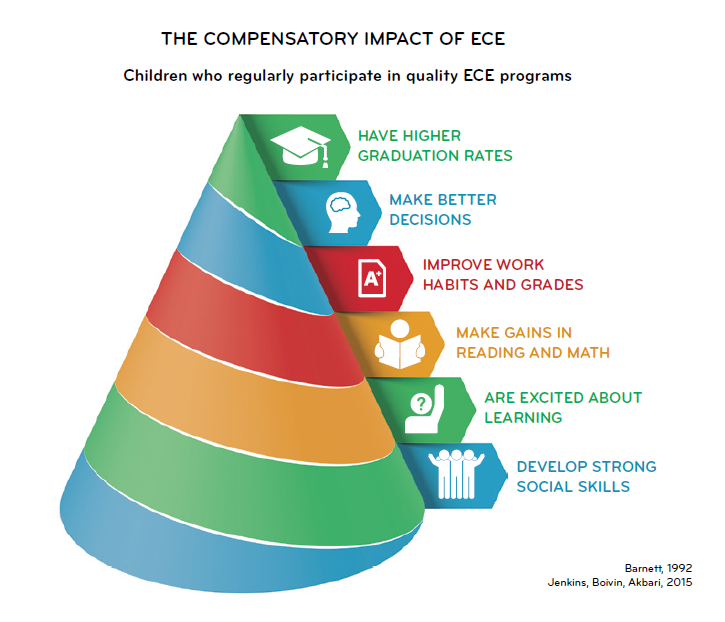
Quality early childhood education can be particularly valuable for children who have fewer learning resources at home or face other disadvantages. A well-designed program can provide access to books, learning materials, trained educators, supportive relationships, and enriching experiences.
However, access alone is not enough. The quality of the program, family involvement, and the child’s wider environment all influence the benefits they receive.
What Makes an Early Childhood Education Program Effective?
Not every early learning environment provides the same experience. The quality of teaching, relationships, activities, and daily care can significantly influence how children benefit.
Parents and caregivers should consider the following characteristics when evaluating a program.
Qualified and Caring Educators
Effective educators understand how young children learn and develop. They create welcoming environments, respond to children’s needs, and adapt activities to different developmental levels.
They also observe children’s progress and communicate respectfully with families.
Safe and Supportive Learning Environments
Children need spaces where they can explore without unnecessary risks. Classrooms and play areas should be clean, appropriately equipped, supervised, and designed for children’s ages and abilities.
A positive environment also protects children from bullying, humiliation, discrimination, and inappropriate discipline.
Play-Based Learning Opportunities
Play is a central way young children explore their world. Effective programs combine purposeful teaching with opportunities for children to make choices, experiment, imagine, and interact.
Play-based learning can include construction activities, dramatic play, outdoor exploration, music, puzzles, and guided group games.
Individualized Attention
Children have different interests, strengths, cultural backgrounds, and learning needs. Educators should recognize these differences and provide appropriate encouragement and assistance.
Smaller groups and suitable adult-to-child ratios can help educators interact meaningfully with individual children.
Strong Family Communication
Parents and educators share an important role in supporting children’s development. Regular communication helps both sides understand a child’s interests, progress, and challenges.
Families should feel comfortable asking questions and discussing concerns about the learning environment.
Inclusive and Developmentally Appropriate Teaching
An effective program provides activities suited to children’s ages and abilities rather than placing unnecessary pressure on them to perform beyond their developmental stage.
It should also respect different languages, family circumstances, cultures, and abilities so that children feel welcomed and valued.
How Parents Can Support Early Childhood Education at Home
Children continue learning outside the classroom. Everyday interactions at home can reinforce the skills they develop through early education.
Read Together Every Day
Choose age-appropriate books and make reading interactive. Ask children to describe pictures, predict what might happen next, and explain which characters they like.
Even short, regular reading sessions can create valuable opportunities for language development and bonding.
Encourage Questions and Exploration
When children ask questions, respond with simple explanations and encourage them to observe their surroundings.
For example, you might discuss why leaves change color, how rain forms, or what happens when different objects are placed in water.
You do not need to know every answer. Exploring questions together can be an important learning experience.
Make Learning Part of Everyday Activities
Cooking, shopping, gardening, and tidying can introduce useful concepts.
Children can count fruit, sort laundry by color, identify shapes, measure ingredients with adult assistance, or help organize toys.
These practical activities show children how learning relates to everyday life.
Encourage Play and Creativity
Provide opportunities for drawing, building, pretend play, music, and outdoor movement. Children do not always need expensive toys or electronic devices to learn.
Simple materials, adult interaction, and time to explore can support curiosity and creativity.
Build Consistent Routines
Predictable routines around meals, sleep, play, and reading can help children understand what to expect throughout the day.
Consistency can also make transitions easier and provide a sense of security.
Praise Effort and Progress
Instead of praising only correct answers or finished products, recognize children’s effort, persistence, and willingness to try.
For example, saying, “You tried a different way to solve that puzzle,” helps draw attention to the learning process.
Encouragement should be sincere and appropriate to the child’s needs.
Common Myths About Early Childhood Education
Several misconceptions can prevent families from fully understanding the purpose of early learning.
Myth 1: Early Education Is Only About Learning ABCs
Letters and numbers are useful, but early childhood education also supports language, movement, creativity, emotional development, independence, and social interaction.
A balanced program considers all these areas.
Myth 2: Children Learn Best Through Formal Lessons Alone
Young children benefit from varied learning experiences. Play, conversation, exploration, movement, and guided instruction can all contribute to development.
Long periods of formal instruction are not the only way to introduce important concepts.
Myth 3: Every Child Should Develop at the Same Speed
Children develop at different rates and have individual strengths. Educators and families should consider developmental patterns and individual circumstances rather than treating every difference as a failure.
If a parent has persistent concerns about development, discussing them with an appropriate professional can help determine whether additional support is needed.
Myth 4: Only Preschool Teachers Are Responsible for Learning
Teachers play an important role, but families and caregivers also influence children’s development through everyday relationships and experiences.
Children benefit when the adults in their lives communicate and work together.
Myth 5: Starting Formal Education Earlier Always Produces Better Results
Starting earlier does not automatically guarantee better outcomes. Program quality, responsive relationships, age-appropriate teaching, and the child’s individual needs matter greatly.
Children need opportunities to learn without unnecessary pressure or unrealistic expectations.
Frequently Asked Questions About the Benefits of Early Childhood Education
What are the main benefits of early childhood education?
The main benefits include stronger foundational thinking and language skills, social and emotional development, improved school readiness, greater independence, opportunities for creative expression, and positive attitudes toward learning. The extent of these benefits depends on program quality and the child’s circumstances.
Why is early childhood education important for a child’s future?
Early childhood education provides experiences that help children develop skills they can use throughout school and everyday life. Quality programs encourage curiosity, communication, problem-solving, and healthy relationships, helping establish a foundation for future development.
At what age should children begin early childhood education?
The appropriate starting age depends on the child, the family’s needs, and the type of program available. Early childhood education can include learning experiences from infancy onward, while formal preschool enrollment commonly begins during the years before primary school. Families should consider the child’s developmental needs and the quality of available care.
Is preschool necessary for every child?
Preschool can provide valuable learning and social opportunities, but children can also learn through responsive caregiving, play, conversation, and enriching experiences at home. Access to a quality early learning program may offer additional benefits, and families should consider their child’s circumstances when making decisions.
How does early childhood education help with school readiness?
It introduces children to early literacy and numeracy while helping them practice listening, communication, following routines, cooperating with others, and completing age-appropriate tasks. These skills can make the transition to primary school more manageable.
What is the difference between early childhood education and early childhood development?
Early childhood development is the broader process through which children grow physically, cognitively, socially, emotionally, and linguistically. Early childhood education is one way of supporting this development through learning opportunities, guided activities, and educational environments.
How can parents support early learning at home?
Parents can read with their children, talk about daily experiences, encourage questions, provide opportunities for imaginative play, establish consistent routines, and involve children in age-appropriate everyday tasks. Warm, responsive interactions are especially important.
Does early childhood education improve long-term academic outcomes?
Research indicates that high-quality early education can improve school readiness and certain later educational outcomes, particularly for children facing disadvantage. Results vary, however, and depend on program quality, family circumstances, and other influences throughout childhood.
Conclusion
The benefits of early childhood education go far beyond preparing children for their first day of school. Quality early learning experiences can help children develop cognitive abilities, language skills, social confidence, emotional resilience, creativity, and independence.
These foundations are built through supportive relationships, age-appropriate activities, opportunities for play, and environments where children feel safe enough to explore and learn.
Parents, educators, and caregivers all have a role in creating these opportunities. By working together and recognizing each child’s individual needs, they can help young learners develop a positive relationship with education and build skills that support their continued growth.
Early childhood education cannot guarantee a particular outcome, but a thoughtful, nurturing start can give children valuable tools for navigating future learning and life’s challenges.
Leave a Reply