Category: education

  • Phonics vs Whole Language: Approaches to Teaching Reading

    Phonics vs Whole Language: Approaches to Teaching Reading

    Learning to read is one of the most important milestones in a child’s education. Strong reading skills help students understand classroom instructions, develop vocabulary, explore new ideas, and succeed across different subjects. However, children do not all learn to read in the same way or at the same pace, which makes choosing effective teaching methods an important responsibility for educators.

    The phonics vs whole language approach debate has influenced reading instruction for decades. Phonics emphasizes the relationship between letters and sounds, helping children decode unfamiliar words. Whole language emphasizes meaningful reading experiences, stories, context, and the use of language for communication.

    Both approaches highlight important aspects of literacy, but they differ in how they teach children to recognize words and develop reading skills. Understanding these differences helps parents and teachers make informed decisions about classroom instruction.

    Research supports explicit, systematic phonics as an important part of early reading instruction. However, phonics alone is not enough. Children also need vocabulary development, reading fluency, comprehension instruction, and opportunities to enjoy meaningful texts.

    What Is Phonics-Based Reading Instruction?

    Phonics is a method of teaching reading that helps children understand the relationship between written letters and spoken sounds. Students learn how letters and groups of letters represent sounds and how these sounds combine to form words.

    For example, children may learn that the letters c, a, and t represent the sounds /k/, /ă/, and /t/. By blending these sounds, they can read the word “cat.”

    This process is called decoding. It allows beginning readers to work out unfamiliar words instead of relying entirely on memory or pictures.

    How Does Phonics Work?

    Phonics instruction typically introduces letter-sound relationships in a planned sequence. Students learn individual sounds, common spelling patterns, and strategies for combining sounds to read words.

    A phonics lesson may include the following activities:

    • Recognizing letters and their corresponding sounds.
    • Blending sounds to read simple words.
    • Segmenting words into individual sounds.
    • Identifying common spelling patterns.
    • Reading suitable practice texts.
    • Applying phonics knowledge to spelling and writing.

    For example, a teacher might introduce the sound represented by “sh,” demonstrate words such as “ship” and “shop,” and ask students to identify other words containing the same sound.

    As students progress, instruction can cover more complex spelling patterns, syllables, and word parts.

    Types of Phonics Instruction

    Synthetic phonics: Students learn to connect individual letters or letter combinations with sounds and blend them to form words.

    Analytic phonics: Students examine familiar words and identify the relationships between their letters and sounds.

    Systematic phonics: Phonics skills are taught in an organized sequence, with new concepts building on previously taught skills.

    Embedded phonics: Letter-sound relationships are taught within meaningful reading activities, often when relevant patterns appear in a text.

    These approaches differ in how explicitly and systematically they teach phonics. A structured program should provide sufficient practice for students to apply what they learn during actual reading and writing.

    What Is the Whole Language Approach?

    The whole language approach views reading as a meaningful language activity. It emphasizes understanding texts, enjoying stories, communicating ideas, and using reading and writing for real purposes.

    Instead of concentrating primarily on teaching individual letter-sound relationships in a predetermined sequence, whole language classrooms often introduce reading through complete stories, poems, books, and other meaningful texts.

    Students may use context, illustrations, prior knowledge, and their understanding of language to make sense of what they read.

    How Does Whole Language Work?

    In a whole language classroom, teachers may read stories aloud, encourage independent book exploration, organize group discussions, and ask students to write about their experiences.

    Common activities include:

    • Reading complete stories and discussing their meanings.
    • Predicting what might happen next in a book.
    • Connecting a story to personal experiences.
    • Writing short stories, letters, and classroom journals.
    • Exploring different genres and types of text.
    • Discussing characters, themes, and important events.

    For example, a teacher might read a story about a family visiting a farm. Students discuss the characters, describe the setting, predict what happens next, and write a few sentences about their favorite part.

    These activities encourage language development, comprehension, and engagement with books.

    How Does Whole Language Address Unknown Words?

    In a whole language classroom, students may be encouraged to use context and illustrations to help understand unfamiliar words.

    For example, if a sentence says that a child put on a coat because the weather was cold, a student might use the surrounding information to infer the meaning of an unfamiliar word.

    Context is valuable for understanding meaning. However, guessing from context should not replace the ability to decode unfamiliar written words. Students also need explicit instruction in how letters and spelling patterns represent sounds.

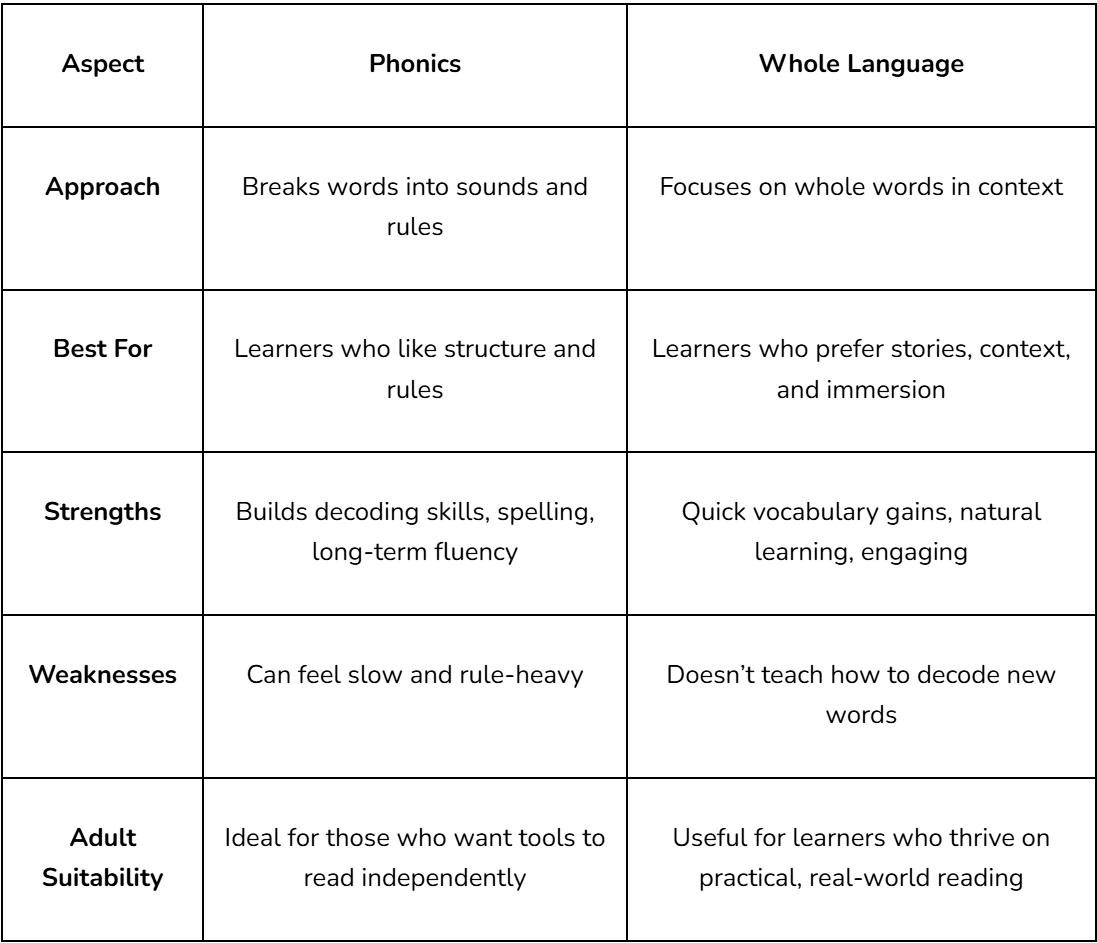
    Phonics vs Whole Language Approach: Key Differences

    Although both approaches aim to develop reading ability, their instructional priorities differ.

    FeaturePhonics approachWhole language approach
    Main focusLetter-sound relationships and decodingMeaningful texts and language use
    Starting pointLetters, sounds, and spelling patternsStories, books, and connected text
    Word recognitionExplicit decoding strategiesOften emphasizes context and familiarity
    Typical activitiesSound blending, word reading, spelling practiceStory discussions, writing, and reading experiences
    Skill developmentTeaches foundational skills systematicallyEmphasizes language, meaning, and authentic literacy
    Main concern when used aloneMay underemphasize comprehension and meaningful readingMay leave some students without sufficient decoding instruction

    The distinction is not absolute. Phonics can be taught through meaningful stories, and whole-text reading can include explicit instruction in letter-sound relationships. Many effective literacy programs combine structured skill instruction with rich reading experiences.

    Advantages of the Phonics Approach

    Phonics can provide children with the foundational skills needed to recognize unfamiliar words and become more independent readers.

    1. Develops Word-Decoding Skills

    Children learn how to use spelling patterns to identify words they have not seen before. This is especially important during the early stages of reading.

    Rather than depending exclusively on memorized words, students develop a strategy they can apply to new examples.

    2. Supports Spelling Development

    Understanding relationships between sounds and letters can help children represent spoken words in writing.

    For example, a student who can identify the sounds in “map” can practice representing each sound with the appropriate letter.

    Spelling also requires knowledge of conventional spelling patterns, irregular words, and word structure, so phonics is one part of broader spelling instruction.

    3. Builds Confidence With Unfamiliar Words

    Students may feel more confident when they have a reliable method for attempting unfamiliar words. Explicit instruction and guided practice allow them to develop accuracy gradually.

    4. Provides a Structured Learning Sequence

    Systematic phonics makes it easier for teachers to introduce skills in manageable steps and identify areas where students need more practice.

    This structure can be especially helpful for beginning readers and children who are struggling to decode words.

    5. Has Strong Research Support

    Research reviewed by the National Reading Panel found that systematic phonics instruction improves important reading outcomes, including decoding and word recognition. The U.S. Institute of Education Sciences also recommends teaching students to connect speech sounds with letters and to decode words as part of foundational reading instruction.

    These findings support systematic phonics as an important component of early literacy teaching, rather than as a complete reading curriculum by itself.

    Limitations of the Phonics Approach

    Although phonics is important, teaching letter-sound relationships alone does not guarantee that a child will become a skilled reader.

    1. Decoding Does Not Automatically Produce Comprehension

    A child may pronounce every word in a sentence correctly without understanding its meaning.

    Students also need vocabulary, background knowledge, language comprehension, and opportunities to discuss what they read.

    2. Excessive Drills Can Reduce Engagement

    Repeated exercises can become monotonous if students have few opportunities to use their skills in stories or meaningful texts.

    Teachers can make practice more engaging by using games, short passages, discussions, and age-appropriate reading materials.

    3. Irregular Words Require Additional Teaching

    English contains words that do not follow the most common spelling patterns. Students need help learning these words while also understanding the regular relationships between letters and sounds.

    4. Instruction Must Be Responsive to Student Needs

    Students progress at different rates. Some need additional practice with sound recognition, blending, or spelling patterns, while others are ready for more complex texts.

    Teachers should monitor progress and adjust instruction rather than moving every student forward at the same pace.

    Advantages of the Whole Language Approach

    Whole language emphasizes the purposes of reading and writing. Its activities can support children’s engagement with language and help them understand texts in meaningful contexts.

    1. Encourages Enjoyment of Reading

    Stories, poems, and interesting nonfiction can help children discover that reading is enjoyable and informative.

    Offering appealing books and allowing students to explore their interests can encourage positive attitudes toward reading.

    2. Develops Language and Comprehension

    Reading complete texts gives children opportunities to discuss characters, follow events, identify main ideas, and connect information.

    These activities help students practice making meaning from written language.

    3. Connects Reading and Writing

    Whole language activities often combine reading with writing, speaking, and listening.

    For example, after reading a story, students might write a different ending or create a short description of a character. This gives them opportunities to apply vocabulary and express ideas.

    4. Provides Context for New Vocabulary

    When children encounter words in complete sentences and stories, they can use surrounding information to develop an understanding of meaning.

    Teachers can build on this by explaining unfamiliar words and asking students to use them in new contexts.

    5. Supports Discussion and Critical Thinking

    Story discussions encourage students to explain opinions, consider different perspectives, and support their interpretations with details from a text.

    These skills become increasingly important as students read more complex material.

    Limitations of the Whole Language Approach

    Whole language activities can support comprehension and engagement, but a program that relies on them without adequate foundational skills instruction may leave some students struggling to read unfamiliar words.

    1. Students May Not Learn Decoding Systematically

    Some children do not independently discover all the letter-sound relationships they need. They benefit from direct explanations, a planned sequence of instruction, and repeated opportunities to practice.

    2. Guessing Can Become a Substitute for Word Reading

    Illustrations and context can help readers understand a story, but they cannot reliably identify every unfamiliar word.

    Students need to learn to examine the letters and spelling patterns in words rather than depending only on pictures, sentence meaning, or the first letter.

    3. Progress May Be Uneven Without Structured Instruction

    Children enter school with different levels of language experience and knowledge of print. Without systematic teaching and assessment, some students may miss important foundational skills.

    4. Reading Difficulties May Go Unnoticed

    A student might participate enthusiastically in story discussions but still struggle to decode words independently. Teachers should assess both comprehension and foundational reading skills so that specific difficulties can be identified early.

    What Does Research Say About Phonics vs Whole Language?

    Research provides stronger support for systematic phonics instruction than for approaches that provide little or no systematic phonics teaching, particularly when helping beginning readers develop decoding skills.

    The National Reading Panel’s review found that systematic phonics instruction improved reading outcomes compared with various approaches that did not provide systematic phonics, including whole language approaches. The findings also emphasized that phonics should be integrated into a complete reading program.

    The Institute of Education Sciences recommends that early reading instruction include:

    • Developing awareness of the individual sounds in spoken language and connecting those sounds with letters.
    • Teaching students to decode words and recognize spelling patterns.
    • Providing daily opportunities to read connected text.
    • Supporting vocabulary and language development.

    These recommendations illustrate an important distinction: effective reading instruction should teach foundational skills explicitly while also helping children understand and engage with meaningful texts.

    Research does not support treating phonics and comprehension as competing goals. Students need both accurate word recognition and the ability to understand language.

    Which Reading Approach Is Better for Young Students?

    For most beginning readers learning English, a balanced, evidence-informed program that includes explicit, systematic phonics alongside vocabulary, oral language, fluency, comprehension, and meaningful reading experiences is a strong choice.

    This does not mean giving equal instructional time to every activity. Teachers should prioritize the skills students need and adapt instruction according to their progress.

    When Phonics Instruction Is Especially Important

    Systematic phonics deserves particular attention when students are learning to read unfamiliar words, connecting letters with sounds, or developing accurate spelling.

    It is also important for students who struggle with decoding and need explicit instruction and guided practice.

    When Meaningful Texts Are Especially Important

    Stories, nonfiction books, discussion, and writing are essential for developing vocabulary, comprehension, background knowledge, and an understanding of how language communicates ideas.

    Students should have opportunities to apply their decoding skills in connected text and discuss what they have read.

    Why a Combined Approach Is Practical

    A combined approach avoids the limitations of relying on a single method. Teachers can explicitly teach a spelling pattern, help students practice reading words that contain it, and then use a suitable story to explore vocabulary and meaning.

    For example, students might learn the “ch” sound, practice reading words such as “chip” and “chop,” and then read a short passage containing those words. The teacher can discuss the passage’s meaning and ask comprehension questions.

    This approach connects foundational skills with the real purpose of reading: understanding written information.

    How to Combine Phonics and Whole-Text Reading in the Classroom

    Teachers can integrate both approaches into a practical lesson without making instruction complicated.

    Step 1: Introduce a Specific Reading Skill

    Choose a skill appropriate to students’ current abilities, such as identifying a letter-sound relationship or blending simple words.

    Explain the skill clearly and demonstrate it with a few examples.

    Step 2: Provide Guided Practice

    Ask students to practice the new skill with teacher support. Use word cards, short exercises, or other activities that allow students to receive feedback.

    Correct errors constructively and give students additional practice when needed.

    Step 3: Apply the Skill in Connected Text

    Choose a suitable passage or story that allows students to use the skill they have practiced.

    Encourage them to read accurately rather than relying exclusively on illustrations or guessing.

    Step 4: Discuss Meaning

    Ask students to explain what the passage communicates. Questions might focus on the main idea, an important detail, a character’s actions, or the meaning of an unfamiliar word.

    This helps connect word reading with comprehension.

    Step 5: Check Progress

    Use short reading tasks, observations, spelling exercises, and comprehension questions to determine whether students have understood the lesson.

    If a student struggles, identify the specific skill that needs more attention and provide targeted support.

    Example of a Combined Reading Lesson

    Consider a lesson for young students learning to read words containing the “sh” sound.

    Learning objective: Students will recognize the “sh” spelling pattern, read simple words containing it, and understand a short passage.

    Activity 1: Explicit teaching

    The teacher explains that “sh” represents a sound heard at the beginning of words such as “ship” and “shop.”

    Activity 2: Word practice

    Students read words such as “shop,” “fish,” and “shell.” They identify where the spelling pattern appears in each word.

    Activity 3: Connected reading

    Students read a short, suitable story that includes several words containing “sh.” The teacher provides support as needed.

    Activity 4: Comprehension discussion

    Students describe what happened in the story and answer questions about its main events.

    Activity 5: Writing practice

    Students write a sentence containing one of the new words.

    This lesson combines explicit instruction, word practice, meaningful reading, comprehension, and writing. Each activity contributes to a clear learning objective.

    Frequently Asked Questions

    What is the main difference between phonics and whole language?

    Phonics emphasizes relationships between letters and sounds to help students decode unfamiliar words. Whole language emphasizes meaningful reading experiences, complete texts, language use, and comprehension. Effective literacy instruction can incorporate useful elements of both.

    Is phonics better than whole language for teaching reading?

    Research provides strong support for systematic phonics as a component of early reading instruction, especially for developing decoding skills. However, phonics alone is not sufficient. Students also need vocabulary, fluency, comprehension, and opportunities to read meaningful texts.

    Can children learn to read without phonics?

    Some children may learn certain words or patterns through exposure and experience, but many benefit from explicit instruction in letter-sound relationships. Teaching systematic phonics helps students develop strategies for reading unfamiliar words rather than relying primarily on memorization or context.

    What is systematic phonics instruction?

    Systematic phonics instruction teaches letter-sound relationships and spelling patterns in an organized sequence. Students practice each skill and apply it to reading and writing as their knowledge develops.

    Does whole language mean children only read stories?

    No. Whole language emphasizes meaningful literacy experiences, which can include stories, nonfiction, writing, discussions, and other forms of communication. The concern arises when meaningful reading activities replace rather than complement explicit instruction in foundational skills.

    What approach should teachers use in kindergarten and first grade?

    Teachers should use an evidence-informed program that explicitly teaches foundational reading skills, including phonemic awareness and systematic phonics, while providing vocabulary instruction, read-alouds, connected texts, and comprehension activities. The balance should reflect students’ developmental needs and progress.

    How can parents support phonics at home?

    Parents can practice letter sounds, play simple sound-blending games, read suitable books together, and encourage children to sound out words when appropriate. Keep activities short and supportive, and seek guidance from the child’s teacher if reading difficulties persist.

    Can phonics and whole language be used together?

    Yes. Teachers can teach spelling patterns explicitly and then help students apply them in stories, nonfiction passages, discussions, and writing activities. This combines foundational reading skills with meaningful language experiences.

    Conclusion

    The phonics vs whole language approach debate highlights two important aspects of learning to read: understanding how written words work and understanding what those words communicate.

    Phonics provides children with explicit strategies for connecting letters and sounds, decoding unfamiliar words, and developing spelling skills. Whole-text reading and language-rich activities provide opportunities to build vocabulary, comprehension, curiosity, and enjoyment.

    The evidence supports systematic phonics as an important part of early reading instruction, but it should not be taught in isolation from the rest of literacy education. Students need direct instruction, guided practice, meaningful texts, and regular opportunities to discuss and understand what they read.

    For parents and teachers, the most useful goal is not to choose a label for a reading program. It is to ensure that every child receives the foundational instruction, language support, and reading experiences needed to become an accurate, fluent, and confident reader.
  • Understanding Multiple Intelligences in the Classroom

    Understanding Multiple Intelligences in the Classroom

    Every student has different strengths, interests, and ways of approaching a challenge. Some students enjoy reading and writing, while others are more comfortable solving problems, creating artwork, working in groups, or learning through practical activities. Recognizing these differences can help teachers create engaging lessons that give students more opportunities to participate.

    Multiple intelligences in education is an approach associated with psychologist Howard Gardner. It proposes that intelligence should be understood through several different capacities rather than measured through a single ability alone. The theory has influenced classroom activities, curriculum planning, and discussions about student strengths.

    However, teachers should understand both its potential applications and its limitations. Research has not established that matching instruction to a student’s supposed intelligence type reliably improves academic achievement. The most practical approach is to use varied teaching strategies while selecting methods according to the learning objective, the needs of students, and evidence of progress.

    What Are Multiple Intelligences in Education?

    Multiple intelligences in education refers to applying Howard Gardner’s theory of multiple intelligences to teaching and learning. Introduced in 1983, the theory suggests that human abilities can be considered across several areas, including language, logical reasoning, music, movement, spatial thinking, social understanding, self-awareness, and understanding the natural world.

    In traditional classrooms, academic performance is often evaluated through reading, writing, mathematical reasoning, and examinations. Gardner’s framework encourages educators to recognize a broader range of human capabilities.

    For example, a student who struggles to explain a scientific concept in a written paragraph might demonstrate understanding by building a model or explaining a process orally. Offering different ways to explore a concept can help teachers identify student strengths without lowering academic expectations.

    The theory is best used as a framework for considering varied classroom experiences, not as a definitive system for labeling students.

    The Eight Types of Intelligence Explained

    Gardner’s original framework described seven intelligences, with naturalistic intelligence added later. The following eight categories are commonly discussed in educational settings.

    1. Linguistic Intelligence

    Linguistic intelligence involves using language effectively to communicate ideas, understand information, and express thoughts.

    Students who enjoy reading, storytelling, writing, or debates may demonstrate strengths in this area.

    Classroom activities include:

    • Writing essays, stories, and short reports.
    • Participating in debates and discussions.
    • Explaining concepts in their own words.
    • Creating summaries, presentations, and classroom newspapers.

    For example, an English teacher can ask students to write a short story using vocabulary from a recent lesson. This activity provides opportunities to practice writing, grammar, and comprehension.

    2. Logical-Mathematical Intelligence

    Logical-mathematical intelligence involves reasoning, identifying patterns, examining relationships, and solving problems.

    Students may demonstrate this strength when working with numbers, investigating scientific questions, or organizing information logically.

    Classroom activities include:

    • Solving mathematical problems.
    • Conducting simple scientific investigations.
    • Comparing data and identifying patterns.
    • Completing logic puzzles and structured challenges.

    In a science lesson, students might compare the results of an experiment and explain why different outcomes occurred. This encourages analytical thinking and evidence-based reasoning.

    3. Spatial Intelligence

    Spatial intelligence involves understanding visual information, shapes, patterns, layouts, and relationships between objects.

    Students who enjoy drawing, designing, mapping, or interpreting diagrams may find visual tasks especially engaging.

    Classroom activities include:

    • Creating diagrams and concept maps.
    • Drawing labeled scientific illustrations.
    • Designing posters and infographics.
    • Using maps, timelines, and models.

    For example, students studying the solar system can create a labeled diagram showing the planets and their relative positions. The activity helps them organize information visually while practicing scientific vocabulary.

    4. Musical Intelligence

    Musical intelligence involves sensitivity to rhythm, pitch, melody, and sound patterns.

    Music can provide a useful teaching resource when it supports the learning objective. However, enjoying music does not necessarily mean that a student learns every subject more effectively through musical activities.

    Classroom activities include:

    • Using rhythm to practice spelling patterns.
    • Creating short songs to review vocabulary.
    • Identifying patterns in musical compositions.
    • Exploring sound and vibration in science.

    A language teacher, for instance, might use rhythm to help students practice pronunciation or remember a sequence of words.

    5. Bodily-Kinesthetic Intelligence

    Bodily-kinesthetic intelligence refers to using physical movement and coordinated actions to perform tasks or express ideas.

    Some students benefit from activities that involve handling objects, building models, demonstrating processes, or practicing skills directly.

    Classroom activities include:

    • Building models and prototypes.
    • Conducting hands-on experiments.
    • Using educational role-play.
    • Practicing skills through guided demonstrations.

    In a mathematics lesson, students can use physical objects to explore fractions. Dividing a paper circle into equal sections makes the relationship between parts and wholes more concrete.

    6. Interpersonal Intelligence

    Interpersonal intelligence involves understanding other people, communicating effectively, and working collaboratively.

    Students who enjoy discussion and group activities may have opportunities to demonstrate these abilities through shared classroom tasks.

    Classroom activities include:

    • Completing group projects.
    • Participating in structured peer discussions.
    • Giving constructive feedback.
    • Solving problems collaboratively.

    For example, students working on a history project can divide responsibilities, compare sources, and prepare a joint presentation. Clear roles help ensure that every group member contributes.

    7. Intrapersonal Intelligence

    Intrapersonal intelligence refers to understanding one’s own emotions, motivations, preferences, and personal goals.

    Activities that encourage reflection can help students evaluate their progress and become more aware of their learning habits.

    Classroom activities include:

    • Writing learning reflections.
    • Setting personal academic goals.
    • Reviewing mistakes and identifying improvements.
    • Completing self-assessment exercises.

    After a test, students might identify which questions they found difficult, explain what they need to practice, and develop a realistic improvement plan.

    8. Naturalistic Intelligence

    Naturalistic intelligence involves recognizing patterns in nature and distinguishing between living things, natural objects, and environmental features.

    It can be explored through science, geography, environmental education, and outdoor learning.

    Classroom activities include:

    • Observing plants and animals.
    • Classifying leaves, rocks, or insects.
    • Maintaining a school garden.
    • Investigating local environmental issues.

    For example, students can record plant growth over several weeks and compare observations. This activity combines scientific observation, measurement, and environmental awareness.

    Why Are Multiple Intelligences Important in the Classroom?

    Although the theory’s claims about distinct forms of intelligence remain debated, considering different ways to engage with a subject can encourage more thoughtful lesson design.

    1. Encourages Active Participation

    When lessons include discussion, demonstrations, visual materials, and practical tasks, students have more opportunities to take part. A variety of activities can make a lesson more interactive than relying exclusively on lectures.

    2. Helps Teachers Recognize Different Strengths

    Students may demonstrate knowledge in different ways. A teacher who observes written work, oral explanations, practical performance, and problem-solving can develop a broader understanding of student progress.

    3. Supports Creative Thinking

    Drawing, model-building, debate, and collaborative projects give students opportunities to explore ideas from different perspectives. These activities can encourage creativity while reinforcing subject knowledge.

    4. Creates Opportunities for Collaboration

    Group tasks can help students share ideas, listen to others, and explain their reasoning. When responsibilities are clearly assigned, students can contribute through different roles while working toward a common learning goal.

    5. Makes Lessons More Varied

    Using different teaching methods can reduce the monotony of repeating the same activity throughout a lesson. Variation should still serve a clear purpose: every activity needs to help students understand, practice, or demonstrate the material.

    6. Encourages Student Reflection

    Reflection activities allow students to recognize areas of confidence and identify skills that need further development. Teachers can use these observations to plan appropriate support and practice.

    How to Apply Multiple Intelligences in Education

    Teachers do not need to create eight separate lessons for every topic. Instead, they can design a clear learning objective and use a suitable combination of instructional methods.

    Step 1: Define the Learning Objective

    Begin by identifying exactly what students should know or be able to do by the end of the lesson.

    For example, a biology lesson might require students to explain the process of photosynthesis and identify the conditions plants need to grow.

    Step 2: Select Appropriate Teaching Strategies

    Choose methods that directly support the objective. A lesson about photosynthesis might include a short explanation, a labeled diagram, a demonstration, and a written summary.

    Each activity should reinforce the same essential concept rather than simply provide variety for its own sake.

    Step 3: Give Students Opportunities to Practice

    Students need time to apply new knowledge. Depending on the subject, this could involve solving problems, explaining a process, completing an experiment, or working through examples with teacher guidance.

    Step 4: Check Understanding

    Use questions, short quizzes, discussions, practical demonstrations, or written tasks to determine whether students have understood the material.

    A student’s preferred activity is not enough to demonstrate mastery. Assessment should measure the knowledge or skill specified in the learning objective.

    Step 5: Adjust Instruction Based on Progress

    If students struggle, provide additional explanations, worked examples, guided practice, or alternative representations of the concept.

    Teachers should make adjustments based on observed learning needs rather than assuming that a student belongs to a fixed intelligence category.

    Practical Examples of Multiple Intelligences Across School Subjects

    The following examples show how teachers can incorporate different types of classroom activities without treating the eight intelligences as rigid categories.

    Mathematics

    A lesson about fractions might include diagrams, physical fraction pieces, teacher explanations, and individual problem-solving exercises. Students can then solve similar questions independently to demonstrate understanding.

    Science

    During a lesson about ecosystems, students might examine a diagram, classify organisms, discuss food chains, and analyze a simple environmental case study.

    English Language Arts

    Students studying a novel can read selected passages, discuss character motivations, create a character map, and write an evidence-based interpretation of the story.

    History and Social Studies

    Students learning about a historical event can analyze a timeline, examine primary-source extracts, participate in a structured debate, and write a short explanation supported by evidence.

    Physical Education

    Teachers can combine demonstrations, guided practice, team activities, and individual feedback. Students can practice a movement, receive feedback, and demonstrate the required technique.

    These examples show that effective teaching can combine different representations and activities while maintaining clear academic expectations.

    Common Mistakes Teachers Should Avoid

    Applying multiple intelligences in education requires careful planning. Some common mistakes can reduce the usefulness of the approach.

    Labeling Students Too Early

    Avoid describing a student as only a musical, visual, or logical learner. Such labels can limit opportunities and overlook the fact that abilities develop with practice and experience.

    Confusing Multiple Intelligences With Learning Styles

    The theory of multiple intelligences is not the same as the claim that every student has a fixed visual, auditory, or kinesthetic learning style. Evidence does not establish that students reliably learn better when teaching is matched to such labels.

    Teachers can offer varied explanations and activities without assigning permanent learning types.

    Using Activities Without Clear Learning Goals

    An entertaining activity may increase participation but still fail to teach the intended concept. Every task should have a clear educational purpose and an appropriate way to evaluate progress.

    Ignoring Evidence of Learning

    Teachers should not assume that students understand a topic because they enjoyed a lesson. Quizzes, discussions, written explanations, and practical demonstrations can reveal whether learning objectives have been achieved.

    Treating the Theory as Scientifically Proven

    Research reviews have raised concerns about the quality of evidence supporting interventions based specifically on multiple intelligences theory. Educators should therefore avoid promising that this approach will automatically improve academic performance.

    Many classroom practices associated with the framework, such as explaining ideas in multiple ways and providing opportunities for active practice, can be useful for reasons that do not depend on the theory being fully validated.

    What Does Research Say About Multiple Intelligences in Education?

    Howard Gardner’s framework has encouraged educators to think more broadly about human abilities and classroom experiences. It remains influential in educational discussions, but its scientific status is contested.

    A 2021 systematic review and meta-analysis examined 39 studies involving 3,009 students. The researchers identified methodological weaknesses that made it difficult to determine whether interventions based on multiple intelligences theory reliably improved academic achievement.

    The British Council also notes that the theory has been widely challenged as a model of how people learn. These concerns are important because educational decisions should be based on reliable evidence rather than appealing assumptions.

    For teachers, the practical lesson is straightforward: use different teaching approaches when they help students understand the material, but evaluate their effectiveness through student performance and credible research. Do not assume that matching instruction to a presumed intelligence type will necessarily produce better results.

    Frequently Asked Questions

    What are multiple intelligences in education?

    Multiple intelligences in education is the application of Howard Gardner’s theory, which describes several areas of human ability, including linguistic, logical-mathematical, spatial, musical, bodily-kinesthetic, interpersonal, intrapersonal, and naturalistic intelligence.

    Who developed the theory of multiple intelligences?

    Psychologist Howard Gardner introduced the theory in his 1983 book Frames of Mind: The Theory of Multiple Intelligences. The framework challenged the idea that intelligence should be understood through a single measure alone.

    What are the eight types of intelligence?

    The eight commonly recognized categories are linguistic, logical-mathematical, spatial, musical, bodily-kinesthetic, interpersonal, intrapersonal, and naturalistic intelligence.

    How can teachers use multiple intelligences in the classroom?

    Teachers can incorporate explanations, diagrams, discussions, practical demonstrations, group tasks, reflection exercises, and problem-solving activities. The chosen methods should support the learning objective and be evaluated through evidence of student understanding.

    Does multiple intelligences theory improve academic performance?

    The evidence is not conclusive. Research reviews have identified weaknesses in studies of multiple-intelligences-based interventions, so educators should not assume that the theory itself reliably improves academic achievement. Individual teaching strategies should be assessed on their own merits.

    Is multiple intelligences theory the same as learning styles?

    No. Multiple intelligences theory proposes different areas of human ability, while learning-styles approaches typically categorize students according to preferred ways of receiving information. Neither preference nor a presumed category should be treated as proof that a student learns best through only one method.

    Why should teachers avoid labeling students by intelligence type?

    Fixed labels can restrict learning opportunities and encourage low expectations. Students can develop new skills, and their performance may change depending on prior knowledge, practice, task difficulty, and the quality of instruction.

    Conclusion

    Understanding multiple intelligences in the classroom can encourage teachers to recognize a broad range of student abilities and consider different ways of presenting academic content. Language activities, logical challenges, visual representations, collaboration, practical tasks, and reflection can all contribute to a varied learning environment when used purposefully.

    However, multiple intelligences theory should be approached critically rather than treated as a proven formula for improving achievement. Teachers should avoid fixed labels, maintain clear learning objectives, and evaluate progress through meaningful assessment.

    Ultimately, effective education combines engaging activities with clear explanations, guided practice, constructive feedback, and evidence-based teaching decisions. By focusing on what students need to learn and how well they demonstrate their understanding, educators can create classrooms that support diverse strengths while maintaining high academic expectations.

  • How Educational Games Can Make Learning More Effective

    How Educational Games Can Make Learning More Effective

    Learning does not always have to involve textbooks, lectures, and written assignments. Students can also develop knowledge and skills through activities that encourage exploration, participation, and problem-solving. Educational games make this possible by combining learning objectives with enjoyable challenges, rules, feedback, and opportunities to practice new concepts.

    When designed effectively, games can help students understand difficult topics, remember important information, and participate more actively in lessons. They can be used to teach mathematics, science, language, history, geography, and many other subjects. Teachers can also use games to review previous lessons, assess understanding, and identify areas where students need additional support.

    However, educational games are most useful when they serve a clear instructional purpose. A game that entertains students without helping them practice or understand a concept may provide little academic value. Teachers therefore need to select activities that match their learning objectives, students’ abilities, and classroom requirements.

    This article explores how educational games for effective learning can improve the learning experience, the different types of games teachers can use, and practical strategies for introducing game-based activities into the classroom.

    What Are Educational Games?

    Educational games are activities designed to help learners develop knowledge, practice skills, or understand concepts through structured play. They may involve physical materials, printed cards, puzzles, classroom competitions, digital applications, or interactive simulations.

    Unlike games created primarily for entertainment, educational games have a specific learning purpose. Students may need to answer questions, solve problems, complete challenges, identify patterns, or apply information to advance through an activity.

    For example, a mathematics teacher might use a number-matching game to help students practice multiplication. A language teacher could organize a vocabulary challenge in which students match words with their meanings. A science teacher might use a simulation to demonstrate how changes in temperature affect a physical process.

    Educational games can be adapted for individual learners, pairs, small groups, or entire classes.

    Common characteristics include:

    • Clear learning objectives.
    • Rules and instructions that students can understand.
    • Challenges appropriate to students’ abilities.
    • Opportunities to practice knowledge or skills.
    • Feedback that helps students recognize errors.
    • Opportunities to review and improve performance.

    The purpose is not simply to make lessons entertaining. It is to create meaningful learning experiences in which students actively use information and receive opportunities to improve.

    Why Are Educational Games Important in Modern Education?

    Students learn in different ways and may respond differently to traditional teaching methods. Some benefit from written explanations, while others understand concepts more easily through practical activities, visual examples, discussion, or repeated practice.

    Educational games provide another way to present and reinforce important information. They can make abstract ideas more concrete, give students immediate opportunities to apply knowledge, and create a structured environment for experimentation.

    Games can also help teachers observe how students approach problems. When learners make decisions, explain answers, and respond to challenges, teachers can identify misunderstandings that might not appear during a lecture.

    Nevertheless, educational games should complement effective instruction rather than replace it. Teachers still need to explain important concepts, provide appropriate support, and evaluate whether students have achieved the intended learning outcomes.

    10 Benefits of Educational Games for Effective Learning

    1. Increase Student Engagement

    Student engagement is an important part of successful learning. When students actively participate in lessons, they have more opportunities to think about concepts, answer questions, and apply their knowledge.

    Educational games can encourage participation by introducing challenges, goals, and interactive activities. Instead of listening passively, students may need to solve a puzzle, complete a task, or collaborate with classmates.

    For example, a teacher introducing geographical concepts could organize a map challenge in which students identify countries, capitals, and physical features. The activity encourages learners to recall information and apply what they know.

    Games can also provide variety during lessons, particularly when students need a change from extended periods of reading or explanation.

    However, engagement should be measured by meaningful participation and learning rather than excitement alone. Students should remain focused on the educational purpose of the activity.

    2. Improve Memory and Knowledge Retention

    Remembering information is essential for academic progress. Educational games can provide repeated opportunities to retrieve and apply information, helping students strengthen their understanding over time.

    For example, students learning new vocabulary might play a matching game in which they connect words with definitions. In later lessons, the teacher can repeat the activity using previously learned terms alongside new vocabulary.

    This process encourages students to recall information rather than simply reread it.

    Games can also combine words, pictures, sounds, and actions to make information easier to understand. These approaches may be particularly useful when introducing unfamiliar concepts or helping students distinguish between similar ideas.

    For lasting learning, teachers should revisit important concepts after the game and provide additional practice in different contexts.

    3. Develop Critical Thinking Skills

    Many educational games require students to evaluate information, recognize patterns, compare options, and choose appropriate solutions.

    These activities can encourage critical thinking because students must consider why an answer is correct instead of relying entirely on memorization.

    For example, a science puzzle might ask students to identify which conditions are necessary for a plant to grow. Learners must examine the available information, compare possible explanations, and select an answer based on scientific knowledge.

    Teachers can strengthen this process by asking students to explain their decisions.

    Questions such as “What evidence supports your answer?” and “Why did you choose this solution?” encourage learners to examine their reasoning.

    Educational games are especially valuable for critical thinking when they include meaningful decisions and require students to explain their approaches.

    4. Strengthen Problem-Solving Abilities

    Problem-solving is an essential skill across academic subjects. Students often need to use existing knowledge in unfamiliar situations rather than simply repeat a memorized answer.

    Educational games can provide manageable challenges that encourage learners to test strategies, identify mistakes, and try alternative approaches.

    For instance, a mathematics game might ask students to reach a target number using a limited set of operations. Students need to consider different combinations and evaluate whether their solutions work.

    If the first attempt fails, they can review their decisions and try another method.

    This process helps students recognize that mistakes can provide useful information. Teachers should encourage learners to explain how they approached a challenge and what they would change in a future attempt.

    5. Encourage Motivation and Confidence

    Students may become discouraged when a subject feels difficult or when they repeatedly struggle with unfamiliar concepts. Well-designed educational games can divide learning into smaller challenges and provide opportunities to experience progress.

    For example, a spelling game might begin with simple words and gradually introduce more complex vocabulary. As students improve, they can attempt increasingly challenging levels.

    This progression allows learners to build confidence through practice.

    Games should provide achievable challenges without making students feel embarrassed when they make mistakes. Teachers can emphasize improvement, effort, and thoughtful strategies instead of focusing exclusively on winning.

    It is also important to recognize that students have different preferences. Some enjoy competitive activities, while others prefer puzzles, individual challenges, or cooperative games.

    Offering a variety of formats helps create a more inclusive learning experience.

    6. Promote Collaboration and Teamwork

    Many educational games involve pairs or groups working toward a shared goal. These activities give students opportunities to exchange ideas, divide responsibilities, and explain their reasoning.

    For example, a group of students might solve a history challenge by organizing events in chronological order. Each learner can contribute information and explain why a particular event belongs in a specific position.

    Students learn to listen to different perspectives and reach decisions through discussion.

    Collaborative games can also help students develop communication skills and practice respectful disagreement.

    To ensure that all learners participate, teachers should assign clear roles, rotate responsibilities, and monitor group interactions. The activity should reward meaningful contributions rather than allowing one student to complete every task.

    7. Provide Immediate Feedback

    Feedback helps students understand whether their answers are correct and what they need to improve. Many educational games provide immediate information through answer explanations, hints, corrections, or progress indicators.

    For example, a grammar game may identify an incorrect answer and explain which rule applies. Students can then try another question while the concept is still fresh in their minds.

    Immediate feedback can help teachers and students identify misunderstandings early.

    However, feedback should provide more than a simple indication that an answer is wrong. Whenever possible, it should explain the reason for the error and suggest a useful next step.

    Teachers should also check that students understand the explanation and can apply the relevant concept independently.

    8. Support Different Learning Needs

    Students have different levels of prior knowledge, learning speeds, and support requirements. Educational games can offer flexible ways to practice skills and adjust the level of difficulty.

    Some learners may benefit from visual clues, while others may need additional time, repeated examples, or simpler instructions.

    For example, a reading game could offer picture clues to students who are learning unfamiliar vocabulary. Students who already understand the basic words could work with more advanced definitions or use the words in sentences.

    Teachers can also adapt games by changing the number of questions, providing additional practice, or allowing students to work with a partner.

    These adjustments help students participate while continuing to work toward meaningful learning objectives.

    9. Make Difficult Concepts Easier to Understand

    Some academic concepts are abstract or difficult to visualize. Educational games can make them more accessible through models, simulations, demonstrations, and interactive tasks.

    For example, students studying the solar system might use a model-based activity to explore the relative positions and movements of planets. Students learning fractions could use physical pieces to represent parts of a whole.

    These activities connect abstract information with observable examples.

    Teachers should explain the connection between the game and the actual concept. Without this step, students may remember the activity but fail to understand the underlying principle.

    A short discussion, written reflection, or follow-up question can help students connect the experience with the lesson objective.

    10. Help Teachers Assess Student Understanding

    Educational games can provide useful information about students’ progress.

    Teachers can observe which questions students answer correctly, which strategies they use, and where errors occur repeatedly. This information can guide decisions about revision, additional explanations, and future lessons.

    For example, if several students struggle with the same type of fraction problem during a classroom game, the teacher may need to revisit the concept before introducing a more advanced topic.

    Games can therefore serve as informal assessment tools.

    However, performance in a game does not always reflect complete understanding. Students may guess answers, copy classmates, or become distracted by the competitive elements.

    Teachers should combine game results with other forms of assessment, including individual questions, written tasks, discussions, and practical demonstrations.

    Types of Educational Games Teachers Can Use

    Different games support different learning objectives. Choosing the right type depends on the subject, students’ ages, available resources, and the skills being taught.

    1. Quiz-Based Games

    Quiz games ask students to answer questions about a topic. They can be used to review lessons, introduce a new subject, or identify areas that require further practice.

    For example, a teacher might ask students to answer questions about historical events, scientific vocabulary, mathematical operations, or grammar rules.

    Quiz games work best when questions test understanding as well as factual recall.

    2. Puzzle and Logic Games

    Puzzles encourage students to recognize patterns, follow clues, organize information, and solve problems.

    Teachers can use number puzzles, word puzzles, logic challenges, and classification activities across different subjects.

    These games are particularly useful when the learning objective involves reasoning and problem-solving.

    3. Vocabulary and Language Games

    Language games help students practice spelling, grammar, reading comprehension, vocabulary, and communication.

    Activities might include word matching, sentence-building challenges, storytelling games, or identifying synonyms and antonyms.

    Teachers should connect the activity to meaningful language use so students can apply new words and rules outside the game.

    4. Mathematics Games

    Mathematics games can help students practice arithmetic, fractions, measurement, geometry, and mathematical reasoning.

    For example, students might use cards to create equations, solve number challenges, or identify shapes based on their properties.

    Repeated practice can help learners become more familiar with mathematical procedures while giving teachers opportunities to identify errors.

    5. Science Games and Simulations

    Science games allow students to explore processes, test predictions, classify objects, and investigate relationships between variables.

    A classroom simulation might ask students to predict how changing one condition affects an outcome. A sorting game could help them classify materials according to their properties.

    Teachers should ensure that simulations represent the intended scientific concept accurately and explain any important limitations.

    6. History and Geography Games

    History and geography games can help students practice chronology, identify locations, compare historical periods, and understand relationships between events.

    Students might arrange events on a timeline, match locations with geographical features, or solve clues related to historical figures.

    These activities should encourage students to understand context and relationships rather than memorizing isolated facts alone.

    7. Digital Educational Games

    Digital games use computers, tablets, interactive displays, or other electronic devices to provide learning activities.

    They may include simulations, interactive stories, adaptive quizzes, and virtual problem-solving tasks.

    Digital tools can provide rapid feedback and make it easier to adjust difficulty levels. However, teachers should consider accessibility, screen time, privacy, device availability, and whether the game genuinely supports the intended lesson.

    Non-digital games can be equally useful when they provide appropriate practice and meaningful feedback.

    How to Use Educational Games Effectively in the Classroom

    Educational games are most useful when teachers integrate them into a clear instructional plan.

    Step 1: Define the Learning Objective

    Before selecting a game, identify what students should know or be able to do by the end of the activity.

    For example, the objective might be to solve multiplication problems accurately, identify the main idea of a passage, or explain a scientific process.

    A clear objective helps teachers decide whether the game is suitable.

    Step 2: Choose an Appropriate Game

    Select a game that directly supports the learning objective and matches students’ abilities.

    Avoid choosing an activity only because it looks entertaining. Consider the instructions, difficulty level, required resources, and opportunities for students to practice the target skill.

    Step 3: Explain the Rules Clearly

    Students should understand how to participate, what counts as success, how much time they have, and how the activity relates to learning.

    Demonstrate the process when necessary and check that students understand the instructions before beginning.

    Step 4: Encourage Meaningful Participation

    Give students enough time to think, make decisions, and explain their answers.

    If the activity is collaborative, ensure that each student has a role. If it is competitive, avoid making speed the only measure of success.

    Accuracy, reasoning, improvement, and cooperation can be equally important.

    Step 5: Monitor Progress

    Observe how students approach the game and identify any recurring difficulties.

    Offer hints or explanations when necessary, but allow students opportunities to think independently before providing a complete answer.

    Step 6: Review the Learning

    After the game, ask students to explain what they learned and how the activity helped them practice the concept.

    A short written reflection, class discussion, or individual question can reveal whether the learning objective has been achieved.

    Step 7: Provide Follow-Up Practice

    Revisit important concepts through another example, a short assignment, or a later lesson.

    Follow-up practice helps students apply their knowledge beyond the original game and gives teachers a better indication of whether understanding has improved.

    Examples of Educational Games for Different Subjects

    Teachers can create effective learning games using simple classroom materials. The following examples demonstrate how games can support different academic goals.

    Mathematics: Number Challenge

    Learning objective: Improve calculation skills and mathematical reasoning.

    Give students a target number and a selection of smaller numbers. Students use mathematical operations to reach the target.

    For example, learners might use the numbers 2, 4, and 6 to create an equation with a target answer of 12.

    Students can compare their methods and explain how they reached their solutions.

    English: Vocabulary Match

    Learning objective: Improve vocabulary recognition and understanding.

    Prepare cards containing words and separate cards containing their definitions. Students match each word with the correct meaning.

    To increase the difficulty, ask students to use each word in a sentence or identify a suitable synonym.

    Science: Predict and Explain

    Learning objective: Develop scientific reasoning.

    Present a simple scientific question and ask students to predict the outcome of an experiment or demonstration.

    Students discuss their predictions, observe the result, and explain whether the evidence supports their original ideas.

    The teacher should clarify the scientific principles behind the activity.

    History: Timeline Challenge

    Learning objective: Understand chronological order and historical relationships.

    Give students cards containing important events. Ask them to place the events in chronological order and explain the relationships between them.

    For deeper learning, students can identify causes, consequences, and connections between different events.

    Geography: Map Detective

    Learning objective: Improve map-reading and geographical knowledge.

    Provide students with a map and a series of clues about locations, physical features, or geographical regions.

    Students use the clues to identify the correct places and explain how they found their answers.

    Reading: Story Sequencing

    Learning objective: Develop comprehension and understand narrative structure.

    Give students sentences or picture cards representing different parts of a story. Ask them to arrange the cards in the correct order and explain what happens at each stage.

    This activity can help students identify the beginning, middle, and ending of a narrative.

    Common Mistakes to Avoid When Using Educational Games

    Although games can support learning, poor planning may reduce their effectiveness.

    Choosing Entertainment Over Learning

    A game may be enjoyable without helping students achieve the intended learning objective.

    How to improve: Select activities that require students to practice the relevant knowledge or skill. Review the objective before and after the game.

    Making Every Activity Competitive

    Excessive competition can discourage students who need more time or find the subject difficult.

    How to improve: Include cooperative games, individual progress goals, and opportunities for students to improve their performance without being compared constantly with classmates.

    Giving Unclear Instructions

    Students may spend more time trying to understand the rules than practicing the lesson content.

    How to improve: Explain the steps briefly, demonstrate an example, and check understanding before starting.

    Ignoring Different Learning Needs

    A game that is too difficult may frustrate students, while an activity that is too easy may provide little meaningful practice.

    How to improve: Adjust the difficulty, offer appropriate support, and provide alternative ways for students to participate.

    Failing to Review the Lesson

    Students may focus on winning or completing a task without understanding the concept behind it.

    How to improve: End the activity with questions, explanations, or a short follow-up assignment that connects the game to the learning objective.

    Using Digital Games Without Considering Their Limitations

    Digital activities may require devices, reliable access, and additional supervision. Some may also include distracting features or collect unnecessary information.

    How to improve: Evaluate the game’s educational value, accessibility, privacy practices, and suitability before using it with students.

    How to Measure the Effectiveness of Educational Games

    Teachers should evaluate whether a game improves learning rather than assuming that an enjoyable activity is automatically effective.

    Several methods can help assess its impact.

    Compare Student Understanding Before and After

    Give students a short assessment before the game and another after the activity. Compare the results to identify changes in understanding.

    The assessments should measure the same learning objectives and use questions appropriate to the students’ level.

    Observe Student Participation

    Monitor whether students participate meaningfully, explain their reasoning, and remain focused on the task.

    High participation can be encouraging, but it should be considered alongside evidence of learning.

    Review Common Mistakes

    Look for repeated errors during the game. These mistakes may indicate that students need further explanation or practice.

    Teachers can use this information to adapt future lessons.

    Ask Students for Feedback

    Invite students to explain which parts of the activity helped them learn and which parts were confusing.

    Their responses can help teachers improve the game while maintaining its academic purpose.

    Check Long-Term Retention

    A student may answer questions correctly immediately after a game but forget the information later.

    Revisit the concept in a subsequent lesson or assessment to determine whether students can still recall and apply what they learned.

    No single measure provides a complete picture. Combining assessment results, classroom observations, student reflections, and follow-up tasks gives teachers a more balanced understanding of effectiveness.

    Frequently Asked Questions

    What are educational games for effective learning?

    Educational games for effective learning are activities designed to help students develop knowledge and skills through challenges, practice, problem-solving, and feedback. They can involve physical materials, classroom activities, digital tools, or interactive simulations.

    How do educational games improve student learning?

    Educational games can encourage active participation, provide opportunities for repeated practice, offer feedback, and help students apply knowledge to specific challenges. Their effectiveness depends on the quality of the game and how well it supports the learning objective.

    Are educational games suitable for all age groups?

    Yes. Educational games can be adapted for preschool children, school students, college learners, and adult learners. The difficulty, instructions, subject matter, and format should match the learners’ abilities and educational goals.

    Can educational games improve academic performance?

    Educational games can support academic performance when they provide meaningful practice and help students understand important concepts. Research on game-based learning and gamification is promising, but results vary according to the activity, subject, learner group, and implementation.

    What is the difference between game-based learning and gamification?

    Game-based learning uses a game as a central learning activity. Gamification introduces game elements, such as points, progress indicators, or challenges, into an activity that is not itself necessarily a game. Both approaches can support learning when they are designed around clear educational objectives.

    Are digital educational games better than traditional games?

    Not necessarily. Digital games may offer interactive simulations and automated feedback, while traditional games can encourage face-to-face communication, hands-on practice, and collaboration. The better option depends on the learning goal, students’ needs, and available resources.

    How can teachers use educational games without distracting students?

    Teachers should define the learning objective, explain the rules, set time limits, and choose activities that require students to practice the target skill. A short review after the game helps students connect the activity with the lesson.

    How often should teachers use educational games?

    There is no single ideal frequency for every classroom. Teachers can use games when they support a specific objective, such as introducing a concept, reviewing knowledge, practicing a skill, or checking understanding. The focus should remain on learning quality rather than the number of games used.

    Conclusion

    Educational games can make learning more interactive, engaging, and practical when they are designed around clear academic objectives. They provide opportunities for students to practice knowledge, solve problems, receive feedback, collaborate with classmates, and build confidence.

    The benefits of educational games for effective learning extend across many subjects and age groups. Mathematics games can strengthen calculation skills, language activities can improve vocabulary, science simulations can encourage investigation, and collaborative challenges can develop communication and teamwork.

    However, educational games are not a replacement for effective teaching. Their value depends on thoughtful planning, appropriate difficulty, clear instructions, meaningful feedback, and opportunities to review what students have learned.

    Teachers should evaluate games according to their educational purpose and use assessment evidence to determine whether students are making progress. By combining well-designed games with explanation, practice, and reflection, educators can create more engaging learning experiences while keeping academic achievement at the center of the classroom.

  • The Benefits of Peer Learning in School and College

    The Benefits of Peer Learning in School and College

    Learning becomes more meaningful when students have opportunities to share ideas, discuss questions, and learn from one another. Although teachers play an essential role in education, students can also support each other’s progress by explaining concepts, exchanging knowledge, and working together to solve problems. This approach, known as peer learning, is valuable in both school and college environments.

    The benefits of peer learning in education extend beyond academic achievement. When students collaborate effectively, they can develop communication skills, improve critical thinking, build confidence, and learn to respect different perspectives. Explaining a difficult concept to a classmate can also help a student strengthen their own understanding.

    Peer learning can take many forms, including group projects, paired discussions, peer tutoring, study groups, classroom debates, and collaborative assignments. Teachers can adapt these activities to different subjects, age groups, and learning needs.

    However, successful peer learning requires thoughtful planning. Students need clear goals, appropriate guidance, fair participation, and opportunities to check their understanding. When these elements are in place, peer learning can become an effective part of a supportive and engaging educational experience.

    What Is Peer Learning in Education?

    Peer learning is an educational approach in which students learn with and from other students. They exchange explanations, discuss ideas, ask questions, practice skills, and work together toward shared or individual learning goals.

    Unlike traditional instruction, where the teacher provides most of the explanations, peer learning gives students a more active role in the learning process. The teacher remains responsible for guiding activities, clarifying misconceptions, and ensuring that learning objectives are achieved.

    For example, a teacher may ask students to solve a mathematics problem independently before comparing their methods with a partner. Each student explains their reasoning, identifies differences, and works toward a correct solution.

    Peer learning does not require students to have identical abilities or knowledge. Students with different strengths can contribute in different ways, while more experienced learners may help classmates understand unfamiliar material.

    Common forms of peer learning include:

    • Peer tutoring: One student helps another understand a particular subject or skill.
    • Collaborative learning: Students work together to complete a task or solve a problem.
    • Peer discussion: Students exchange ideas and explain their answers.
    • Study groups: Students review lessons, prepare for examinations, and share study strategies.
    • Peer assessment: Students review each other’s work using clear criteria.
    • Project-based learning: Students collaborate to research a topic and present their findings.

    Each method provides opportunities for students to participate actively, learn from different viewpoints, and take greater responsibility for their education.

    10 Major Benefits of Peer Learning in Education

    Peer learning can support academic, social, and personal development when activities are well designed and students receive appropriate guidance.

    1. Improves Academic Understanding

    One of the most important benefits of peer learning in education is that it encourages students to explain concepts in their own words.

    When learners discuss a topic, they must organize their thoughts and connect new information with what they already know. This process can reveal gaps in understanding and encourage them to think more carefully about the subject.

    For example, two students studying biology may explain the stages of photosynthesis to each other. One student might understand the basic process, while the other can explain the role of sunlight and chlorophyll. By combining their explanations, both students may develop a clearer understanding.

    Research on peer instruction has found that students’ answers can become more accurate after discussing challenging questions with classmates. However, the results depend on the activity and the quality of the discussion.

    Peer learning works best when students explain their reasoning instead of simply sharing answers.

    2. Develops Communication Skills

    Effective communication is essential in education, employment, and everyday life. Peer learning gives students regular opportunities to practice explaining ideas, asking questions, listening carefully, and responding respectfully.

    During group activities, students must communicate their opinions in ways that other people can understand. They may also need to clarify confusing information or explain why they disagree with a particular answer.

    For example, students working on a history assignment may need to discuss different interpretations of an event. Each student can present evidence, listen to classmates, and explain their conclusions.

    These experiences help learners practice both speaking and listening skills.

    Teachers can strengthen communication development by establishing simple discussion rules, such as allowing everyone to speak, supporting opinions with evidence, and responding to ideas rather than criticizing individuals.

    3. Builds Confidence and Participation

    Some students hesitate to ask questions in front of an entire class because they fear making mistakes or receiving negative reactions.

    Discussing a topic with a partner or small group can create a less intimidating environment. Students may feel more comfortable expressing uncertainty, testing an idea, and asking for clarification before sharing their thoughts publicly.

    For instance, a student who struggles with mathematics may feel nervous about answering a question in front of the class. Working through a similar problem with a supportive classmate can help the student practice and become more confident.

    Teachers should ensure that peer learning groups remain respectful and supportive. Students should understand that mistakes are a normal part of learning and that no one should be embarrassed for asking a question.

    Confidence develops gradually when students receive constructive guidance and experience genuine progress.

    4. Strengthens Critical Thinking

    Peer learning encourages students to consider different explanations, compare evidence, and evaluate whether an argument makes sense.

    Instead of accepting the first answer they hear, students can ask questions, identify weaknesses in reasoning, and explain why they support a particular conclusion.

    Consider a classroom debate about environmental protection. One group may focus on reducing plastic waste, while another explores renewable energy. Students must examine evidence, evaluate possible solutions, and respond to alternative viewpoints.

    This process can help students develop analytical thinking and make more informed decisions.

    Teachers can encourage critical thinking by asking questions such as:

    • What evidence supports your answer?
    • Can you explain your reasoning?
    • Is there another way to solve this problem?
    • What are the strengths and weaknesses of this argument?
    • How could we test whether this explanation is correct?

    These questions help move peer learning beyond simple answer sharing toward deeper understanding.

    5. Encourages Teamwork and Cooperation

    Many academic and professional tasks require people to work together. Peer learning allows students to practice dividing responsibilities, managing disagreements, sharing resources, and completing tasks as a team.

    A successful group project requires more than putting several students at the same table. Each member needs a clear responsibility, and the group must communicate effectively to achieve its objective.

    For example, students preparing a science presentation could divide the work into research, data collection, slide design, and presentation delivery. They would then combine their contributions into one coherent project.

    These experiences help students understand that teamwork depends on accountability as well as cooperation.

    Teachers can encourage fair participation by assigning roles, setting individual responsibilities, and asking each student to reflect on their contribution.

    6. Provides Different Explanations of Difficult Concepts

    A teacher may explain a concept clearly, but some students may still find it difficult to understand. A classmate might use a different example, familiar language, or an alternative method that makes the idea easier to follow.

    Peer learning therefore provides opportunities to encounter multiple explanations of the same topic.

    For example, one student may understand fractions through numerical calculations, while another finds visual diagrams more helpful. Comparing both approaches can improve understanding and reveal different ways to solve a problem.

    However, classmates can also misunderstand concepts or share incorrect information. Teachers should monitor discussions, provide reliable learning materials, and correct misconceptions when necessary.

    Peer explanations should complement professional instruction rather than replace it.

    7. Supports Independent Learning

    Peer learning can help students become more responsible for their own progress.

    When students explain answers, prepare questions, review assignments, and evaluate their understanding, they must take an active role in learning. They gradually learn to identify what they understand and where they need further practice.

    For example, students preparing for an examination might create a revision schedule, divide topics into manageable sections, and quiz each other at the end of a study session.

    Each student still needs to review the material independently, but the group provides structure, discussion, and opportunities to check understanding.

    Teachers can support independence by encouraging students to set goals, track progress, and reflect on which study strategies are most effective for them.

    8. Improves Problem-Solving Skills

    Many educational tasks have more than one possible approach. Working with classmates allows students to compare methods, identify mistakes, and consider alternative solutions.

    For example, students studying computer science might work together to identify a programming error. One student may notice a problem in the logic, while another identifies an incorrect variable or missing condition.

    Combining their observations can help the group reach a solution more efficiently.

    Peer learning also teaches students that difficult problems often require persistence. When the first approach fails, classmates can suggest alternatives and test new ideas.

    To make these activities effective, teachers should encourage students to explain how they reached a solution rather than focusing only on the final answer.

    9. Develops Social and Emotional Skills

    Learning with classmates provides opportunities to practice patience, empathy, responsibility, and respectful disagreement.

    Students may encounter different opinions, working styles, and levels of understanding. They need to learn how to listen, share responsibilities, offer assistance, and resolve conflicts constructively.

    For example, a group may disagree about how to organize a presentation. Instead of allowing the disagreement to disrupt the task, students can compare the available options and select the approach that best meets the assignment requirements.

    These experiences help students understand that collaboration requires respect and flexibility.

    Teachers should model appropriate communication and address exclusion, bullying, or unfair treatment promptly. Peer learning should create a supportive environment, not increase social pressure.

    10. Prepares Students for College and Future Careers

    Higher education and many professional environments require collaboration, communication, research, and independent problem-solving.

    Peer learning allows students to practice these skills before entering college or the workplace.

    College students, for example, may participate in research groups, laboratory activities, academic discussions, and team presentations. These experiences require them to share information, meet deadlines, evaluate evidence, and contribute to collective goals.

    Peer learning can also help students become more comfortable receiving feedback and explaining their decisions.

    Although classroom collaboration cannot reproduce every workplace situation, it provides a useful environment for developing transferable skills that students can continue to strengthen throughout their education.

    Benefits of Peer Learning in School

    Peer learning can be especially useful in primary and secondary schools, where students are developing foundational academic knowledge and social skills.

    Makes Lessons More Interactive

    Students are more actively involved when lessons include paired questions, group discussions, practical activities, and collaborative challenges.

    Instead of listening throughout the entire lesson, learners have opportunities to explain concepts and apply what they have learned.

    Helps Students Practice Foundational Skills

    Younger learners can practice reading, spelling, arithmetic, vocabulary, and comprehension with classmates.

    For example, two students might take turns reading a passage aloud and asking each other questions about its meaning. The teacher can provide guidance and check that both students are developing accurate skills.

    Encourages Positive Classroom Relationships

    Structured peer learning gives students opportunities to work with classmates they might not usually interact with.

    When teachers establish clear expectations for respectful participation, these activities can encourage cooperation and a stronger sense of classroom community.

    Supports Different Learning Needs

    Students do not all learn at the same pace. Pair and group activities can provide additional opportunities to ask questions, review instructions, and practice challenging skills.

    Teachers should still monitor progress and provide individual support when needed. Peer assistance should not become a substitute for appropriate teaching or specialist support.

    Benefits of Peer Learning in College

    Peer learning also offers important opportunities for college and university students, particularly in courses that require independent research, complex problem-solving, and preparation for examinations.

    Encourages Deeper Academic Discussion

    College students often encounter complex theories, technical concepts, and competing interpretations. Discussing these subjects with classmates can help them test their understanding and consider alternative perspectives.

    A student studying economics, for example, might explain how a particular policy could affect consumers while another student considers its potential effects on businesses.

    Such discussions encourage students to connect theoretical knowledge with practical situations.

    Supports Examination Preparation

    Study groups allow college students to review lecture notes, discuss difficult topics, create practice questions, and explain important concepts to one another.

    A well-organized study group can help students identify gaps in their knowledge before an examination.

    However, students should verify important information against course materials and instructors’ guidance. Group discussions are most useful when they supplement individual revision rather than replace it.

    Builds Academic Networks

    Peer learning helps students develop relationships with classmates who share similar academic interests or career goals.

    These relationships may provide opportunities to exchange resources, collaborate on projects, and discuss future academic plans.

    Students should still maintain their own responsibilities and respect academic integrity when working together.

    Develops Research and Presentation Skills

    Collaborative assignments often require students to review evidence, organize information, develop arguments, and present findings.

    These tasks can help students become more comfortable discussing research methods, explaining conclusions, and answering questions from an audience.

    The skills developed through these experiences can be useful in further study and professional settings.

    Effective Peer Learning Strategies for Teachers

    The benefits of peer learning in education are more likely to appear when teachers select suitable activities and establish clear expectations.

    1. Think-Pair-Share

    Think-pair-share gives students time to consider a question individually before discussing their ideas with a partner and sharing selected answers with the class.

    This method works well for comprehension questions, classroom discussions, problem-solving tasks, and lesson reviews.

    It also gives quieter students time to organize their thoughts before speaking publicly.

    2. Peer Tutoring

    In peer tutoring, one student helps another practice a particular concept or skill.

    The teacher should provide clear instructions, suitable materials, and guidance about how the tutor should explain information and check understanding.

    Students can take turns explaining different topics, allowing everyone to experience both teaching and learning roles.

    3. Collaborative Projects

    Group projects allow students to combine research, writing, creativity, and presentation skills.

    Teachers should define the learning objectives, establish deadlines, and assign responsibilities. Each student should contribute meaningfully to the final result.

    Individual reflections or short presentations can help teachers evaluate what each student has learned.

    4. Peer Review

    Students can review each other’s essays, reports, presentations, or creative work using a rubric or checklist.

    For example, a writing checklist might ask whether the work includes a clear main idea, relevant supporting evidence, logical organization, and appropriate grammar.

    Teachers should demonstrate how to provide respectful, specific feedback before asking students to review classmates’ work.

    5. Group Problem-Solving

    Teachers can give small groups a challenging question that requires reasoning rather than simple memorization.

    Students discuss possible solutions, compare methods, and explain why they selected a particular approach.

    Asking groups to present their reasoning helps teachers assess understanding and identify misconceptions.

    6. Structured Study Groups

    Students can form study groups to review course content, prepare practice questions, and explain challenging concepts.

    To remain productive, each session should have a clear objective, a time limit, and an agreed division of responsibilities.

    Students should prepare individually before meetings and summarize what they learned afterward.

    How to Make Peer Learning Successful

    Peer learning is not automatically effective simply because students work together. Teachers need to create conditions that support meaningful participation and accurate learning.

    Set Clear Learning Objectives

    Students should understand what they are expected to learn or produce.

    A specific objective, such as explaining a scientific process or comparing two historical sources, gives the group a clear purpose.

    Create Balanced Groups

    Teachers should consider students’ knowledge, learning needs, communication styles, and relationships when forming groups.

    Sometimes students benefit from working with classmates who have similar skills. In other situations, a mix of abilities may encourage students to exchange different perspectives.

    No single grouping method is suitable for every task.

    Give Every Student a Role

    Assigning roles can help prevent one student from completing the entire assignment while others remain uninvolved.

    Possible roles include discussion leader, researcher, note-taker, timekeeper, and presenter. Roles can rotate so that students develop a range of skills.

    Encourage Evidence-Based Discussion

    Students should explain their reasoning and support claims with appropriate examples, calculations, observations, or course materials.

    Teachers can encourage questions such as “Why do you think that?” and “What evidence supports your answer?”

    This reduces the risk of students simply accepting the most confident speaker’s opinion.

    Monitor Progress

    Teachers should circulate during activities, check group understanding, and provide clarification when necessary.

    Short progress reports, individual questions, or exit tickets can help establish whether each student has learned the intended material.

    Reflect After Activities

    At the end of a peer learning session, students can identify what they learned, which challenges they encountered, and how effectively the group worked together.

    This reflection helps teachers improve future activities and encourages students to become more aware of their learning habits.

    Common Challenges of Peer Learning and How to Overcome Them

    Although peer learning has many potential advantages, teachers should also recognize its limitations.

    Unequal Participation

    Some students may dominate discussions while others contribute very little.

    Solution: Assign clear roles, establish turn-taking expectations, and use individual tasks to ensure that every student demonstrates understanding.

    Incorrect Information

    Students may unintentionally teach each other incorrect concepts or repeat misunderstandings.

    Solution: Provide reliable resources, check answers, monitor discussions, and clarify important misconceptions before the activity ends.

    Lack of Focus

    Group work may become distracting when students do not understand the task or have too much unstructured time.

    Solution: Provide concise instructions, manageable tasks, deadlines, and clear expectations for the final result.

    Conflicts Between Students

    Differences of opinion or working styles can create tension.

    Solution: Teach respectful disagreement, establish group agreements, and intervene when conflict prevents students from learning safely and productively.

    Overdependence on Stronger Students

    Some learners may rely too heavily on classmates who understand the material better.

    Solution: Rotate roles, require individual explanations, and give every student an opportunity to solve problems independently.

    Difficulty Assessing Individual Learning

    A successful group project does not necessarily mean that every member has understood the material equally well.

    Solution: Combine group assignments with individual quizzes, reflections, presentations, or follow-up questions.

    By addressing these challenges, teachers can make peer learning more structured, inclusive, and academically meaningful.

    Frequently Asked Questions About Peer Learning

    What are the main benefits of peer learning in education?

    The main benefits include improved academic understanding, stronger communication skills, increased confidence, better critical thinking, improved teamwork, and greater learner independence. The results depend on the quality of the activities, teacher guidance, and student participation.

    How does peer learning improve academic performance?

    Peer learning gives students opportunities to explain concepts, compare approaches, ask questions, and identify misunderstandings. These activities can strengthen understanding and help students practice applying their knowledge to new problems.

    Is peer learning suitable for primary school students?

    Yes. Primary school students can benefit from structured reading pairs, mathematics activities, vocabulary games, group discussions, and collaborative projects. Activities should match students’ developmental levels and include clear instructions.

    What is the difference between peer learning and group work?

    Group work is an activity in which students complete a task together. Peer learning specifically emphasizes learning through interaction, explanation, feedback, and the exchange of ideas. Group work can support peer learning when the activity is designed around meaningful learning objectives.

    How can teachers make peer learning more effective?

    Teachers can establish clear goals, form suitable groups, assign responsibilities, model respectful communication, monitor discussions, and assess individual understanding. Providing opportunities to reflect and apply learning also improves the quality of peer activities.

    Can peer learning help shy students?

    Peer learning may help shy students participate more comfortably, especially when they begin with paired discussions or small groups. Teachers should create supportive conditions and avoid forcing students into uncomfortable situations without appropriate preparation.

    What are the disadvantages of peer learning?

    Possible challenges include unequal participation, incorrect explanations, distractions, interpersonal conflicts, and difficulty assessing individual contributions. Clear expectations, active supervision, and individual assessment can reduce these problems.

    Is peer learning useful for college students?

    Yes. College students can use peer learning to discuss complex concepts, prepare for examinations, collaborate on research, review assignments, and develop presentation skills. It works best when combined with independent study and guidance from instructors.

    Conclusion

    Peer learning is a valuable educational approach that allows students to learn through discussion, cooperation, explanation, and shared problem-solving. When properly structured, it can support academic understanding while helping students develop communication, critical thinking, confidence, and teamwork skills.

    The benefits of peer learning in education are relevant to both school and college students. Younger learners can use peer activities to practice foundational skills and build positive relationships, while college students can use collaborative learning to explore complex topics and prepare for academic and professional responsibilities.

    Successful peer learning requires more than placing students in groups. Teachers need to establish clear objectives, encourage fair participation, monitor understanding, and correct misconceptions when they arise. Students should also have opportunities to reflect on their progress and demonstrate what they have learned individually.

    By combining thoughtful instruction with meaningful collaboration, schools and colleges can create learning environments where students become active participants in their own education and contribute positively to the progress of their classmates.

  • How to Give Constructive Feedback That Helps Students Improve

    How to Give Constructive Feedback That Helps Students Improve

    Every student needs guidance to understand what they are doing well, where they can improve, and how to make progress. Teachers play an important role in this process by providing feedback that is clear, supportive, and connected to learning goals. When delivered effectively, feedback helps students recognize mistakes, strengthen their skills, and become more independent learners.

    However, not all feedback produces positive results. Comments such as “Good job,” “Try harder,” or “This is wrong” may not give students enough information to understand their performance or decide what to do next. Students need specific guidance that identifies strengths, explains areas for improvement, and provides realistic next steps.

    Constructive feedback for students focuses on helping learners improve rather than simply judging their performance. It encourages reflection, supports motivation, and gives students practical ways to develop their knowledge and skills.

    In this guide, teachers will discover what constructive feedback means, why it matters, how to deliver it effectively, and how to use real classroom examples to support student progress.

    What Is Constructive Feedback for Students?

    Constructive feedback is specific, respectful, and useful information that helps students understand their current performance and identify ways to improve.

    It may be provided through written comments, classroom discussions, verbal guidance, peer review, quizzes, presentations, or individual meetings. The purpose is to connect a student’s work with clear learning expectations and help them take the next step.

    For example, consider a student who writes an essay with a strong central idea but provides limited supporting evidence.

    Instead of saying, “Your essay needs work,” a teacher could say:

    “Your main argument is clear, and your introduction gives the reader a good understanding of the topic. To strengthen the essay, include two relevant examples in the second paragraph and explain how each example supports your argument.”

    This feedback identifies a strength, describes a specific improvement, and gives the student a practical action to take.

    Effective feedback should help students answer three important questions:

    • Where am I going? What learning goal or standard am I working toward?
    • How am I doing? What is working well, and what needs improvement?
    • What should I do next? Which action will help me make progress?

    When teachers address these questions, feedback becomes a meaningful part of the learning process rather than a comment students read and forget.

    Why Is Constructive Feedback Important in Education?

    Feedback can support learning in several ways when it is relevant, understandable, and used appropriately. Research reviews have found that feedback can improve learning, although its impact depends on the type of information provided and how students respond to it.

    1. Helps Students Identify Learning Gaps

    Students do not always recognize which parts of their work are correct or where their understanding is incomplete. Constructive feedback helps them identify specific gaps before those misunderstandings affect future learning.

    For example, a mathematics teacher may notice that a student understands the correct formula but repeatedly makes errors when applying it. Explaining the exact step where the error occurs allows the student to focus on the skill that needs practice.

    This is more useful than simply marking the answer incorrect.

    2. Encourages Continuous Improvement

    Feedback gives students a way to improve their work through practice, revision, and reflection.

    When teachers explain what needs to change, students can set realistic goals and monitor their progress. Over time, this approach helps learners understand that academic development is a process rather than a single test result.

    A student who receives guidance on organizing paragraphs, for example, can apply the same principles to future writing assignments.

    3. Builds Confidence and Motivation

    Supportive feedback helps students recognize their strengths while understanding that mistakes are part of learning.

    Instead of focusing only on weaknesses, teachers can acknowledge progress and explain how students can build on what they already do well.

    For instance, a teacher might say, “You have improved the clarity of your explanations. Your next step is to use subject-specific vocabulary more accurately.”

    This approach recognizes achievement while maintaining clear expectations for further improvement.

    4. Develops Independent Learning Skills

    Students become more independent when they learn how to evaluate their own work, identify mistakes, and choose appropriate strategies for improvement.

    Teachers can encourage this process by asking reflective questions such as:

    • Which part of your assignment are you most satisfied with?
    • What was the most difficult part of this task?
    • What would you change if you completed it again?
    • Which suggestion will you apply to your next assignment?

    These questions help students become active participants in their education rather than relying entirely on teachers to identify every problem.

    5. Strengthens Teacher-Student Relationships

    Respectful feedback communicates that teachers care about students’ progress and believe they can improve.

    When students feel comfortable asking questions and discussing mistakes, they may be more willing to seek help and attempt challenging tasks.

    Teachers can strengthen these relationships by listening to student concerns, explaining expectations fairly, and providing feedback without sarcasm, embarrassment, or personal criticism.

    8 Principles of Effective Constructive Feedback for Students

    To make feedback useful, teachers should focus on the quality of the information, the way it is delivered, and the opportunities students have to apply it.

    1. Make Feedback Specific

    General comments rarely tell students exactly what to improve. Specific feedback identifies a particular strength, mistake, or skill.

    Less effective: “Your presentation was weak.”

    More effective: “Your introduction explained the topic clearly. Add evidence to support your second point, and slow down when explaining the final example.”

    Specific comments make expectations easier to understand and give students a clear direction.

    2. Focus on the Work, Not the Student’s Personality

    Feedback should describe performance rather than label a learner.

    Avoid statements such as “You are careless,” “You are lazy,” or “You are bad at writing.” These comments make broad judgments without explaining what the student can change.

    Instead, describe the behavior or outcome:

    “You missed three questions because the instructions were not followed carefully. Next time, underline the key information before answering.”

    This approach keeps attention on an achievable improvement.

    3. Provide Feedback at the Right Time

    Feedback is generally more useful when students receive it while they can still remember the task and apply the advice.

    For a classroom discussion, a brief correction may be helpful immediately. For a complex essay, the teacher may need time to review the work carefully and provide thoughtful comments.

    The important point is to give feedback early enough that it can influence future learning.

    Teachers should also consider the student’s readiness. If a learner is frustrated or overwhelmed, a short supportive conversation followed by more detailed guidance may be more effective than delivering every correction at once.

    4. Connect Feedback to Learning Objectives

    Students need to understand how their work relates to the intended learning goal.

    Before giving feedback, explain what successful performance looks like. This might include a marking rubric, a model answer, a checklist, or a few clear success criteria.

    For example, if students are learning to write persuasive paragraphs, the criteria might include a clear claim, relevant evidence, logical reasoning, and an appropriate conclusion.

    Feedback can then refer directly to these criteria, making it easier for students to identify the next improvement.

    5. Balance Strengths With Areas for Improvement

    Constructive feedback should not hide important weaknesses, but it should help students understand what is already working.

    A useful structure is:

    1. Identify a specific strength.
    2. Explain one important area for improvement.
    3. Suggest a practical next step.

    For example:

    “Your science report presents the experiment in a logical order. To make the results more convincing, include the measurements from each trial in a table. Then use those results to explain whether your prediction was supported.”

    This is more actionable than giving praise alone or listing several mistakes without guidance.

    6. Keep Feedback Manageable

    Too many comments can overwhelm students, particularly when they are learning a new skill.

    Teachers should prioritize the most important improvement areas instead of correcting every minor issue at once.

    For a developing writer, the first priority might be organizing ideas into clear paragraphs. Spelling and punctuation can be addressed alongside that goal or in a later revision, depending on the student’s needs.

    A manageable set of priorities makes it easier for learners to act on the feedback and see progress.

    7. Use Respectful and Encouraging Language

    The tone of feedback influences how students interpret and respond to it.

    Teachers should use calm, respectful language that makes the improvement process feel achievable. This does not mean lowering standards or avoiding difficult conversations. It means explaining problems honestly without making students feel personally attacked.

    For example:

    Instead of “You clearly did not understand this lesson,” say, “Your answer suggests that the difference between these two concepts is still unclear. Let’s review an example together.”

    The second statement identifies the learning gap and offers support.

    8. Give Students Time to Apply the Feedback

    Feedback is most useful when students have an opportunity to respond to it.

    Teachers can provide revision time, follow-up questions, practice activities, or short reflection tasks. Students might rewrite a paragraph, correct a mathematical solution, improve a presentation slide, or retry a question after reviewing the explanation.

    Without opportunities to apply feedback, students may understand a comment but struggle to turn it into better performance.

    Practical Examples of Constructive Feedback for Students

    The best feedback depends on the subject, task, age group, and learning objective. The following examples show how teachers can turn vague comments into useful guidance.

    Example 1: Feedback on Essay Writing

    Situation: A student writes an essay with a clear opinion but limited evidence.

    Unhelpful feedback: “Add more detail.”

    Constructive feedback: “Your position is clear in the introduction. In the second paragraph, add a relevant example or fact to support your main point. Explain how that evidence connects to your argument.”

    Why it works: The student understands what is already effective and what to add next.

    Example 2: Feedback on Mathematics

    Situation: A student uses the correct method but makes an error when calculating the final answer.

    Unhelpful feedback: “Wrong answer. Try again.”

    Constructive feedback: “You selected the correct method and set up the equation properly. Review the subtraction in your final step, then solve the equation again and check your result.”

    Why it works: The comment identifies the specific difficulty without making the student repeat the entire process unnecessarily.

    Example 3: Feedback on Science Projects

    Situation: A student completes an experiment but does not explain the results clearly.

    Unhelpful feedback: “Your conclusion is incomplete.”

    Constructive feedback: “You described the experiment accurately. Strengthen your conclusion by referring to two observations from your results and explaining whether they support your original prediction.”

    Why it works: The feedback connects the task to evidence-based scientific reasoning.

    Example 4: Feedback on Classroom Participation

    Situation: A student has good ideas but frequently interrupts classmates.

    Unhelpful feedback: “You need to stop being disruptive.”

    Constructive feedback: “You contribute interesting ideas to our discussions. Your next goal is to let classmates finish speaking before you respond. Try writing down your idea while you wait for your turn.”

    Why it works: The feedback addresses a specific behavior while offering a strategy the student can use.

    Example 5: Feedback on Presentations

    Situation: A student understands the topic but speaks too quickly.

    Unhelpful feedback: “You were difficult to understand.”

    Constructive feedback: “Your main points were well organized. During your next presentation, pause briefly between sections and slow down when explaining important terms. Practicing with a timer can help you maintain a comfortable pace.”

    Why it works: The student receives a clear action that can be practiced before the next presentation.

    Example 6: Feedback on Homework

    Situation: A student completes most of an assignment but leaves several questions unanswered.

    Unhelpful feedback: “You did not finish your work.”

    Constructive feedback: “You completed the first section accurately. You left questions five through seven unanswered, so review the instructions and try those questions again. If you are unsure how to begin, mark the part you find difficult so we can work through it together.”

    Why it works: The feedback identifies what is missing and provides a way to seek help.

    How to Give Constructive Feedback Step by Step

    Teachers can use a simple process to make feedback more consistent and useful.

    Step 1: Identify the Learning Goal

    Before reviewing student work, clarify what the task is intended to teach or assess.

    Is the goal to develop critical thinking, improve grammar, apply a mathematical procedure, conduct an experiment, or communicate an argument?

    A clear objective helps teachers focus feedback on the skills that matter most.

    Step 2: Review the Student’s Work Carefully

    Look for evidence of understanding, progress, errors, and areas where additional support may be necessary.

    Avoid making assumptions about a student’s effort or motivation based on a single mistake. Consider whether the instructions were clear and whether the student had the necessary knowledge and resources.

    Step 3: Select the Most Important Feedback

    Choose a manageable number of points that can make a meaningful difference.

    For example, if a student’s report contains weak evidence and several spelling mistakes, it may be more useful to address evidence and reasoning first if those are the main learning objectives.

    Step 4: Explain the Feedback Clearly

    Use straightforward language and refer to specific parts of the student’s work.

    Avoid vague comments such as “Improve your analysis” unless you explain what stronger analysis would involve.

    A more useful comment might be, “Compare the two examples and explain one important difference between them.”

    Step 5: Invite Student Questions

    Students may interpret feedback differently from how teachers intended it. Give them an opportunity to ask questions or explain their thinking.

    Questions such as “Which part would you like me to clarify?” or “What do you think your next step should be?” encourage discussion and help teachers identify misunderstandings.

    Step 6: Provide an Opportunity to Revise

    Allow students to apply the feedback through corrections, a second draft, a short practice task, or a follow-up assessment.

    This step helps teachers see whether the student has understood the advice and can use it independently.

    Step 7: Check Progress Over Time

    Review later work to determine whether the student has improved in the targeted area.

    If the same difficulty continues, try a different explanation, provide a worked example, break the skill into smaller steps, or seek additional support where appropriate.

    Feedback should be part of an ongoing learning cycle rather than a one-time event.

    Different Types of Constructive Feedback in Education

    Teachers can use several forms of feedback depending on the task and the needs of their students.

    Verbal Feedback

    Verbal feedback is useful during discussions, classroom activities, demonstrations, and individual support sessions.

    It allows teachers to respond quickly and check whether students understand the guidance. Short verbal comments can help students correct errors while they are still working.

    Written Feedback

    Written feedback gives students a record of what they did well and what they should improve.

    It is especially useful for essays, reports, projects, and assignments that require revision. Teachers should keep written comments clear, organized, and focused on actionable steps.

    Peer Feedback

    Peer feedback allows students to review each other’s work using agreed criteria.

    For example, students might exchange essays and use a checklist to identify a clear main argument, supporting evidence, and a logical conclusion.

    Teachers should model respectful feedback and teach students how to provide specific suggestions rather than simply saying they like or dislike another student’s work.

    Self-Assessment

    Self-assessment encourages students to compare their work with learning objectives and success criteria.

    Students can use checklists, reflection questions, learning journals, or rubrics to identify strengths and improvement areas before submitting an assignment.

    This process supports independence and helps students develop the ability to evaluate their own progress.

    Digital Feedback

    Digital tools can help teachers provide comments on assignments, share rubrics, create quizzes, and monitor student responses.

    For example, a digital quiz can explain why an answer is incorrect and offer another example for practice. Teachers should check that automated feedback is accurate and appropriate for the learning objective.

    Technology can support feedback, but it does not replace professional judgment, personal guidance, or meaningful student-teacher interaction.

    How to Make Feedback Inclusive for Different Learners

    Students may need different forms of support to understand and use feedback effectively. Teachers should consider language proficiency, prior knowledge, accessibility needs, and individual learning differences.

    Use Clear and Accessible Language

    Avoid unnecessary jargon and lengthy comments. Break complex suggestions into manageable steps, and provide examples where useful.

    For students learning in an additional language, teachers may clarify key terms or provide sentence starters that help them understand the feedback.

    Provide Different Ways to Understand Feedback

    Some students benefit from written comments, while others may need a brief conversation, a visual example, or a demonstration.

    Where appropriate, combine written guidance with verbal explanation or a model answer.

    Focus on Individual Progress

    Compare a student’s current work with the relevant learning objectives and previous performance, not only with the achievements of classmates.

    Recognizing progress helps students understand what they have learned while keeping attention on the next learning goal.

    Allow Processing and Revision Time

    Students may need time to read feedback, ask questions, and plan their response. Build opportunities for revision into classroom activities rather than expecting every learner to improve immediately.

    These practices can help make feedback more accessible without reducing the academic expectations of the task.

    Common Feedback Mistakes Teachers Should Avoid

    Even well-intentioned feedback can be ineffective if it is unclear, overwhelming, or disconnected from students’ learning goals.

    Giving Only Praise

    Comments such as “Excellent work” may encourage students, but they do not explain what made the work effective or how students can improve further.

    Better approach: Explain the specific strength and identify an appropriate next step.

    Focusing Only on Mistakes

    A list of errors can make students unsure where to begin, particularly if they do not know what they are doing well.

    Better approach: Identify important strengths, prioritize the most significant improvement areas, and provide practical guidance.

    Comparing Students With One Another

    Comments such as “Why can’t you write as well as your classmate?” can undermine confidence and distract from the learning objective.

    Better approach: Compare the student’s work with clear success criteria and recognize individual progress.

    Providing Too Much Information at Once

    Long paragraphs of comments may be difficult to understand and apply.

    Better approach: Prioritize a few high-impact suggestions and address additional issues during later revisions.

    Giving Feedback Without Follow-Up

    If students never use the comments they receive, teachers may not know whether the feedback helped them understand or improve.

    Better approach: Schedule time for corrections, reflection, or another attempt at the task.

    Using Feedback as a Personal Judgment

    Labels such as “careless,” “weak,” or “unmotivated” do not explain what the student should do differently.

    Better approach: Describe the specific work, behavior, or skill and provide a realistic improvement strategy.

    How Constructive Feedback Connects With Formative Assessment

    Constructive feedback and formative assessment work together to support learning.

    Formative assessment helps teachers gather evidence about what students understand during the learning process. Feedback uses that evidence to explain progress and identify next steps.

    For example, a teacher might give students a short quiz after introducing a new concept. The answers reveal that several students misunderstand one important step. The teacher can then explain the concept again, demonstrate a different example, and provide a short practice activity.

    Students benefit because they receive guidance before the final assessment. Teachers benefit because they can adjust instruction based on actual student understanding.

    Frequently Asked Questions

    What is constructive feedback for students?

    Constructive feedback for students is clear, respectful, and actionable guidance that helps learners understand their performance and identify ways to improve. It focuses on specific work or skills rather than making personal judgments about the student.

    What are examples of constructive feedback?

    Examples include, “Your argument is clear, but add evidence to support your second point,” and “You selected the correct mathematical method. Review the calculation in your final step and try again.” Both comments identify a specific next action.

    How can teachers give feedback without discouraging students?

    Teachers can use respectful language, acknowledge genuine strengths, focus on changeable actions, and offer manageable next steps. They should avoid personal labels, public embarrassment, and overwhelming students with too many corrections at once.

    When should teachers give constructive feedback?

    Feedback should be provided when it can help students understand or improve their work. Brief corrections may be useful during an activity, while detailed comments may be more appropriate after reviewing an assignment. Teachers should also give students time to understand and apply the guidance.

    Is positive feedback better than negative feedback?

    Neither positive comments nor corrections are sufficient on their own. Effective feedback provides useful information about performance and next steps. It can recognize strengths while explaining mistakes and showing students how to improve.

    How can students use feedback to improve their grades?

    Students should read comments carefully, identify the most important improvement points, ask questions when necessary, and apply the advice to revisions or future assignments. They should also review recurring mistakes to identify skills that need more practice.

    What is the difference between constructive feedback and criticism?

    Constructive feedback explains what is working, what needs improvement, and what action can help. Unhelpful criticism often makes a negative judgment without providing a clear path forward. Constructive feedback focuses on learning and improvement.

    How can teachers measure whether feedback is effective?

    Teachers can review revised assignments, compare student work against learning objectives, use follow-up quizzes, and ask students to explain how they applied the advice. Improvement over time can indicate whether feedback is helping, although progress may also depend on instruction, practice, and other factors.

    Conclusion

    Constructive feedback is an essential part of effective teaching because it helps students understand their progress and identify practical ways to improve. When teachers provide specific, timely, respectful, and actionable guidance, learners have a clearer path toward achieving their academic goals.

    The most effective approach goes beyond giving grades or pointing out mistakes. It connects feedback to learning objectives, recognizes meaningful progress, and gives students opportunities to revise their work and practice new skills.

    Teachers can begin by focusing on one or two important improvements at a time, using clear examples, and checking whether students understand the next steps. Over time, this approach can support stronger learning habits, greater independence, and a more positive classroom experience.

    Ultimately, constructive feedback for students should be a two-way learning process. Teachers provide guidance, students reflect and take action, and both use evidence of progress to decide what should happen next.

  • Classroom Management Techniques for a Positive Learning Environment

    Classroom Management Techniques for a Positive Learning Environment

    A positive classroom environment is essential for effective teaching and meaningful learning. When students feel safe, respected, and supported, they are more likely to participate in lessons, collaborate with classmates, and develop the confidence to ask questions. However, creating this environment requires more than delivering lessons and enforcing rules. Teachers need practical strategies that encourage positive behavior, maintain classroom routines, and respond constructively to challenges.

    Effective classroom management techniques for teachers help establish clear expectations, reduce unnecessary disruptions, and give students more opportunities to focus on learning. These techniques also help teachers build stronger relationships with learners while supporting different academic abilities, personalities, and learning needs.

    Whether you teach young children, elementary students, or teenagers, the right classroom management approach can make everyday teaching more organized and rewarding. This guide explores practical strategies that teachers can apply to create a respectful, engaging, and productive learning environment.

    What Is Classroom Management?

    Classroom management refers to the strategies teachers use to organize learning activities, establish behavioral expectations, maintain routines, and support positive interactions among students.

    It includes several important elements:

    • Establishing clear classroom rules and expectations.
    • Developing predictable daily routines.
    • Building respectful teacher-student relationships.
    • Encouraging participation and cooperation.
    • Responding consistently to disruptive behavior.
    • Creating an inclusive environment for different learning needs.
    • Using lesson activities that keep students interested and involved.

    Classroom management is not simply about controlling students. It is about creating conditions in which students understand what is expected, feel connected to their classroom community, and can participate in learning with fewer unnecessary distractions.

    Research-informed guidance from education authorities emphasizes proactive strategies, explicit teaching of expectations, and positive classroom relationships as important parts of effective classroom management.

    Why Is Classroom Management Important?

    Strong classroom management supports both academic learning and students’ social development. A well-organized classroom allows teachers to spend more time teaching and less time repeatedly addressing preventable disruptions.

    1. Improves Student Engagement

    Students are more likely to remain engaged when lessons are organized, instructions are clear, and activities are appropriate for their abilities. Teachers can improve engagement by including discussions, group activities, demonstrations, and opportunities for students to practice new skills.

    For example, instead of explaining an entire topic through a long lecture, a teacher might introduce the concept, demonstrate an example, and then ask students to solve a problem with a partner.

    2. Creates a Safe and Respectful Environment

    Students learn more confidently when they believe their ideas will be heard and their mistakes will be treated as opportunities to improve. Respectful classroom interactions also help reduce unnecessary conflict and encourage cooperation.

    Teachers can support this environment by listening carefully, addressing teasing promptly, and showing students how to disagree respectfully.

    3. Protects Instructional Time

    Repeated interruptions can make it difficult to complete lessons and provide individual support. Clear procedures for entering the classroom, collecting materials, transitioning between activities, and submitting assignments help reduce confusion.

    When students know what to do next, lessons can move forward more smoothly.

    4. Supports Different Learning Needs

    Students differ in their academic skills, communication styles, attention, and learning preferences. Flexible classroom management helps teachers provide suitable instructions and support without lowering expectations for student growth.

    Teachers can use visual schedules, written instructions, flexible grouping, and additional practice to help more learners participate successfully.

    10 Effective Classroom Management Techniques for Teachers

    The following classroom management techniques for teachers can be adapted to different grade levels, subjects, and classroom settings.

    1. Establish Clear Classroom Rules

    Students need to understand which behaviors support learning and which behaviors interfere with it. Teachers should create a small number of clear, age-appropriate expectations and explain what each one looks like in practice.

    For example, classroom expectations might include:

    • Listen when another person is speaking.
    • Follow instructions and ask for help when needed.
    • Respect classmates, teachers, and classroom materials.
    • Participate in activities without preventing others from learning.
    • Take responsibility for completing assigned work.

    Rather than simply displaying these rules, teachers should explain and demonstrate them. Ask students to describe what respectful listening or responsible group work looks like.

    Practical tip: Review expectations at the beginning of the school year and briefly revisit them before activities that require specific behaviors, such as group projects or classroom discussions.

    2. Develop Consistent Classroom Routines

    Routines help students understand how the classroom operates. Predictable procedures reduce uncertainty and make transitions easier, particularly for younger learners and students who benefit from additional structure.

    Useful routines include:

    • Entering the classroom and preparing materials.
    • Starting a short opening activity.
    • Asking questions or requesting assistance.
    • Moving between individual and group work.
    • Submitting assignments.
    • Cleaning up and preparing to leave.

    For example, a teacher might place a short warm-up question on the board before students arrive. Students know to take their seats, prepare their notebooks, and begin working while the teacher checks attendance.

    Teach each routine explicitly, allow students to practice it, and provide reminders until it becomes familiar.

    3. Build Positive Teacher-Student Relationships

    Strong relationships are a foundation for positive classroom management. Students are more likely to communicate concerns, accept guidance, and participate when they feel that their teacher respects them.

    Teachers can strengthen these relationships by learning students’ names, showing interest in their progress, listening without immediately judging, and acknowledging individual strengths.

    Small actions can make a difference. Greeting students at the door, checking in with a student who seems unusually quiet, or privately recognizing an improvement can help build trust.

    Positive relationships do not mean avoiding rules. Teachers can maintain high expectations while treating students with patience, fairness, and dignity.

    4. Use Positive and Specific Feedback

    Feedback helps students recognize which behaviors support learning and encourages them to repeat those behaviors.

    Instead of giving only general praise, describe the action you want to reinforce.

    For example:

    • General: “Good job.”
    • Specific: “You waited for your classmate to finish speaking before sharing your idea.”
    • General: “Excellent teamwork.”
    • Specific: “Your group divided the tasks fairly and listened to everyone’s suggestions.”

    Specific feedback makes expectations clearer and helps students understand what they are doing well.

    Teachers should recognize effort, progress, cooperation, persistence, and responsible choices. Feedback should be genuine and inclusive rather than reserved for the same high-performing students.

    5. Keep Students Actively Engaged

    Disengagement can occur when lessons are too difficult, too easy, repetitive, or unclear. Well-planned activities give students meaningful opportunities to participate and demonstrate understanding.

    Teachers can increase engagement by using:

    • Think-pair-share discussions.
    • Short quizzes and knowledge checks.
    • Hands-on demonstrations.
    • Collaborative problem-solving.
    • Student presentations.
    • Educational games connected to learning objectives.
    • Choice between suitable assignment formats.

    For example, after introducing a science concept, the teacher could ask students to predict an outcome, discuss their reasoning with a partner, and compare their predictions with the demonstration.

    Clear learning goals and manageable task steps help students understand what they are doing and why it matters.

    6. Respond to Disruptive Behavior Calmly and Consistently

    Disruptive behavior should be addressed, but a teacher’s response can influence whether a situation improves or escalates.

    Start with the least disruptive effective response. Depending on the situation, this may involve moving closer to the student, giving a brief reminder, repeating an instruction, or offering a clear choice.

    For example, if a student is talking during independent work, the teacher might say, “Please return to question three now. You can ask me for help if you’re stuck.”

    If the behavior continues, follow the established classroom procedure and school policy. Consequences should be predictable, proportionate, and connected to the behavior whenever possible.

    Avoid humiliating students, using sarcasm, or arguing publicly. When a longer conversation is necessary, speak privately if practical.

    The goal is not only to stop the immediate disruption but also to help students understand the expected behavior and learn a more appropriate way to respond.

    7. Use Active Supervision

    Active supervision means moving around the classroom, observing student progress, checking understanding, and offering assistance before minor problems grow.

    Rather than remaining at the front of the room throughout an activity, teachers can circulate, scan different areas, and briefly check in with individuals and groups.

    This approach helps teachers notice when students are confused, off task, struggling with materials, or ready for an additional challenge.

    For example, during a group assignment, the teacher might visit each group, ask what it is working on, and clarify the next step. A quick intervention can prevent frustration from turning into disengagement.

    Active supervision also communicates that the teacher is available and attentive without needing to interrupt the entire class.

    8. Make the Classroom Inclusive and Flexible

    A positive learning environment recognizes that students have different backgrounds, strengths, communication styles, and support needs.

    Teachers can make classroom expectations accessible by providing written and spoken instructions, using visual reminders, checking understanding, and breaking complex assignments into smaller steps.

    Flexible approaches may include:

    • Providing additional time when appropriate.
    • Offering examples or sentence starters.
    • Giving students structured choices.
    • Using pairs or small groups strategically.
    • Providing quiet work options when feasible.
    • Adjusting the level of task support without removing meaningful learning goals.

    For instance, a student who finds a lengthy written assignment challenging might first organize ideas using a graphic organizer before writing a paragraph.

    9. Encourage Student Responsibility and Independence

    Students can help create a positive classroom when they have meaningful responsibilities and opportunities to make appropriate decisions.

    Depending on their age, students might manage classroom materials, lead a discussion, distribute worksheets, monitor group progress, or help develop shared classroom agreements.

    Teachers can also provide limited choices, such as allowing students to choose between two suitable reading tasks or decide which problem to solve first.

    These opportunities encourage independence while keeping learning objectives and behavioral expectations clear.

    Responsibility should be taught gradually. Explain the task, demonstrate the process, provide support, and offer feedback as students become more confident.

    10. Communicate with Families and Colleagues

    Some classroom challenges require collaboration beyond the classroom. When a behavior pattern continues despite reasonable adjustments, teachers should document relevant observations and work with appropriate school staff and families.

    Useful communication focuses on specific observations rather than labels or assumptions. For example, explain when a student struggles to begin independent work, what strategies have been tried, and what changes have been observed.

    Families may offer useful information about the student’s strengths, interests, or circumstances. Colleagues and support staff may suggest adjustments or additional resources.

    Follow school policies on confidentiality, safeguarding, and family communication. The goal is to build a coordinated support plan that helps the student participate successfully.

    Classroom Management Strategies for Different Age Groups

    The best classroom management approach depends partly on students’ developmental stages and learning needs.

    Early Childhood and Preschool

    Young children benefit from predictable routines, simple language, visual reminders, movement, and frequent opportunities to practice expected behaviors.

    Teachers can use songs to signal transitions, picture cards to explain routines, and short activities that match children’s attention and developmental needs.

    Positive guidance should focus on teaching what children can do, not only correcting what they should stop doing.

    Elementary School

    Elementary students often benefit from clear classroom agreements, structured group activities, specific feedback, and consistent procedures.

    Teachers can model how to share materials, take turns, ask for assistance, and resolve minor disagreements. Classroom jobs can also encourage cooperation and responsibility.

    Middle and High School

    Older students generally benefit from respectful communication, meaningful choices, transparent expectations, and opportunities to take ownership of their learning.

    Teachers can involve students in discussions about classroom norms, explain the purpose behind procedures, and connect assignments to real-world interests.

    Although the techniques may differ by age, the underlying principles remain similar: clarity, fairness, engagement, and respect.

    Common Classroom Management Mistakes to Avoid

    Even experienced teachers may encounter challenges when classroom management strategies are applied inconsistently or without considering the reasons behind student behavior.

    1. Setting Too Many Rules

    A long list of rules can be difficult to remember and apply. Focus on a few meaningful expectations that can guide everyday behavior.

    2. Applying Rules Inconsistently

    When similar situations receive very different responses without a clear reason, students may view classroom expectations as unfair. Explain expectations in advance and apply them predictably while considering individual circumstances and school policies.

    3. Relying Only on Punishment

    Punishment alone may stop a behavior temporarily without teaching students what to do instead. Pair appropriate consequences with instruction, practice, and feedback about the expected behavior.

    4. Ignoring Lesson Design

    A classroom management problem may sometimes reflect unclear instructions, an unsuitable task, or a lesson that does not provide enough opportunities to participate. Review lesson structure as well as student behavior.

    5. Correcting Students Publicly When a Private Conversation Would Work Better

    Public correction can distract classmates and make a student defensive. Whenever appropriate, use a quiet reminder or follow up privately, while addressing urgent safety concerns immediately.

    6. Using the Same Approach for Every Student

    A strategy that works well for one student may not work for another. Observe patterns, seek appropriate support, and adjust methods while maintaining fair and clear expectations.

    How to Create a Positive Classroom Management Plan

    Teachers can turn these techniques into a practical plan by following a few manageable steps.

    Step 1: Identify priorities. Decide which areas need the most attention, such as transitions, student participation, noise levels, or assignment completion.

    Step 2: Establish expectations. Select a small set of clear classroom agreements and explain how students can demonstrate them.

    Step 3: Teach routines. Demonstrate important procedures and let students practice them before expecting independence.

    Step 4: Plan engaging lessons. Include clear instructions, suitable challenges, active participation, and opportunities to check understanding.

    Step 5: Prepare responses. Decide how to handle common disruptions calmly, consistently, and in line with school policy.

    Step 6: Monitor progress. Observe student engagement, transitions, work completion, and classroom interactions.

    Step 7: Reflect and adjust. Identify which strategies are helping, seek feedback where appropriate, and make changes when a method is not working.

    Teachers do not need to introduce every strategy at once. Starting with one or two important routines and reviewing their impact can make improvement more manageable.

    Frequently Asked Questions

    What are the most effective classroom management techniques for teachers?

    Effective techniques include establishing clear expectations, teaching consistent routines, building positive relationships, using specific feedback, keeping students engaged, supervising actively, and responding calmly to disruptive behavior. The best combination depends on students’ ages, learning needs, and classroom circumstances.

    How can teachers manage a noisy classroom?

    First, determine whether the noise is appropriate for the activity or is preventing learning. Use a clear attention signal, explain acceptable voice levels, give concise instructions, and reinforce the expected behavior. If noise continues, review seating, task difficulty, transitions, and group-work expectations.

    How can teachers manage disruptive students without shouting?

    Teachers can use calm reminders, proximity, clear choices, private conversations, and consistent consequences. It is also helpful to understand whether the behavior is connected to confusion, frustration, unmet support needs, or difficulty with the task. Immediate safety concerns should be addressed according to school procedures.

    Why are classroom routines important?

    Routines help students understand what to do and what comes next. They reduce confusion during transitions, support independence, and make classroom expectations more predictable.

    How can teachers create an inclusive learning environment?

    Teachers can provide clear instructions in different formats, adapt appropriate levels of support, use respectful language, encourage participation from all students, and respond to bullying or exclusion. They should also work with families and school support staff when individual needs require additional planning.

    How can new teachers improve classroom management?

    New teachers can begin by teaching a few essential routines, using clear and consistent expectations, planning engaging lessons, and observing which situations lead to disruption. Feedback from experienced colleagues and regular reflection can help them refine their approach.

    Does positive classroom management improve student learning?

    Effective classroom management can create better conditions for learning by reducing avoidable disruptions, increasing engagement, and making expectations clearer. Results depend on how strategies are implemented and whether they meet the needs of the students and classroom.

    Conclusion

    Classroom management is an essential part of creating a positive and productive learning environment. By establishing clear expectations, developing consistent routines, building supportive relationships, and keeping students actively involved, teachers can create classrooms where learners feel respected and ready to participate.

    The most effective classroom management techniques for teachers combine prevention with calm, consistent responses when challenges occur. They also recognize that student behavior can be influenced by lesson design, classroom relationships, developmental needs, and the level of support available.

    Teachers can begin with a few practical changes, observe their impact, and gradually build a classroom management plan that works for their students. With ongoing reflection, collaboration, and a commitment to fairness, teachers can support both academic progress and students’ social development.

  • How Formative Assessment Helps Teachers Improve Learning

    How Formative Assessment Helps Teachers Improve Learning

    Effective teaching involves more than explaining a topic and asking students to complete an assignment. Teachers also need to understand what students are learning, identify misunderstandings, and determine which concepts require further explanation. Formative assessment makes this process possible by providing ongoing information about student understanding during instruction.

    Using formative assessment strategies for teachers can help educators recognize learning gaps, adjust teaching methods, and provide feedback that guides students toward their learning goals. Instead of waiting until a final examination to discover difficulties, teachers can check understanding throughout a lesson and respond before small misunderstandings become larger problems.

    For example, after teaching a mathematics concept, a teacher might ask students to solve one problem independently and explain their reasoning. Their answers can reveal whether they understand the process, need another example, or are ready for a more challenging task.

    Formative assessment is useful across subjects, grade levels, and learning environments. It can involve classroom discussions, short quizzes, observation, peer feedback, exit tickets, and student self-assessment. The most important part is not the assessment activity itself, but how teachers and students use the information it provides.

    In this article, we explore what formative assessment means, why it matters, practical classroom techniques, examples for different subjects, and ways educators can use assessment evidence to improve teaching and learning.

    What Is Formative Assessment?

    Formative assessment is an ongoing process of gathering and using evidence about student learning to make informed decisions about instruction and next steps.

    It helps teachers answer three important questions:

    • What are students expected to learn?
    • What do students understand right now?
    • What should happen next to help them make progress?

    The U.S. Department of Education’s TEAL Center explains that formative assessment provides information about students’ thinking and helps teachers adjust instruction, provide feedback, and identify appropriate next steps.

    Unlike an assessment used primarily to assign a final grade, formative assessment is intended to improve learning while it is taking place. It can be informal or structured, brief or detailed, written or spoken.

    For example, a teacher may listen to students explain a science concept, review a short written response, or ask learners to identify the most confusing part of a lesson. These activities become formative when the information is used to guide subsequent teaching or learning.

    Formative Assessment vs. Summative Assessment

    Formative and summative assessments serve different purposes, although the same type of activity can sometimes be used for either purpose.

    Formative assessmentSummative assessment
    Monitors learning during instructionEvaluates learning after a period of instruction
    Identifies misunderstandings and learning needsMeasures achievement against established expectations
    Guides teaching adjustments and feedbackOften contributes to final grades or formal reporting
    Encourages improvement and reflectionSummarizes what students have achieved
    Examples: exit tickets, classroom questioning, practice quizzesExamples: final examinations, end-of-unit tests, final projects

    For example, a short quiz can be formative if a teacher reviews the responses and reteaches a difficult concept. The same quiz may serve a summative purpose if it is primarily used to determine a student’s final grade.

    The distinction depends on how assessment information is used, not simply on the format of the task.

    Why Is Formative Assessment Important for Teachers?

    Formative assessment helps educators make teaching decisions based on evidence rather than assumptions. It can reveal which students understand a concept, which misconceptions remain, and whether the current instructional approach is working.

    Research summarized by the Organisation for Economic Co-operation and Development (OECD) emphasizes the connection between learning goals, evidence of student understanding, feedback, and adjustments to instruction.

    1. Identifies Learning Gaps Early

    Students may appear to understand a lesson while listening but struggle when they apply the concept independently. Regular assessment helps teachers recognize this difference.

    For example, students learning fractions may correctly repeat a rule but make mistakes when comparing fractions with different denominators.

    A quick problem or explanation can reveal the misunderstanding before the class moves to a more advanced topic.

    Teachers can then revisit the concept, use visual models, provide additional examples, or arrange targeted practice.

    Early identification helps prevent students from building new knowledge on an incomplete understanding of earlier material.

    2. Helps Teachers Adjust Instruction

    Not every lesson will work equally well for every class. Some explanations may be unclear, activities may be too challenging, or students may need more practice than expected.

    Formative assessment gives teachers information they can use to adjust their approach.

    If many students answer a question incorrectly, the teacher might explain the concept in a different way. If most students demonstrate understanding, the class may be ready for independent work or a more challenging application.

    This flexibility allows teachers to respond to actual learning needs rather than following a lesson plan regardless of student progress.

    3. Provides Useful Feedback to Students

    Feedback helps students understand what they have done successfully and what they should do next.

    Effective feedback should be specific, understandable, and connected to the learning objective.

    For example, instead of writing “Try harder” on a student’s paragraph, a teacher could write, “Your main idea is clear. Add a supporting example to explain your second point.”

    This tells the student what is working and how to improve the next draft.

    Feedback is most useful when students have an opportunity to act on it. Teachers should provide time for corrections, revisions, additional practice, or reflection.

    4. Supports Different Learning Levels

    Students often need different levels of support when learning a new skill. Some may benefit from additional demonstrations, while others are ready to work independently.

    Formative assessment helps teachers identify these differences and plan appropriate responses.

    For example, after a reading activity, one group may need help identifying the main idea, another may practice finding supporting details, and a third may compare the author’s arguments across two texts.

    The groups should remain flexible because student needs can change as learning progresses.

    5. Encourages Student Engagement

    Students are more likely to participate meaningfully when they understand learning goals and can recognize their own progress.

    Short reflection activities, self-assessment, and classroom discussions allow students to express what they understand and identify areas where they need help.

    These activities also show students that mistakes are useful sources of information rather than reasons for embarrassment.

    A classroom that treats questions and corrections as normal parts of learning can encourage students to seek support when they need it.

    10 Effective Formative Assessment Strategies for Teachers

    Teachers can use many different techniques to gather evidence of student understanding. The best choice depends on the learning objective, the age of the students, the subject, and the amount of time available.

    1. Exit Tickets

    An exit ticket is a short task students complete near the end of a lesson. It allows teachers to check whether the main learning objective has been achieved.

    For example, after a lesson on the water cycle, students might answer:

    • What is evaporation?
    • How is condensation different from precipitation?
    • Which part of the water cycle is still confusing to you?

    The responses help the teacher identify common misunderstandings and decide what to review during the next lesson.

    Exit tickets work best when questions are directly connected to the lesson’s learning objectives.

    2. Classroom Questioning

    Thoughtful questioning helps teachers explore students’ understanding during instruction.

    Instead of asking only questions that require a one-word answer, teachers can invite students to explain their reasoning.

    Examples include:

    • How did you arrive at that answer?
    • Why do you think this method works?
    • Can you explain the concept in your own words?
    • What evidence supports your conclusion?
    • What might happen if one part of the problem changed?

    These questions help teachers identify whether students understand a concept or have simply memorized a response.

    Teachers should also provide enough thinking time and use different participation methods so that assessment does not rely only on students who volunteer quickly.

    3. Quick Quizzes

    Short quizzes can reveal whether students remember key information and can apply a recently taught skill.

    A quiz might contain three to five questions, a matching activity, a few multiple-choice items, or one short written response.

    For example, after a grammar lesson, students might identify the subject and verb in several sentences.

    The teacher can quickly review the answers and determine whether to move forward, provide another example, or organize a short review activity.

    When used formatively, quick quizzes should primarily inform learning decisions rather than create unnecessary pressure.

    4. Think-Pair-Share

    Think-pair-share gives students time to consider a question independently, discuss their ideas with a partner, and share their reasoning with the class.

    For example, a science teacher might ask, “Why do some objects float while others sink?”

    Students first develop an explanation, compare their ideas with a partner, and then discuss possible answers.

    The teacher listens for accurate reasoning, incomplete explanations, and misconceptions.

    This method gives more students an opportunity to express their thinking than relying entirely on whole-class questioning.

    5. The Traffic-Light Method

    The traffic-light method allows students to communicate how confident they feel about a topic.

    Students can use colored cards, symbols, or a simple digital response:

    • Green: I understand and can complete the task independently.
    • Yellow: I understand some of it but need more practice.
    • Red: I need help understanding the concept.

    Teachers can use the responses to decide whether to provide another explanation, offer guided practice, or move students toward independent application.

    However, self-reported confidence should not be the only evidence used. A student may feel confident but still misunderstand a concept, so teachers should combine this method with actual responses or demonstrations.

    6. Observation and Anecdotal Notes

    Teachers can learn a great deal by observing how students approach classroom tasks.

    During group work, reading activities, experiments, or independent practice, teachers can note students’ strategies, common mistakes, participation, and level of independence.

    For example, a teacher may notice that a student can solve a multiplication problem with counters but struggles to represent the same problem using numbers.

    This observation can guide the next teaching step.

    Brief notes are often sufficient. Teachers do not need to record every action; they should focus on evidence relevant to the learning objectives.

    7. Student Self-Assessment

    Self-assessment encourages students to compare their work with clear learning goals and success criteria.

    For example, after writing a paragraph, students might check whether they have included a topic sentence, supporting details, and a concluding sentence.

    A simple checklist could ask:

    • Have I completed all parts of the task?
    • Can I explain my main idea?
    • Which part of my work is strongest?
    • What should I improve next?

    Self-assessment helps students develop reflection and self-monitoring skills.

    Teachers should model the process and provide clear criteria so that students evaluate their work realistically rather than simply marking everything as complete.

    8. Peer Assessment

    Peer assessment allows students to review one another’s work using agreed-upon criteria.

    For example, students writing persuasive paragraphs might exchange drafts and identify the main argument, one strong supporting reason, and one area that could be clearer.

    This process can help students recognize effective work and think more carefully about their own writing.

    Peer assessment should be structured and respectful. Teachers should explain how to provide constructive feedback and monitor the process, especially when students are reviewing unfamiliar or complex work.

    9. One-Minute Papers

    A one-minute paper asks students to write a brief response to a question at the end of a lesson.

    Possible prompts include:

    • What is the most important thing you learned today?
    • What question do you still have?
    • Which example helped you understand the topic?
    • How would you explain today’s concept to someone else?

    These responses can reveal what students consider important, where confusion remains, and which explanations were helpful.

    The activity is particularly useful when teachers want a quick snapshot of student understanding without administering a formal quiz.

    10. Concept Maps and Visual Responses

    Concept maps allow students to show relationships between ideas through diagrams, labels, and connecting lines.

    For example, after studying an ecosystem, students might connect plants, animals, water, sunlight, and other environmental factors.

    The connections can reveal whether students understand how different components relate to one another.

    Teachers can also use labeled diagrams, timelines, flowcharts, and annotated drawings to assess understanding when a visual representation is appropriate for the learning objective.

    How to Use Formative Assessment in Different Subjects

    Formative assessment can be adapted to almost any subject. The important step is to select an activity that provides useful evidence of the specific skill or concept being taught.

    Formative Assessment in Mathematics

    Mathematics teachers can use short problems, worked examples, oral explanations, and error analysis to understand student reasoning.

    For example, after teaching equivalent fractions, ask students to write two fractions that represent the same value and explain why they are equivalent.

    A correct answer with a clear explanation provides stronger evidence of understanding than a correct answer alone.

    If students make similar mistakes, the teacher can revisit the concept using fraction strips, diagrams, or additional worked examples.

    Formative Assessment in Reading and English

    Reading teachers can check understanding through summaries, vocabulary questions, main-idea exercises, and discussions about a text.

    For example, after reading a passage, students might identify its main idea and provide two supporting details.

    The teacher can use the responses to determine whether students need help distinguishing important information from minor details.

    In writing lessons, reviewing a draft against specific criteria can reveal whether students need more support with organization, grammar, evidence, or sentence structure.

    Formative Assessment in Science

    Science teachers can ask students to make predictions, explain observations, interpret simple data, or describe the results of an experiment.

    For example, before investigating which objects float, students might predict what will happen to several objects placed in water and explain their reasoning.

    After the experiment, students compare their predictions with their observations.

    This process allows teachers to assess scientific thinking, not simply whether students can remember a definition.

    Formative Assessment in Social Studies

    Social studies teachers can use timelines, map activities, source analysis, short written responses, and classroom discussions.

    After studying a historical event, students might explain one cause and one consequence.

    Their answers can help the teacher identify whether they understand the relationship between events or have only memorized dates and names.

    A Practical Example of Formative Assessment in a Lesson

    Consider a 40-minute mathematics lesson on equivalent fractions.

    Learning objective: Students will identify equivalent fractions and explain why they represent the same value.

    Success criteria: Students can identify at least two equivalent fractions, represent them visually, and explain the relationship between them.

    Lesson sequence

    1. Warm-up — 5 minutes

    Students answer a question about the meaning of numerators and denominators. The teacher checks whether they remember the necessary foundational knowledge.

    2. Teacher explanation — 10 minutes

    The teacher demonstrates equivalent fractions using diagrams or fraction strips and asks students to explain what they notice.

    3. Guided practice — 10 minutes

    Students solve two examples with teacher support. The teacher asks students to explain their methods and identifies common errors.

    4. Independent check — 10 minutes

    Students solve a short set of questions independently. Their responses help the teacher identify who understands the concept and who needs further guidance.

    5. Exit ticket — 5 minutes

    Each student writes one pair of equivalent fractions and explains why they are equivalent.

    How the teacher uses the results

    If many students struggle, the teacher may revisit the concept with additional visual models. Students who understand the basics but make occasional errors may benefit from guided practice. Students who demonstrate secure understanding can move to more complex problems.

    The next lesson should reflect this evidence. This is what makes assessment formative: the results influence what happens next.

    How Teachers Can Provide Effective Feedback

    Assessment becomes more useful when it leads to feedback that students can understand and apply.

    Effective feedback focuses on the learning task, explains what needs improvement, and gives students a realistic next step.

    Make Feedback Specific

    General comments such as “Good work” or “Needs improvement” provide limited information.

    More useful feedback identifies a particular strength or area for development.

    For example:

    • Instead of “Improve your answer,” say, “Explain why your evidence supports the main idea.”
    • Instead of “Incorrect,” say, “Check the denominator and compare the fractions using a diagram.”
    • Instead of “Write more,” say, “Add one example that supports your argument.”

    Specific comments help students understand how to improve.

    Give Feedback at a Useful Time

    Feedback should arrive when students can still use it to improve their work or understanding.

    For example, comments on a draft are more useful when students have time to revise the draft. Feedback after a mathematics exercise can help students correct an error before practicing the same skill again.

    The appropriate timing depends on the task, but teachers should avoid providing feedback so late that students cannot connect it with their learning.

    Allow Time to Act on Feedback

    Students need opportunities to use the information they receive.

    Teachers can include time for corrections, rewriting, additional practice, or a second attempt at a problem.

    This creates a feedback cycle in which students receive information, make adjustments, and demonstrate their learning again.

    Feedback should not be treated as complete simply because the teacher has written comments on a page.

    How Formative Assessment Supports Differentiated Instruction

    Formative assessment and differentiated instruction work well together.

    Formative assessment helps teachers identify what students currently understand, while differentiated instruction helps them respond to the needs revealed by that evidence.

    For example, after a reading comprehension check, a teacher might identify three temporary groups:

    • Students who need guided practice identifying the main idea.
    • Students who are ready to identify the main idea and supporting details independently.
    • Students who are ready to compare the main ideas of two texts.

    The teacher can provide appropriate tasks and reassess students during the activity.

    These groups should remain flexible. Students should be able to move between tasks as their understanding develops.

    Assessment evidence should guide instructional decisions rather than become a permanent label of a student’s ability.

    Common Mistakes Teachers Should Avoid

    Formative assessment is most effective when it leads to meaningful decisions. Several common mistakes can reduce its value.

    Assessing Without a Clear Objective

    A quiz or question should measure something connected to the intended learning goal.

    Before choosing an assessment method, teachers should identify what students need to demonstrate and select a task that provides suitable evidence.

    Asking Questions Only to Volunteers

    If teachers rely only on students who raise their hands, they may overlook misunderstandings among other learners.

    Strategies such as think-pair-share, written responses, response cards, and short independent tasks can provide information from more students.

    Treating Every Mistake as a Failure

    Mistakes can reveal how students are thinking and which concepts require further instruction.

    Teachers should investigate the reasoning behind an error and use it to guide the next teaching step.

    Collecting Results Without Acting on Them

    An assessment does not automatically improve learning. Teachers must interpret the evidence and decide whether to reteach, provide feedback, change activities, or offer additional challenge.

    Giving Vague Feedback

    Comments that do not explain what students should do next are unlikely to guide meaningful improvement.

    Feedback should be connected to clear success criteria and provide a practical next step.

    Using Too Many Assessments

    Frequent testing can take time away from instruction and create unnecessary pressure.

    Teachers should choose short, purposeful checks that provide useful information. One well-designed question may reveal more than a lengthy quiz that does not directly measure the learning objective.

    How to Improve Your Formative Assessment Practice

    Teachers can strengthen their assessment routines by making small, consistent changes.

    Start with clear learning goals. Explain what students should learn and what successful work looks like.

    Choose an appropriate assessment method. Select questions or tasks that reveal the intended knowledge or skill.

    Gather evidence from different students. Use written responses, discussion, observation, and independent tasks rather than relying on one source.

    Look for patterns. Identify common misconceptions and distinguish them from individual mistakes.

    Respond to what you discover. Adjust explanations, provide targeted support, or offer more challenging work as appropriate.

    Encourage student reflection. Help learners recognize their progress, understand feedback, and identify their next steps.

    Review the impact. Check whether the changes you made have helped students develop a stronger understanding.

    These practices turn formative assessment into a regular part of teaching rather than an additional task performed only at the end of a lesson.

    Frequently Asked Questions About Formative Assessment Strategies for Teachers

    1. What are formative assessment strategies for teachers?

    Formative assessment strategies are techniques teachers use to gather evidence of student understanding during instruction. Examples include exit tickets, classroom questioning, short quizzes, observation, peer assessment, self-assessment, and concept maps.

    Teachers use the results to provide feedback and decide what students need next.

    2. What is the main purpose of formative assessment?

    The main purpose is to improve learning while it is taking place. Formative assessment helps teachers identify learning gaps, adjust instruction, and provide feedback that guides students toward their learning objectives.

    3. What are the five main formative assessment strategies?

    A widely used framework emphasizes five connected practices: clarifying learning intentions and success criteria, eliciting evidence of learning, providing feedback that moves learning forward, helping students learn from one another, and helping students take responsibility for their own learning.

    These practices combine teacher assessment, feedback, peer learning, and student reflection.

    4. What is the difference between formative and summative assessment?

    Formative assessment is used to monitor learning and guide next steps during instruction. Summative assessment is used to evaluate achievement after a period of learning, often for grading or reporting. The same activity can serve either purpose depending on how the results are used.

    5. How often should teachers use formative assessment?

    Teachers can use brief assessment checks throughout lessons whenever they need evidence of student understanding. The frequency should depend on the learning objective, the complexity of the topic, and the decisions the teacher needs to make.

    6. Can formative assessment improve student performance?

    Formative assessment can support better learning when teachers use the evidence to adjust instruction and provide useful feedback. Simply collecting answers or scores is not enough; students need opportunities to address misunderstandings and apply what they learn from feedback.

    7. What are examples of formative assessment in primary classrooms?

    Examples include picture-based questions, matching activities, oral explanations, thumbs-up or thumbs-down responses, short quizzes, drawing and labeling diagrams, and exit tickets. Teachers should choose activities appropriate for students’ ages, abilities, and learning objectives.

    8. How does formative assessment support differentiated instruction?

    It helps teachers identify which students need additional explanations, guided practice, independent work, or extension tasks. This information allows educators to adjust instruction and group students flexibly according to their current learning needs.

    9. Does formative assessment have to be graded?

    No. Many formative assessments are ungraded because their main purpose is to provide information for improvement. Teachers can use descriptive feedback, observations, checklists, and short practice activities without assigning a formal score.

    Conclusion

    Formative assessment helps teachers improve learning by making student understanding visible throughout the teaching process. It allows educators to identify misconceptions, provide meaningful feedback, adjust lesson activities, and support students as they work toward clear learning objectives.

    The most effective formative assessment strategies for teachers include exit tickets, classroom questioning, short quizzes, observation, student self-assessment, peer feedback, and concept mapping. Each technique can provide valuable information when it is connected to a specific learning goal.

    The key is to use assessment evidence to make informed decisions. Teachers should review student responses, identify patterns, provide actionable feedback, and give learners opportunities to improve their work.

    By making formative assessment a regular part of classroom instruction, educators can respond more effectively to student needs, strengthen understanding, and create a learning environment where progress is continuously monitored and supported.

  • Differentiated Instruction: Teaching Strategies for Diverse Classrooms

    Differentiated Instruction: Teaching Strategies for Diverse Classrooms

    Every classroom includes students with different abilities, interests, backgrounds, experiences, and educational needs. Some students quickly understand new concepts, while others need additional explanations, practical examples, or more time to develop their skills. Teachers must recognize these differences to create learning experiences that help every student progress.

    This is why differentiated instruction strategies are important in modern education. Differentiated instruction allows teachers to adapt their teaching methods, learning materials, classroom activities, and assessment approaches to support students with different levels of readiness.

    Instead of expecting every student to learn in exactly the same way, educators provide appropriate support and challenges while working toward meaningful learning objectives. For example, during a reading lesson, some students may use vocabulary guides and shorter passages, while others analyze more complex texts and explore deeper themes.

    Differentiated instruction does not mean preparing an entirely separate lesson for every student. It means understanding student needs, using assessment information, and creating flexible learning opportunities within the classroom.

    In this guide, we explore what differentiated instruction means, why it matters, practical teaching strategies, classroom examples, common challenges, and ways teachers can make differentiated learning more effective.

    What Is Differentiated Instruction?

    Differentiated instruction is an approach to teaching that responds to differences in students’ readiness, interests, strengths, and learning needs. Teachers adjust aspects of instruction so students can access important concepts, practice essential skills, and demonstrate their understanding.

    The U.S. Department of Education’s TEAL Center describes differentiated instruction as an approach that considers learner readiness, interests, and learning profiles when planning and delivering instruction.

    For example, imagine a classroom where students are learning how to write a persuasive paragraph. Some students may need a paragraph outline, sentence starters, and examples of persuasive language. Other students may be ready to write independently, evaluate evidence, and develop counterarguments.

    Both groups work toward improving persuasive writing, but they receive different levels of support and challenge.

    Effective differentiation is flexible. A student who needs help with writing may perform advanced work in mathematics. Another student may need additional reading support in one unit but demonstrate strong understanding in a different topic.

    Teachers should therefore use evidence of student learning rather than assigning permanent labels such as weak, average, or advanced.

    The Main Elements of Differentiated Instruction

    Teachers can differentiate instruction in four main areas.

    Content: What students learn and the resources used to introduce the material.

    Process: How students explore, practice, and develop understanding.

    Product: How students demonstrate what they have learned.

    Learning environment: How the classroom is organized to support participation, concentration, collaboration, and accessibility.

    These elements can be adjusted individually or together, depending on the lesson objectives and students’ needs.

    Why Is Differentiated Instruction Important?

    Students do not all begin with the same knowledge or develop skills at the same pace. When instruction is designed for only one level of readiness, some students may struggle to access the material while others may not receive enough challenge.

    Differentiated instruction helps teachers respond to these differences without losing sight of the curriculum’s essential goals.

    1. Supports Different Learning Needs

    Students may need different forms of support to understand the same concept. Some benefit from visual examples, while others need guided practice, additional vocabulary explanations, or opportunities to work through problems step by step.

    For example, a science teacher introducing the water cycle might provide an illustrated diagram and vocabulary cards to students who need extra support. Other students could explain the process using a written paragraph, while advanced learners investigate how temperature affects evaporation.

    These approaches allow students to engage with the same central concept at an appropriate level of complexity.

    2. Encourages Student Engagement

    Students are more likely to participate when learning activities are meaningful and appropriately challenging.

    If an assignment is far beyond a student’s current understanding, the student may become frustrated. If it is too easy, the student may lose interest.

    Differentiated activities give students opportunities to work toward achievable goals while gradually developing greater independence.

    Teachers can also incorporate students’ interests into assignments. For instance, during an informational writing unit, students might research sports, animals, technology, environmental issues, or another suitable topic while practicing the same writing skills.

    3. Promotes Confidence and Independence

    Students can develop confidence when they receive the support needed to make progress and opportunities to take responsibility for their learning.

    A student who initially relies on a writing template may gradually move toward creating an outline independently. A student who uses visual mathematics models may eventually solve similar problems without them.

    Teachers can encourage this development by recognizing effort, providing specific feedback, and gradually reducing support as students become more capable.

    4. Challenges Advanced Learners

    Differentiation is not only for students who need additional help. Students who already understand a concept also need opportunities to deepen their knowledge.

    Advanced activities might include complex problem-solving, independent research, open-ended projects, or applying a concept in a new situation.

    For example, students who have mastered basic fractions could solve multi-step word problems or investigate how fractions are used in recipes, measurements, and financial calculations.

    These activities encourage deeper thinking rather than simply requiring students to complete more repetitive work.

    5. Helps Create Inclusive Classrooms

    An inclusive classroom recognizes that students may differ in language proficiency, physical abilities, communication needs, prior educational experiences, and access to learning resources.

    Differentiated instruction can help teachers reduce unnecessary barriers by using accessible materials, providing clear instructions, allowing suitable response formats, and offering appropriate support.

    The goal is to make meaningful participation possible for a wider range of learners while maintaining suitable expectations and learning objectives.

    10 Effective Differentiated Instruction Strategies for Teachers

    Teachers do not need to redesign every classroom activity to differentiate instruction effectively. Small, purposeful adjustments can make lessons more responsive to students’ needs.

    The following strategies can be adapted across subjects and grade levels.

    1. Use Flexible Grouping

    Flexible grouping means organizing students into temporary groups according to a particular learning need, task, interest, or objective.

    Unlike permanent ability groups, flexible groups can change as students develop new skills or encounter different topics.

    For example, after a short mathematics assessment, a teacher might create three temporary groups:

    • One group practices a foundational skill with teacher guidance.
    • Another group completes grade-level problems with a partner.
    • A third group explores a more challenging application.

    After reviewing the results, the teacher can regroup students for the next activity.

    Flexible grouping allows teachers to provide targeted support without assuming that a student’s current performance defines their overall ability.

    2. Provide Tiered Assignments

    Tiered assignments allow students to work toward the same essential learning objective through tasks that differ in complexity, scaffolding, or independence.

    For example, during a lesson on ecosystems, students might complete the following activities:

    Foundational task: Label the main parts of a simple ecosystem diagram and identify producers and consumers.

    Grade-level task: Explain how plants, animals, and environmental conditions interact in an ecosystem.

    Extension task: Analyze how a change in one population might affect other organisms in the ecosystem.

    Each task develops understanding of ecosystems, but the level of reasoning and support differs.

    Good tiered assignments should be meaningful at every level. Students who need additional support should not be limited to unchallenging work, and students who finish quickly should receive opportunities to deepen their understanding.

    3. Use Formative Assessment

    Formative assessment helps teachers understand what students know during the learning process.

    Instead of waiting until the end of a unit, educators can use short quizzes, questioning, classroom observations, written responses, and exit tickets to identify progress and misconceptions.

    For example, after introducing equivalent fractions, a teacher might ask every student to identify two fractions that represent the same value and explain their reasoning.

    The answers can reveal who understands the concept, who needs another example, and who is ready for more complex problems.

    Assessment becomes especially valuable when teachers use the results to adjust instruction, select appropriate activities, or provide additional feedback.

    4. Offer Different Learning Resources

    Students may need different resources to access the same information.

    Teachers can use diagrams, short texts, demonstrations, vocabulary cards, audio materials, physical models, and digital resources when appropriate.

    For example, in a history lesson, students might explore a topic through a textbook passage, a timeline, a map, and a collection of historical images.

    Using multiple representations can clarify complex ideas and make information more accessible.

    However, teachers should select resources based on the learning objective and students’ needs rather than providing unnecessary materials simply for variety.

    5. Break Complex Tasks Into Smaller Steps

    Some students struggle when an assignment contains several unfamiliar steps. Breaking a task into smaller sections can make it easier to understand and complete.

    For example, a research project might be divided into the following stages:

    1. Choose a research question.
    2. Find relevant and reliable information.
    3. Organize notes under key headings.
    4. Develop an outline.
    5. Write the first draft.
    6. Review and improve the work.

    Teachers can provide checklists, sample answers, planning templates, or brief progress checks where needed.

    As students gain confidence, educators can gradually reduce these supports to encourage independence.

    6. Provide Choice in Learning Activities

    Giving students appropriate choices can increase participation and encourage responsibility.

    For example, students learning about animal habitats might choose to write a short explanation, create a labeled diagram, or give an oral presentation.

    The options should assess the same essential understanding. If the objective is to develop formal writing skills, students must still demonstrate writing proficiency rather than completing only an oral or visual task.

    Learning choices work best when expectations and success criteria are clear.

    7. Use Learning Stations

    Learning stations divide the classroom into areas where students complete different activities related to a shared topic.

    For example, a primary classroom studying vocabulary might include:

    • A reading station with a short text.
    • A word-matching station.
    • A writing station for sentence practice.
    • A teacher-led station for targeted instruction.

    Students rotate between stations according to a planned schedule, or the teacher may assign stations based on current learning needs.

    Learning stations can support differentiated practice, but they require clear instructions, appropriate materials, and manageable transitions.

    8. Incorporate Scaffolding

    Scaffolding refers to temporary support that helps students complete a task they may not yet be able to manage independently.

    Examples include worked examples, sentence starters, graphic organizers, guiding questions, visual cues, and teacher demonstrations.

    During a writing lesson, a student might begin with a paragraph frame that includes an introduction, supporting details, and a conclusion. As the student becomes more confident, the teacher can remove the frame and encourage independent writing.

    The purpose of scaffolding is to help students develop the skills needed to work independently over time.

    9. Include Extension Activities

    Extension activities give students opportunities to apply knowledge at a greater level of depth or complexity.

    These tasks are especially useful when students demonstrate mastery before their classmates.

    For example, after learning how to calculate the area of rectangles, students might design a floor plan for a room using specified dimensions and explain their calculations.

    Other extension activities include comparing alternative solutions, conducting independent research, evaluating evidence, or developing original examples.

    Extension work should be intellectually meaningful rather than simply adding more questions of the same difficulty.

    10. Build Regular Feedback Into Lessons

    Specific feedback helps students understand what they have done well and what they should improve next.

    Instead of writing only “Good job,” a teacher might explain, “Your main idea is clear. Add one piece of evidence to support your second point.”

    Feedback should be timely, understandable, and connected to the learning objective.

    Teachers can also invite students to review their work using checklists or success criteria. This helps them recognize strengths, identify gaps, and take a more active role in improving their performance.

    How to Differentiate Content, Process, Product, and Learning Environment

    Understanding the four main elements of differentiation can help teachers decide which adjustments will be most useful for a particular lesson.

    Differentiating Content

    Content differentiation focuses on what students learn and how information is presented.

    Examples include:

    • Providing reading passages at different levels of complexity.
    • Pre-teaching important vocabulary.
    • Using diagrams to explain unfamiliar concepts.
    • Offering supplementary examples or reference materials.
    • Allowing students to review instructions in written and spoken formats.

    The objective is to make essential knowledge accessible while preserving the central learning goal.

    Differentiating Process

    Process differentiation focuses on how students learn and practice new information.

    Teachers might use guided practice, independent investigation, partner discussions, learning stations, experiments, or structured group work.

    For example, during a lesson on plant growth, some students might observe seeds with a teacher and record changes using a guided chart. Other students might design an investigation comparing how different conditions affect plant growth.

    Differentiating Product

    Product differentiation provides suitable ways for students to demonstrate what they understand.

    Depending on the objective, students may create a written explanation, labeled diagram, presentation, model, or practical demonstration.

    Assessment criteria should remain aligned with the learning goal. Students should not be assessed on presentation design when the objective is to measure scientific understanding, unless presentation skills are also part of the intended outcome.

    Differentiating the Learning Environment

    The learning environment includes the physical organization of the classroom, routines, access to resources, and social conditions that support learning.

    Teachers might provide quiet workspaces, clearly labeled materials, visual schedules, accessible seating, and predictable routines.

    Some activities may work best in pairs or small groups, while others require individual concentration.

    A supportive classroom should allow students to ask questions, make mistakes, receive assistance, and participate respectfully.

    Practical Classroom Examples of Differentiated Instruction

    The most effective differentiated instruction strategies are connected to real learning objectives. Here are examples teachers can adapt for different subjects.

    Example 1: Differentiated Reading Instruction

    Learning objective: Students will identify the main idea and supporting details in an informational text.

    • Students needing support: Read a shorter passage with key vocabulary explained and use a graphic organizer to identify the main idea.
    • Students working at grade level: Read an appropriate passage and write the main idea with two supporting details.
    • Students ready for extension: Compare two related passages and explain how their main ideas are connected.

    The teacher checks responses and adjusts the next reading activity based on student understanding.

    Example 2: Differentiated Mathematics Instruction

    Learning objective: Students will solve multiplication problems and explain their reasoning.

    • Students needing support: Use arrays, counters, or visual models to represent multiplication.
    • Students working at grade level: Solve multiplication problems and explain the steps they used.
    • Students ready for extension: Solve multi-step word problems involving multiplication and compare different solution methods.

    Students develop the same core skill with different levels of support and complexity.

    Example 3: Differentiated Science Instruction

    Learning objective: Students will explain the basic requirements for plant growth.

    • Students needing support: Label a plant diagram and match basic needs, such as water and light, to pictures.
    • Students working at grade level: Write an explanation of how plants use water, light, and air to grow.
    • Students ready for extension: Plan a simple investigation about how one environmental factor may influence plant growth.

    Teachers should help students distinguish between an observation and a conclusion when discussing experimental results.

    Example 4: Differentiated Writing Instruction

    Learning objective: Students will write a paragraph expressing an opinion and supporting it with reasons.

    • Students needing support: Use sentence starters and a paragraph organizer.
    • Students working at grade level: Write an opinion paragraph with a clear statement and supporting reasons.
    • Students ready for extension: Develop a more detailed argument that considers an alternative viewpoint and responds to it.

    The teacher uses a common rubric focused on the quality of the argument, relevant supporting reasons, and clarity of communication, with additional criteria where appropriate.

    How to Plan a Differentiated Lesson Step by Step

    A practical planning process helps teachers apply differentiation without making preparation unnecessarily complicated.

    Step 1: Identify the Main Learning Objective

    Decide what students should know or be able to do by the end of the lesson.

    Keep the objective clear and measurable so it can guide the activities and assessment.

    Step 2: Assess Prior Knowledge

    Use a brief quiz, discussion, review task, or observation to identify what students already understand.

    Look for specific knowledge gaps rather than making broad assumptions about students’ abilities.

    Step 3: Decide What Needs to Be Differentiated

    Consider whether students need different materials, levels of scaffolding, activity formats, group arrangements, or extension tasks.

    Not every lesson requires adjustments in every area.

    Step 4: Prepare a Small Number of Flexible Activities

    Plan meaningful tasks that address the learning objective at appropriate levels of support and challenge.

    Where possible, reuse existing resources and adapt them rather than creating entirely separate lessons.

    Step 5: Establish Clear Instructions and Success Criteria

    Explain what students must do, how much time they have, and what successful work looks like.

    Use examples or checklists when they help clarify expectations.

    Step 6: Monitor Learning During the Lesson

    Observe students, ask questions, review work, and provide feedback.

    Use this evidence to decide whether to offer additional guidance, change a group, or increase the level of challenge.

    Step 7: Review the Results

    At the end of the lesson, examine whether students achieved the objective and identify what should happen next.

    Some students may need further practice, while others may be ready to apply the skill in a new context.

    Common Challenges in Differentiated Instruction

    Differentiated instruction can improve how teachers respond to student needs, but implementing it consistently can be challenging.

    Limited Planning Time

    Preparing multiple versions of every activity can be time-consuming.

    Teachers can make the process more manageable by adapting existing materials, creating reusable templates, and focusing first on the concepts where students demonstrate the greatest differences in readiness.

    Small adjustments can be effective without requiring an entirely separate lesson for every learner.

    Large Class Sizes

    Teachers in large classrooms may find it difficult to provide individual attention to every student.

    Flexible grouping, peer discussion, clear independent-work routines, and self-checking resources can help teachers manage classroom activities while targeting support where it is most needed.

    Peer collaboration should supplement teacher instruction rather than replace necessary assistance.

    Limited Teaching Resources

    Some schools may not have access to extensive digital tools, specialized materials, or additional staff.

    Teachers can often differentiate using existing textbooks, paper-based organizers, diagrams, classroom objects, and carefully designed questions.

    The quality of the instructional decision is often more important than the cost of the resource.

    Avoiding Permanent Student Labels

    Students’ strengths and needs can change across subjects, topics, and stages of learning.

    Teachers should avoid assigning fixed ability labels based on one test or a single classroom observation.

    Flexible grouping and ongoing assessment allow students to receive support when needed and move to more challenging tasks when they are ready.

    Maintaining Appropriate Challenge

    Differentiation should not result in some students repeatedly receiving easier work with limited opportunities to develop higher-level skills.

    All students should have meaningful learning goals, suitable expectations, and opportunities to progress.

    Teachers should use assessment evidence to decide when support can be reduced or the level of challenge increased.

    How Technology Can Support Differentiated Instruction

    Technology can help teachers provide different learning resources, gather assessment information, and organize classroom activities.

    Digital quizzes can reveal common misunderstandings, while educational videos and interactive diagrams can provide alternative explanations of difficult concepts.

    Text-to-speech tools, captions, adjustable text sizes, and accessible digital documents may also support students who face particular barriers to accessing written material.

    Learning platforms can help teachers share supplementary practice or extension activities with students who need them.

    However, technology should serve a clear educational purpose. Teachers should consider accessibility, student privacy, reliable access to devices, and whether a digital resource genuinely improves learning.

    A well-designed paper-based activity may be just as effective as a digital alternative when it meets the same learning need.

    How to Measure the Effectiveness of Differentiated Instruction

    Teachers should evaluate differentiation by examining student progress and the quality of learning, rather than simply counting how many different activities they have prepared.

    Useful evidence includes:

    • Student performance before and after instruction.
    • Accuracy and reasoning in classroom tasks.
    • Progress toward clearly defined learning objectives.
    • Student participation and engagement.
    • The ability to apply skills independently.
    • Feedback from students about confusing or helpful parts of the lesson.
    • Progress toward individual support goals where applicable.

    For example, if students who struggled with equivalent fractions begin solving problems accurately after using visual models and guided practice, the teacher has evidence that the additional support is helping.

    If students remain confused, the teacher should reconsider the explanation, materials, task difficulty, or prerequisite knowledge.

    Differentiation is most effective as an ongoing cycle of assessment, instructional adjustment, feedback, and reflection.

    Frequently Asked Questions About Differentiated Instruction Strategies

    1. What are differentiated instruction strategies?

    Differentiated instruction strategies are teaching methods that adapt learning materials, activities, support, assessment, or classroom arrangements to meet differences in students’ readiness, interests, and learning needs.

    Examples include flexible grouping, tiered assignments, scaffolding, formative assessment, learning stations, and extension tasks.

    2. What is the main purpose of differentiated instruction?

    The main purpose is to help students access meaningful learning opportunities and make progress toward important educational objectives. Teachers adjust instruction in response to student needs while maintaining appropriate expectations and opportunities for growth.

    3. What are the four main types of differentiation?

    The four main areas are content, process, product, and learning environment. Teachers can adjust what students learn, how they learn it, how they demonstrate understanding, and the conditions that support their participation.

    4. How can teachers differentiate instruction in a large classroom?

    Teachers can use temporary groups, common learning objectives, reusable resources, clear instructions, peer discussions, and short formative assessments. These approaches help identify students who need targeted support without requiring individualized lesson plans for everyone.

    5. Is differentiated instruction suitable for advanced students?

    Yes. Differentiation supports advanced students through extension activities, more complex problems, independent investigations, and opportunities to apply concepts in new contexts. It is intended to respond to a range of student needs, not only learning difficulties.

    6. What is the difference between differentiated instruction and individualized instruction?

    Differentiated instruction often involves adjusting teaching for groups of students with similar needs, while individualized instruction focuses more directly on the specific needs of one learner. Both approaches can be useful, but effective differentiation does not require a separate lesson for every student.

    7. How can teachers assess whether differentiation is working?

    Teachers can review student work, formative assessment results, classroom observations, and progress toward learning objectives. If students develop greater understanding and apply skills more independently, the approach may be effective. Continued misunderstandings indicate that instruction may need adjustment.

    8. Does differentiated instruction require technology?

    No. Teachers can differentiate through questions, printed materials, flexible grouping, visual models, guided practice, and classroom discussions. Technology can be helpful when it improves access or provides useful feedback, but it is not essential.

    9. How often should teachers differentiate instruction?

    Teachers should respond to learning needs whenever useful evidence indicates that students require different levels of support or challenge. The type and amount of differentiation will vary depending on the topic, learning objectives, and students’ progress.

    Conclusion

    Differentiated instruction helps teachers create more responsive classrooms by recognizing that students develop knowledge and skills at different rates and may need different forms of support.

    The most effective differentiated instruction strategies include flexible grouping, tiered assignments, formative assessment, scaffolding, varied learning resources, student choice, and meaningful extension activities. These methods help educators provide appropriate support without losing sight of shared learning objectives.

    Successful differentiation does not require teachers to prepare an entirely separate lesson for every student. It requires thoughtful planning, clear expectations, ongoing assessment, and a willingness to adjust instruction when students need something different.

    By applying these strategies consistently, teachers can create inclusive learning environments where students have opportunities to participate, build confidence, strengthen essential skills, and progress toward their educational goals.

  • How to Create Effective Lesson Plans for Different Learning Levels

    How to Create Effective Lesson Plans for Different Learning Levels

    Every classroom includes students with different abilities, interests, backgrounds, and learning needs. Some students understand new concepts quickly, while others need additional explanations, guided practice, or more time to develop their skills. Teachers must consider these differences when designing lessons that help every student make meaningful progress.

    This is where effective lesson planning strategies become essential. A well-designed lesson plan gives teachers a clear direction, establishes achievable learning objectives, organizes classroom activities, and identifies ways to measure student understanding. It also helps educators adapt their teaching methods so students can learn at an appropriate level of challenge.

    Effective lesson planning is not about creating a completely different lesson for every student. Instead, it involves identifying the most important learning goals and providing different pathways for students to achieve them. Through differentiated instruction, flexible grouping, formative assessment, and appropriate learning resources, teachers can create inclusive lessons that support a wide range of learners.

    In this guide, we explain how to create effective lesson plans for different learning levels, explore practical teaching strategies, provide a sample differentiated lesson plan, and discuss common planning mistakes educators should avoid.

    What Is Effective Lesson Planning?

    Effective lesson planning is the process of deciding what students should learn, how they will learn it, what resources they will need, and how their progress will be assessed.

    A lesson plan acts as a roadmap for classroom instruction. It helps teachers organize learning activities, manage classroom time, prepare teaching materials, and anticipate possible difficulties.

    According to the U.S. Department of Education’s Teaching Excellence in Adult Literacy (TEAL) resources, effective lesson planning involves establishing clear objectives, selecting appropriate instructional strategies, preparing resources, and determining how learning outcomes will be evaluated.

    A strong lesson plan should answer five essential questions:

    1. What should students know or be able to do by the end of the lesson?
    2. What do students already know about the topic?
    3. Which teaching methods and activities will help them learn?
    4. How will the lesson support students at different learning levels?
    5. How will the teacher determine whether students have achieved the objectives?

    Answering these questions before entering the classroom helps teachers make informed decisions and respond more effectively to students’ needs.

    Why Are Effective Lesson Planning Strategies Important?

    Lesson planning benefits both teachers and students. It creates structure without preventing teachers from making adjustments when classroom situations change.

    When educators plan carefully, they can identify learning priorities, prepare suitable activities, and use assessment results to decide what students need next.

    1. Provides Clear Learning Objectives

    Clear objectives explain what students are expected to learn by the end of a lesson. They help teachers select relevant activities instead of filling the lesson with tasks that do not contribute directly to the learning goal.

    For example, a vague objective might be:

    “Students will understand fractions.”

    A more effective objective would be:

    “Students will identify equivalent fractions and represent them using diagrams with at least 80% accuracy.”

    The second objective identifies a specific skill and provides a way to measure progress.

    Clear objectives also help students understand the purpose of their work and recognize what successful learning looks like.

    2. Supports Students With Different Abilities

    Students do not always begin a lesson with the same level of knowledge or confidence. Some may need additional examples, while others may be ready to apply a concept to more complex problems.

    Effective lesson planning allows teachers to prepare suitable support and extension activities in advance.

    For example, during a mathematics lesson, some students might use visual fraction models, others might solve standard fraction problems, and advanced learners might solve word problems involving multiple operations.

    All students work toward the same essential concept, but the level of support and complexity can vary.

    3. Improves Classroom Time Management

    A well-organized lesson plan helps teachers decide how much time to spend on introductions, explanations, practice, group activities, and assessment.

    Without a plan, teachers may spend too long explaining one concept and leave insufficient time for students to practice or demonstrate their understanding.

    Planning realistic time limits helps maintain a steady pace while leaving room for questions and unexpected learning needs.

    4. Makes Student Progress Easier to Monitor

    Lesson planning encourages teachers to identify evidence of learning before instruction begins.

    This might include students answering questions, completing a short task, explaining a process, solving a problem, or producing a written response.

    When teachers know what evidence they are looking for, they can identify misunderstandings earlier and adjust their teaching accordingly.

    5. Encourages Consistent and Purposeful Teaching

    Lesson plans provide a clear structure for instruction and help teachers connect individual lessons to broader curriculum goals.

    They also make it easier to review what worked, identify areas for improvement, and prepare future lessons based on students’ progress.

    Effective planning is therefore an ongoing process rather than a document that is written once and never changed.

    Step 1: Identify Students’ Learning Needs

    Before designing classroom activities, teachers should consider what students already know and what they need to learn next.

    A class may include students who are developing foundational skills, students who can complete grade-level tasks independently, and students who are ready for additional challenges.

    Understanding these differences helps educators plan lessons that are neither too difficult nor too easy.

    Use Pre-Assessments

    A pre-assessment is a short activity that helps teachers determine students’ existing knowledge before introducing a new topic.

    Useful examples include:

    • A short quiz covering previously learned material.
    • A few questions about the new topic.
    • A quick written explanation of a concept.
    • A classroom discussion or brainstorming activity.
    • A practical task that demonstrates an existing skill.

    For example, before teaching multiplication, a teacher might ask students to solve simple addition problems and explain how repeated addition works.

    The responses can reveal which students are ready to move forward and which may need a review of foundational concepts.

    Pre-assessments should be brief and appropriate to the learning goal. Their purpose is to guide instruction, not to label students permanently.

    Consider More Than Test Scores

    Assessment results are useful, but they do not provide a complete picture of a student’s learning needs.

    Teachers should also consider classroom observations, participation, previous work, language needs, confidence, interests, and any relevant accessibility requirements.

    Some students may understand a concept but struggle to explain it in writing. Others may perform well during guided practice but need additional support when working independently.

    Considering different sources of information helps teachers create a more accurate picture of student readiness.

    Step 2: Set SMART Learning Objectives

    Learning objectives describe what students should be able to demonstrate by the end of a lesson.

    One useful approach is to make objectives SMART: specific, measurable, achievable, relevant, and time-bound.

    For example, instead of writing “Students will learn about ecosystems,” a teacher could write:

    “By the end of the lesson, students will identify three components of an ecosystem and explain one relationship between living organisms and their environment.”

    This objective provides a clear direction for instruction and assessment.

    Align Activities With the Learning Objective

    Every major activity should contribute to the intended learning outcome.

    If the objective is to identify the main idea of a passage, students should have opportunities to read, discuss, and identify main ideas. A decorative activity that does not support this skill should not take up most of the lesson.

    Teachers should also decide what successful performance will look like.

    For example, success criteria might include identifying the main idea accurately, supporting it with relevant details, and explaining the answer in the student’s own words.

    Sharing these criteria with students helps them understand expectations and evaluate their own progress.

    Step 3: Use Differentiated Instruction

    Differentiated instruction is one of the most useful approaches for planning lessons for students at different learning levels.

    It involves adjusting teaching methods, learning materials, activities, or assessment options in response to students’ readiness, interests, and support needs.

    Differentiation does not mean lowering expectations for some students or creating unrelated learning goals. Instead, it provides suitable pathways toward important learning outcomes.

    Differentiate the Content

    Content refers to the information, concepts, or skills students are expected to learn.

    Teachers can adjust how content is presented without changing the central learning goal.

    For example, during a science lesson about the water cycle, students might use:

    • Illustrated diagrams with labeled stages.
    • A short written explanation with key vocabulary.
    • A detailed scientific text describing evaporation, condensation, and precipitation.
    • An animation or teacher demonstration to show the process.

    These resources allow students to access the same essential concept with different levels of support or complexity.

    Differentiate the Learning Process

    The learning process refers to how students explore, practice, and develop understanding.

    Some students may benefit from teacher modeling and guided practice. Others may learn effectively through collaborative tasks, independent investigations, or practical experiments.

    For example, when teaching sentence structure, a teacher could provide sentence-building cards to students who need support, guided writing activities to students who are developing independence, and a paragraph-editing challenge to students who have already mastered the basics.

    The key is to select methods based on the skill being taught and the needs demonstrated by students, rather than assuming that each student always learns best through one fixed method.

    Differentiate the Final Product

    The product is the work students complete to demonstrate their understanding.

    Depending on the objective, students may be able to show what they know through a written explanation, oral presentation, labeled diagram, practical demonstration, or project.

    For example, after studying a historical event, students might write a structured summary, present an explanation, or create a timeline with descriptions.

    These options are appropriate when they assess the same essential learning goals. If the objective specifically measures writing ability, however, an oral presentation alone may not provide sufficient evidence of writing proficiency.

    Adjust the Learning Environment

    The classroom environment can also influence students’ ability to participate.

    Teachers may provide quiet work areas, clear visual instructions, accessible materials, flexible seating where appropriate, and spaces for small-group teaching.

    Predictable routines and clear expectations can help students focus on learning.

    A supportive environment should encourage students to ask questions, make mistakes, seek assistance, and participate without fear of embarrassment.

    Step 4: Plan Activities for Different Learning Levels

    Once teachers understand students’ needs and have established learning objectives, they can plan activities with different levels of challenge.

    A useful method is to prepare three broad levels of support: foundational, grade-level, and extension.

    These groups should remain flexible. Students may need different levels of challenge in different subjects or even within the same lesson.

    Foundational Learning Activities

    Foundational activities are designed for students who need more support with prerequisite knowledge or the main concept.

    Useful strategies include:

    • Breaking complex tasks into smaller steps.
    • Demonstrating the skill before asking students to try it.
    • Providing visual examples and concrete materials.
    • Using guided practice with immediate feedback.
    • Offering sentence starters, checklists, or worked examples.
    • Reviewing relevant prerequisite skills.

    For example, during a fraction lesson, students might use fraction strips or shaded diagrams to understand how different fractions represent parts of a whole.

    The goal is to remove unnecessary barriers while keeping the essential learning objective meaningful.

    Grade-Level Learning Activities

    Students who are ready for standard grade-level work can practice applying the target skill with an appropriate level of independence.

    Activities may include solving problems, completing structured assignments, discussing concepts with peers, or explaining their reasoning.

    During a fractions lesson, these students might compare fractions with common denominators and explain how they reached their answers.

    Teachers should monitor progress and provide additional support when students encounter difficulties.

    Extension Activities for Advanced Learners

    Students who demonstrate mastery may need opportunities to apply their knowledge in more complex situations.

    Extension activities should deepen understanding rather than simply add more repetitive work.

    Examples include:

    • Solving multi-step problems.
    • Comparing different methods of reaching an answer.
    • Investigating a real-world application.
    • Creating a problem for classmates to solve.
    • Evaluating alternative explanations.
    • Designing a project that applies the concept in a new context.

    For example, students who understand basic fractions might solve a recipe problem that requires adjusting ingredient quantities for a different number of people.

    This allows advanced learners to develop reasoning and application skills while the teacher supports other students.

    Step 5: Organize the Lesson Into Clear Stages

    A practical lesson structure helps students move from prior knowledge to new learning and then to independent application.

    The following sequence can be adapted for different subjects and grade levels.

    1. Warm-Up and Review

    Begin with a short activity that activates prior knowledge and prepares students for the new topic.

    Examples include a review question, a vocabulary matching task, a short problem, or a quick discussion.

    A warm-up also gives teachers an early opportunity to identify misunderstandings.

    2. Introduction and Learning Objectives

    Explain the topic, why it matters, and what students should be able to do by the end of the lesson.

    Use clear language and share the success criteria.

    Connecting the lesson to a familiar experience can help students understand the purpose of the new concept.

    3. Direct Instruction and Modeling

    Introduce the key information, demonstrate the process, or explain the concept.

    Teachers may use examples, diagrams, short explanations, demonstrations, or think-alouds to make their reasoning visible.

    Avoid presenting too much new information at once. Break complex concepts into manageable steps and check for understanding throughout the explanation.

    4. Guided Practice

    Give students opportunities to practice while the teacher provides support.

    This might involve solving a problem together, completing an example as a class, discussing a text in pairs, or practicing a new skill with prompts.

    Guided practice helps students identify errors before they are expected to work independently.

    5. Differentiated Practice

    Provide tasks that reflect different levels of readiness and appropriate support.

    Students may work independently, in pairs, or in temporary small groups. Teachers can move between groups, clarify instructions, and provide targeted feedback.

    6. Independent Application

    Ask students to demonstrate what they can do without the same level of assistance.

    This stage helps teachers determine whether students can apply the concept beyond the examples practiced together.

    7. Assessment and Reflection

    End the lesson with a short assessment or reflection.

    Students might answer an exit question, solve a final problem, summarize a concept, or identify one thing they still find confusing.

    The results should inform the next lesson, including decisions about review, additional practice, or more advanced work.

    Step 6: Use Formative Assessment Throughout the Lesson

    Formative assessment is the process of gathering evidence of student learning while instruction is taking place.

    It helps teachers identify what students understand, what remains unclear, and which instructional adjustments may be necessary.

    Rather than waiting for a final test, teachers can monitor learning at several points during the lesson.

    Effective Formative Assessment Techniques

    Exit tickets: Ask students to answer one or two questions before leaving the classroom.

    Questioning: Use questions that require students to explain their reasoning, not just recall a fact.

    Mini-quizzes: Use brief checks to identify common errors and knowledge gaps.

    Observation: Watch how students approach tasks, use resources, and explain their ideas.

    Student self-assessment: Ask learners to compare their work with the success criteria and identify areas for improvement.

    Peer discussion: Invite students to explain a concept to a partner and listen for misunderstandings.

    For example, after teaching equivalent fractions, a teacher might ask students to write two fractions that represent the same value and explain how they know.

    If several students cannot explain their answers, the teacher may need to revisit the concept with visual models before moving forward.

    Assessment is most useful when its results lead to an instructional decision. Collecting scores without responding to what they reveal does little to improve the learning process.

    Step 7: Prepare Materials and Learning Resources

    Teaching materials should make the lesson clearer, more accessible, and more engaging.

    Depending on the objective, resources may include textbooks, worksheets, diagrams, physical objects, digital presentations, videos, reading passages, manipulatives, and practical equipment.

    Teachers should prepare resources in advance and confirm that students can access and use them appropriately.

    Choose Resources That Match Student Needs

    For a reading lesson, some students may benefit from vocabulary previews, shorter sections of text, or teacher-guided reading. Others may be ready to compare multiple texts or analyze an author’s argument.

    For a science lesson, visual diagrams and physical models may help students understand a process, while more advanced learners can examine data or investigate a related question.

    Resources should be selected according to the learning objective and the support students need. More materials do not automatically produce better learning.

    Make Instructions Clear and Accessible

    Students should know what they are expected to do, which materials they need, how much time is available, and how they will demonstrate completion.

    Teachers can use numbered steps, visual instructions, worked examples, vocabulary lists, or demonstrations when these supports are appropriate.

    Clear instructions reduce confusion and allow students to spend more time on the learning task itself.

    Step 8: Manage Time and Classroom Activities

    A strong lesson plan includes realistic time allocations for each stage.

    For a 45-minute lesson, a teacher might use the following structure:

    Lesson stageSuggested time
    Warm-up and review5 minutes
    Introduction and objectives4 minutes
    Explanation and modeling10 minutes
    Guided practice8 minutes
    Differentiated activities12 minutes
    Exit assessment and reflection6 minutes

    This is an example rather than a fixed formula. Younger students, practical lessons, discussions, and complex topics may require different timings.

    Teachers should also plan transitions between activities, explain group expectations, and prepare materials before students begin working.

    Flexibility remains important. If assessment shows that students have not understood a central concept, it may be better to adjust the lesson rather than rush through the remaining activities.

    Sample Differentiated Lesson Plan

    The following example shows how effective lesson planning strategies can be applied to a mathematics lesson for students with different levels of readiness.

    Subject: Mathematics

    Topic: Equivalent fractions

    Lesson duration: 45 minutes

    Target group: Elementary or primary school students, adapted to the relevant curriculum

    Learning objective: Students will identify and represent equivalent fractions and explain why two fractions can have the same value.

    Success criteria:

    • Identify at least two equivalent fractions.
    • Represent equivalent fractions using a diagram or mathematical model.
    • Explain the relationship between the fractions.

    Lesson Activities

    Warm-up — 5 minutes

    Students review the meaning of a numerator and denominator using a simple diagram. The teacher asks students to identify the fraction represented by a shaded shape.

    Teacher explanation — 10 minutes

    The teacher demonstrates how two different fractions can represent the same amount using fraction strips or shaded circles.

    Guided practice — 8 minutes

    The class works through examples together. Students explain how they can tell whether two fractions are equivalent.

    Differentiated activities — 12 minutes

    • Foundational level: Students use fraction strips and shaded diagrams to match equivalent fractions with teacher support.
    • Grade-level practice: Students identify equivalent fractions and explain their reasoning using pictures and numbers.
    • Extension level: Students solve word problems involving equivalent fractions and identify multiple fractions that represent the same value.

    Exit assessment — 6 minutes

    Students write one pair of equivalent fractions and explain why they represent the same amount.

    Teacher reflection

    After the lesson, the teacher reviews student responses and identifies who needs additional practice, who has achieved the objective, and who is ready for a more challenging application.

    This plan provides a shared learning goal while allowing different forms of support and challenge. The teacher can adjust the tasks based on actual student performance rather than assuming that students will remain at the same level.

    Common Lesson Planning Mistakes to Avoid

    Even experienced teachers can encounter difficulties when preparing lessons. Recognizing common mistakes can make planning more effective.

    Setting Too Many Objectives

    Trying to teach too many concepts in one lesson can leave students confused or rushed.

    Choose a small number of meaningful objectives and ensure that the main activities directly support them.

    Using the Same Task for Every Student

    A single task may be too difficult for some learners and insufficiently challenging for others.

    Prepare appropriate supports and extension opportunities while maintaining clear expectations for the essential learning outcome.

    Relying Only on Lectures

    Teacher explanations can be useful, but students also need opportunities to practice, discuss, investigate, and apply new knowledge.

    Balance direct instruction with active learning and guided practice where appropriate.

    Ignoring Assessment Results

    A lesson plan should not remain unchanged when evidence shows that students need additional support.

    Use assessment information to decide whether to reteach a concept, change an example, form a temporary group, or introduce a more advanced task.

    Overloading the Lesson With Activities

    More activities do not necessarily mean more learning. A smaller number of carefully selected tasks may provide better opportunities for practice, feedback, and deeper understanding.

    Failing to Reflect After Teaching

    After a lesson, consider which objectives students achieved, which activities were effective, and where confusion occurred.

    These observations can improve future lesson plans and reduce repeated planning mistakes.

    How to Evaluate and Improve Your Lesson Plans

    Effective lesson planning improves through regular reflection and adjustment.

    After teaching a lesson, teachers can ask themselves several questions:

    • Did students achieve the intended learning objectives?
    • Which parts of the lesson were most effective?
    • Which students needed additional support?
    • Were the extension tasks sufficiently challenging?
    • Did the activities provide useful evidence of understanding?
    • Was the time allocation realistic?
    • What should be changed before teaching this lesson again?

    Teachers can record brief notes, review student work, compare assessment results, and discuss approaches with colleagues.

    Over time, this process helps educators identify successful strategies and make better-informed decisions about instruction.

    Lesson plans should be treated as flexible teaching tools. A plan provides direction, but teachers still need to respond to students’ questions, progress, and changing needs.

    Frequently Asked Questions About Effective Lesson Planning Strategies

    1. What are effective lesson planning strategies?

    Effective lesson planning strategies include setting measurable objectives, reviewing prior knowledge, differentiating activities, organizing instruction into clear stages, using formative assessment, selecting suitable resources, and reflecting on student progress.

    2. How can teachers plan lessons for different learning levels?

    Teachers can begin by assessing students’ current knowledge and identifying the main learning objective. They can then provide additional scaffolding for students who need support, appropriate grade-level practice for students who are ready, and extension tasks for students who have demonstrated mastery.

    3. What is differentiated lesson planning?

    Differentiated lesson planning involves adjusting content, learning activities, instructional support, resources, or assessment options to respond to differences in student readiness, interests, and learning needs. Students can work toward shared learning goals through different pathways.

    4. Why are learning objectives important in lesson planning?

    Learning objectives clarify what students should know or be able to do by the end of a lesson. They help teachers choose relevant activities, communicate expectations, and select assessment methods that measure the intended learning outcomes.

    5. How long should a lesson plan take to prepare?

    Preparation time depends on the subject, lesson complexity, teaching experience, and students’ needs. A familiar lesson may require relatively little preparation, while a new topic or a lesson involving multiple learning levels may require more time to develop resources and assessments.

    6. How do teachers know whether a lesson plan is effective?

    Teachers can examine student work, quiz results, classroom participation, explanations, and other evidence of learning. If students achieve the intended objectives and can apply the skills appropriately, the lesson may be effective. If significant gaps remain, the teacher should adjust future instruction.

    7. What should a basic lesson plan include?

    A basic lesson plan should include the topic, learning objectives, success criteria, required materials, lesson activities, estimated timings, assessment methods, and adaptations for students who need additional support or greater challenge.

    8. Can technology improve lesson planning?

    Technology can help teachers prepare presentations, organize learning materials, create quizzes, and provide accessible resources. However, digital tools should support the learning objective rather than distract from it. Teachers should consider student access, accessibility, privacy, and the educational value of each tool.

    Conclusion

    Creating effective lesson plans for different learning levels requires careful preparation, clear objectives, flexible teaching methods, and ongoing assessment. Teachers need to understand what students already know, identify the skills they should develop, and design activities that provide appropriate support and challenge.

    The most useful effective lesson planning strategies combine differentiated instruction, guided practice, formative assessment, suitable learning resources, and regular reflection. These approaches help educators identify learning gaps, extend student understanding, and make classroom activities more purposeful.

    A successful lesson does not need to follow every planned step exactly. Instead, it should provide a clear direction while allowing teachers to adjust their approach in response to student progress.

    By planning with flexibility and focusing on measurable learning outcomes, educators can create more inclusive lessons that help students build confidence, strengthen essential skills, and continue making progress.

  • The Importance of Play-Based Learning in Early Education

    The Importance of Play-Based Learning in Early Education

    Early childhood is one of the most important stages of human development. During these early years, children begin to understand the world around them, develop communication skills, build relationships, and discover their interests. The experiences children have during this period can influence how they approach learning throughout their lives. One effective way to support this development is through play based learning in early childhood.

    Play-based learning allows young children to develop knowledge and skills through enjoyable, meaningful activities. Instead of relying entirely on lectures, memorization, and worksheets, children learn by exploring objects, asking questions, building structures, telling stories, playing games, and interacting with others.

    When thoughtfully planned, play becomes much more than entertainment. It provides opportunities to develop early literacy, mathematical thinking, creativity, emotional awareness, and problem-solving skills. According to the National Association for the Education of Young Children (NAEYC), play supports children’s cognitive, social, emotional, physical, and language development.

    In this article, we explore what play-based learning means, why it matters in early education, its main benefits, practical classroom activities, and how parents and teachers can create effective learning experiences through play.

    What Is Play-Based Learning in Early Childhood?

    Play-based learning is an educational approach that uses play and hands-on experiences to help young children develop knowledge, understanding, and essential life skills. It encourages children to explore their surroundings, experiment with ideas, solve problems, and learn through meaningful interactions.

    Unlike activities focused only on memorizing information, play-based learning gives children opportunities to participate actively in the learning process. They can make choices, test their ideas, learn from mistakes, and discover new possibilities.

    For example, when children build a tower using blocks, they are not simply playing with toys. They are exploring balance, shapes, sizes, spatial relationships, and basic engineering concepts. When they pretend to operate a grocery store, they may practice counting, recognizing numbers, communicating, and cooperating with classmates.

    Effective play-based learning combines children’s natural curiosity with purposeful educational goals. Teachers prepare suitable materials and environments while allowing children enough freedom to explore and make decisions.

    Key Characteristics of Play-Based Learning

    Several characteristics distinguish play-based learning from other early education approaches:

    • Active participation: Children learn by touching, moving, creating, experimenting, and exploring.
    • Curiosity and discovery: Activities encourage children to ask questions and investigate new ideas.
    • Choice and independence: Children have opportunities to select materials, activities, and approaches.
    • Social interaction: Children learn to communicate, cooperate, share, and solve problems together.
    • Meaningful experiences: Learning connects with familiar objects, everyday situations, and children’s interests.
    • Teacher support: Educators guide learning with thoughtful questions, demonstrations, and appropriate resources.

    These characteristics help create a learning environment where children feel encouraged to participate and develop confidence in their abilities.

    Why Is Play-Based Learning Important in Early Education?

    Play is a natural way for young children to explore and understand their surroundings. By incorporating play into early education, teachers can make learning more engaging while supporting several areas of development at the same time.

    The NAEYC explains that play can support language development, self-regulation, social competence, cognitive skills, and subject knowledge. UNICEF also highlights the role of play in helping children develop physical, emotional, social, and intellectual abilities.

    The importance of play-based learning extends beyond keeping children entertained. It helps build the foundations children need for future academic learning and everyday life.

    1. Supports Cognitive Development

    Cognitive development includes the skills children use to think, remember, reason, recognize patterns, and solve problems.

    Play-based activities provide regular opportunities to practice these skills. For example, puzzles encourage children to recognize shapes and consider how different pieces fit together. Sorting games help them identify similarities and differences, while building activities encourage experimentation and planning.

    Children may also develop early scientific thinking through simple experiments. They can observe what happens when objects float or sink, compare different materials, or explore how plants grow.

    These experiences encourage children to make observations, form ideas, test possibilities, and learn from results. Rather than simply receiving information, children participate in discovering how things work.

    2. Develops Language and Communication Skills

    Language development is an essential part of early childhood education. Children need opportunities to listen, speak, understand instructions, express ideas, and communicate their needs.

    Play provides natural situations for practicing these abilities. During pretend play, children may create conversations between characters, describe objects, explain their plans, or tell stories about what is happening.

    For example, a pretend restaurant activity can introduce words such as menu, order, customer, and payment. Children can take turns being customers and restaurant workers, ask questions, and respond to one another.

    Storytelling, puppet shows, picture games, and role-playing can also support vocabulary development and listening skills.

    Teachers can strengthen these experiences by introducing new words, asking open-ended questions, and encouraging children to explain their thinking without interrupting their creativity.

    3. Encourages Social and Emotional Development

    Young children are learning how to understand emotions, build friendships, manage frustration, and interact respectfully with others.

    Group play gives them opportunities to practice these skills in everyday situations. Children may need to share materials, negotiate roles, wait for a turn, or decide together how to complete a project.

    These experiences help children understand that other people may have different ideas and feelings.

    For example, when two children want to use the same toy, an educator can help them discuss possible solutions, such as taking turns or finding another activity they can enjoy together.

    Play can also provide a safe way for children to express feelings. Through drawing, storytelling, imaginative games, and role-playing, they may explore experiences that are difficult to describe directly.

    Teachers should guide these interactions with patience and help children develop age-appropriate strategies for managing emotions and resolving disagreements.

    4. Builds Creativity and Imagination

    Creativity helps children explore possibilities, express original ideas, and approach challenges in different ways.

    Open-ended play activities are particularly useful because they do not require every child to produce the same result. Building blocks can become a house, a bridge, a spaceship, or an imaginary city. Art materials can be used to create pictures, patterns, models, or imaginative characters.

    When children participate in pretend play, they invent stories, develop characters, and experiment with different roles. These activities encourage flexible thinking and creative expression.

    Teachers can encourage creativity by offering varied materials and asking questions such as:

    • What else could you build with these blocks?
    • How might your character solve this problem?
    • What would happen if we changed this part?
    • Can you think of another way to complete the activity?

    The goal is not to provide one correct answer for every activity. Instead, children should have opportunities to explore ideas, experiment, and learn from their own discoveries.

    5. Strengthens Early Mathematics Skills

    Mathematics begins long before children formally study addition, subtraction, and multiplication. Young learners first develop foundational concepts through everyday experiences involving numbers, shapes, patterns, measurement, and comparison.

    Play-based learning makes these concepts easier to explore in meaningful contexts.

    Examples include:

    • Counting toy animals or building blocks.
    • Sorting objects by color, shape, or size.
    • Comparing which container holds more water.
    • Recognizing patterns during art activities.
    • Using pretend money in a classroom shop.
    • Measuring towers to see which one is taller.

    These activities help children connect mathematical ideas with objects and situations they can understand.

    For example, a teacher might ask children to build a tower using ten blocks and then compare it with a tower containing six blocks. Children can count the blocks, compare heights, and discuss the differences.

    Through repeated hands-on experiences, children gradually build the understanding needed for more formal mathematics instruction.

    6. Improves Physical Development and Coordination

    Physical development is another important benefit of play-based learning. Young children need opportunities to move their bodies, strengthen their muscles, and develop coordination.

    Outdoor games, dancing, running, climbing, and ball activities support gross motor skills. Activities such as drawing, threading beads, using child-safe scissors, and arranging small objects help develop fine motor control.

    For example, children who create pictures using crayons practice hand movements that later support writing. Building with small blocks can improve coordination between the eyes and hands.

    Physical play also allows children to explore movement, understand their surroundings, and develop confidence in their abilities.

    A balanced early childhood environment should include both active movement and quieter activities, with suitable safety measures for children’s ages and abilities.

    7. Promotes Independence and Confidence

    Children develop confidence when they have opportunities to make decisions, attempt challenges, and see the results of their efforts.

    During play, they may decide what to build, choose materials for an art project, or develop their own rules for an imaginary game. These choices help them practice independence and responsibility.

    Play also gives children opportunities to experience manageable difficulties. A structure might fall, a puzzle piece might not fit, or a game might not work as expected. With encouragement, children can try a different approach instead of giving up immediately.

    Teachers can support this process by recognizing effort, asking guiding questions, and allowing children time to solve problems.

    Rather than completing every task for a child, an educator might say, “What could you try next?” This encourages children to think independently while knowing support is available when needed.

    Different Types of Play-Based Learning

    Play can take many forms, and each type provides different learning opportunities. A strong early childhood program includes a mixture of play experiences suited to children’s developmental stages, interests, and abilities.

    1. Free Play

    Free play gives children substantial control over what they do, which materials they use, and how their activities develop.

    For example, children may choose to build with blocks, draw pictures, play with toy animals, or create an imaginary world with classmates.

    This approach encourages independence, imagination, curiosity, and self-directed exploration.

    Educators still have an important role. They provide a safe environment, select suitable resources, observe children’s interests, and intervene when support is necessary.

    2. Guided Play

    Guided play combines children’s choices with an educator’s learning goals. The teacher prepares an activity and offers support without taking complete control of the experience.

    For example, an educator might provide building materials and invite children to create a bridge that can hold several toy cars. Children decide how to construct the bridge while the teacher asks questions about balance, strength, and design.

    Guided play can help connect enjoyable activities with specific learning objectives, including vocabulary, mathematical concepts, and problem-solving.

    It also allows teachers to adjust their support according to children’s needs and progress.

    3. Pretend and Role Play

    Pretend play allows children to imagine situations, adopt roles, and create stories.

    A classroom might include a pretend hospital, grocery store, kitchen, post office, or travel agency. Children can act as doctors, shopkeepers, customers, or visitors while communicating and cooperating with others.

    These activities encourage language development, social understanding, creativity, and early numeracy.

    Role play can also introduce children to everyday responsibilities and community roles in a simple, age-appropriate way.

    4. Constructive Play

    Constructive play involves creating or building something using materials such as blocks, cardboard, clay, recycled containers, or construction toys.

    Children may design a house, build a tower, make a model vehicle, or create a small town.

    These activities support spatial awareness, planning, creativity, fine motor development, and early engineering concepts.

    Educators can extend the experience by asking children to explain their designs or consider how they might improve a structure.

    5. Outdoor and Nature-Based Play

    Outdoor play gives children opportunities to move, observe nature, and investigate their environment.

    Activities may include collecting leaves, observing insects, planting seeds, playing with sand, or creating obstacle courses.

    Nature-based experiences can introduce early science concepts while encouraging curiosity and physical activity.

    Teachers should choose safe locations, supervise activities appropriately, and consider weather, accessibility, and individual needs.

    6. Games and Learning Activities

    Simple games can support early academic skills while helping children practice following rules, taking turns, and cooperating.

    Examples include matching cards, counting games, picture bingo, shape hunts, and storytelling games.

    These activities work best when the difficulty is appropriate for the children’s ages and abilities. Teachers should focus on participation and learning rather than placing unnecessary pressure on children to win.

    Practical Play-Based Learning Activities for Preschool Children

    Parents and educators do not need expensive equipment to create meaningful play-based learning experiences. Everyday materials and familiar situations can provide valuable opportunities for exploration.

    Here are several practical activities that can be used at home or in an early childhood classroom.

    Counting and Sorting Games

    Provide children with safe objects such as large blocks, toy animals, or colored counters. Ask them to group the objects by color, count each group, or compare which group contains more items.

    Learning goals: Number recognition, counting, classification, comparison, and early mathematical reasoning.

    Storytelling With Puppets

    Use puppets, dolls, or simple paper characters to create a story. Invite children to choose the characters, describe what happens, and suggest different endings.

    Learning goals: Vocabulary, listening, imagination, narrative skills, and emotional expression.

    Building a Block Tower

    Give children blocks and challenge them to build a tower, house, or bridge. Encourage them to test different designs and explain what makes their structures stable.

    Learning goals: Spatial awareness, problem-solving, creativity, coordination, and early engineering concepts.

    Water and Sand Exploration

    Under close adult supervision, let children explore sand or water using suitable containers, scoops, and measuring cups. Ask them to predict which container will hold more or what might happen when water is poured into a different shape.

    Learning goals: Observation, measurement, comparison, prediction, and sensory exploration.

    Always supervise young children around water and use age-appropriate materials to reduce choking and other safety risks.

    Nature Discovery Walk

    Take children on a supervised walk and invite them to notice leaves, flowers, clouds, stones, or birds. Encourage them to describe what they observe and compare different objects.

    Learning goals: Observation, descriptive language, curiosity, environmental awareness, and early science skills.

    Pretend Grocery Store

    Create a simple shop using clean, safe household items, picture labels, baskets, and play money. Let children take turns being customers and shopkeepers.

    Learning goals: Counting, communication, categorization, social interaction, and practical problem-solving.

    These activities can be adapted for different ages, abilities, and interests. The most important element is not the complexity of the materials but the quality of the child’s participation and the opportunities available for exploration.

    The Role of Teachers in Play-Based Learning

    Teachers are essential to effective play-based learning because they connect children’s interests with meaningful educational opportunities.

    Their role is not simply to provide toys and leave children without support. Instead, educators plan environments, observe children’s behavior, introduce useful resources, and provide guidance when it helps extend learning.

    Create a Safe and Engaging Learning Environment

    Classrooms should include accessible materials, clearly defined activity areas, and spaces for both active and quiet play.

    Materials should be suitable for children’s ages, interests, and developmental needs. Books, puzzles, art supplies, building blocks, pretend-play objects, and natural materials can support a variety of learning experiences.

    Teachers should also ensure that children with different abilities can participate meaningfully.

    Observe Children’s Interests and Progress

    Observation helps teachers understand what children enjoy, what they already know, and where additional support may be useful.

    For example, a child who repeatedly builds with blocks may be ready for activities involving patterns, balance, or simple measurement. A child who enjoys storytelling may benefit from opportunities to describe pictures or create stories with peers.

    Teachers can use these observations to plan relevant activities without forcing every child to learn in exactly the same way.

    Ask Open-Ended Questions

    Questions can encourage children to think more deeply while preserving their independence.

    Instead of asking only questions that require a yes-or-no answer, teachers can ask:

    • What do you notice about these objects?
    • How did you decide to build it this way?
    • What do you think will happen next?
    • How could we solve this problem?
    • Can you explain your idea to your friends?

    These questions encourage children to describe their thinking, consider alternatives, and communicate their discoveries.

    Balance Play With Intentional Instruction

    Play-based learning does not mean that teachers should avoid all direct teaching. Children may still need clear explanations, demonstrations, feedback, and structured activities.

    An effective approach combines child-led exploration, guided play, and intentional instruction according to the learning goal and children’s developmental needs.

    For example, a teacher might demonstrate how to recognize a particular shape, then invite children to find that shape in blocks, books, or objects around the classroom.

    This balance helps children explore independently while receiving the support needed to develop new skills.

    How Parents Can Support Play-Based Learning at Home

    Parents and caregivers can reinforce early learning by making play a regular part of family life. Formal lessons and expensive educational toys are not always necessary. Many valuable learning experiences can happen through ordinary household activities.

    Here are some practical ways parents can help.

    Read and tell stories together. Ask children to describe pictures, predict what might happen next, and invent alternative endings.

    Encourage creative activities. Provide suitable paper, crayons, blocks, and craft materials so children can draw, build, and experiment.

    Include children in everyday tasks. Sorting laundry, counting fruit, arranging safe kitchen items, or matching socks can introduce early mathematical concepts.

    Make time for outdoor exploration. When practical and safe, encourage children to observe plants, notice changes in the weather, and explore natural surroundings.

    Allow children to make choices. Offer a small selection of suitable activities and let children decide what interests them.

    Praise effort and curiosity. Recognize persistence, creative thinking, and attempts to solve problems rather than focusing only on correct answers.

    Play together without taking over. Join children’s activities, listen to their ideas, and offer suggestions when helpful while allowing them to direct much of the play.

    Regular, enjoyable interactions can strengthen family relationships while giving children opportunities to develop language, confidence, and problem-solving skills.

    Common Challenges in Play-Based Learning

    Although play-based learning has many benefits, implementing it effectively can require planning and flexibility.

    Concern That Children Are Not Learning Enough

    Some parents may believe children need worksheets, memorization, or formal lessons to make academic progress.

    Teachers can address this concern by explaining the learning goals behind play activities. For example, a block-building activity can develop mathematical reasoning, while pretend play can support vocabulary and communication.

    Sharing observations and examples of children’s progress can help families understand how play contributes to learning.

    Limited Classroom Resources

    Not every school has access to expensive toys or specialized learning equipment.

    Fortunately, many activities can use affordable, reusable materials. Cardboard boxes, large blocks, picture cards, safe household objects, paper, and natural items can support creative exploration.

    Educators should inspect materials carefully and avoid objects that pose choking, injury, or other safety risks.

    Different Learning Needs and Abilities

    Children develop at different rates and may have different communication, sensory, physical, or learning needs.

    Teachers can make activities more inclusive by offering multiple ways to participate, adapting materials, providing extra time, and adjusting the level of support.

    For example, a child who finds verbal communication difficult might participate by pointing to pictures, arranging objects, using gestures, or working with a supportive partner.

    The objective is to provide meaningful learning opportunities for every child rather than expecting everyone to participate in exactly the same way.

    Balancing Play and Curriculum Requirements

    Early education programs may have specific learning objectives and assessment expectations. Teachers can address these requirements by designing playful activities around relevant skills and concepts.

    Counting games, story-based activities, building challenges, and nature exploration can all support curriculum goals.

    Careful planning allows educators to maintain purposeful learning while protecting the curiosity, engagement, and enjoyment that make play valuable.

    How to Recognize Effective Play-Based Learning

    A classroom that uses play-based learning effectively should provide more than a collection of toys or unstructured free time.

    Look for the following signs:

    • Children actively participate and show curiosity about activities.
    • Materials are safe, accessible, and appropriate for different developmental needs.
    • Teachers observe children and provide guidance when needed.
    • Activities encourage language, thinking, movement, creativity, and social interaction.
    • Children have opportunities to make choices and solve problems.
    • Educators connect play experiences with meaningful learning objectives.
    • Assessment includes observation of children’s skills, participation, and progress.

    Parents can also ask teachers how particular activities support learning and how they can reinforce related skills at home.

    Effective play-based education respects children’s developmental needs while ensuring that activities have a clear educational purpose.

    Frequently Asked Questions About Play-Based Learning in Early Childhood

    1. What is play-based learning in early childhood?

    Play-based learning is an educational approach in which children develop knowledge and skills through playful activities, exploration, experimentation, and social interaction. Teachers may guide activities toward specific learning goals while allowing children to participate actively and make choices.

    2. Why is play-based learning important for preschool children?

    Play-based learning supports cognitive development, language skills, creativity, physical coordination, emotional awareness, and social relationships. It also gives children opportunities to practice problem-solving, develop independence, and build foundations for later academic learning.

    3. What are examples of play-based learning activities?

    Examples include building with blocks, sorting objects, storytelling, pretend grocery stores, matching games, nature walks, art projects, and supervised water exploration. Each activity can support different learning goals depending on how it is planned and facilitated.

    4. Is play-based learning better than traditional teaching?

    Neither approach is sufficient for every learning goal on its own. Play-based learning is especially useful for exploration, social interaction, and hands-on understanding, while direct instruction can help introduce specific information or demonstrate a skill. A balanced, developmentally appropriate approach combines these methods thoughtfully.

    5. How does play-based learning prepare children for school?

    Play can help children develop foundational literacy and numeracy, follow instructions, communicate with classmates, manage emotions, and solve problems. These abilities support participation in classroom activities and help children approach new learning experiences with greater confidence.

    6. Can parents use play-based learning at home?

    Yes. Parents can support learning through reading together, counting everyday objects, drawing, building, playing pretend games, and exploring nature. Simple activities can provide meaningful learning opportunities when adults encourage curiosity and allow children to participate actively.

    7. At what age should children start play-based learning?

    Play and exploration support learning from infancy onward, with activities adapted to children’s ages and abilities. Babies may explore through sensory experiences and interaction with caregivers, while preschoolers may engage in storytelling, construction, counting games, and imaginative play.

    8. Does play-based learning help children with different learning needs?

    It can provide flexible opportunities for participation because activities can be adapted to children’s interests, abilities, and communication styles. Educators should select suitable materials, provide appropriate support, and work with families and relevant specialists when additional assistance is needed.

    Conclusion

    Play-based learning is an important part of high-quality early childhood education because it gives children opportunities to learn through exploration, creativity, communication, and meaningful experiences.

    The benefits extend across several areas of development, including cognitive growth, language, social relationships, emotional awareness, physical coordination, and early academic skills. Through building, storytelling, role-playing, games, and outdoor discovery, children can develop abilities that support both school readiness and everyday life.

    Successful play-based learning requires thoughtful planning, safe environments, suitable materials, and supportive adults. Teachers should connect playful activities with clear learning goals, while parents can reinforce these experiences through simple interactions at home.

    By recognizing play as a meaningful part of education rather than merely a break from learning, families and educators can create richer opportunities for children to explore their potential and develop a lasting interest in learning.