Choosing the right educational approach is an important decision for parents who want to support their child’s learning and development. While traditional classrooms often rely on teacher-led lessons and structured activities, Montessori education takes a different approach by encouraging independence, curiosity, hands-on exploration, and learning at an individual pace.
Developed by Italian physician and educator Dr. Maria Montessori, this educational philosophy focuses on helping children develop academically, socially, emotionally, and practically. Instead of expecting every child to learn in exactly the same way, Montessori classrooms provide carefully prepared environments where children can explore meaningful activities with guidance from trained educators.
Understanding Montessori education methods and benefits can help parents determine whether this approach matches their child’s needs, interests, and learning preferences. From practical life activities to specially designed learning materials, Montessori education offers a distinctive way to introduce children to essential academic concepts and everyday skills.
In this guide, we explain what Montessori education is, explore its core principles and teaching methods, discuss its potential benefits, and share practical advice for choosing a suitable Montessori school.
What Is Montessori Education?
Montessori education is a child-centered approach that emphasizes active learning, independence, observation, and respect for each child’s developmental needs. It was developed by Maria Montessori in the early twentieth century and has since been adopted by schools in many countries.
The Montessori approach views children as active participants in their own learning. Rather than relying entirely on lectures, worksheets, or teacher-directed instruction, educators prepare environments where children can select appropriate activities, work with hands-on materials, and develop skills through practice.
Teachers remain essential to the process. They observe children’s interests, introduce activities, demonstrate how materials work, and provide guidance when needed.
A Montessori classroom may include low shelves, accessible learning materials, individual workspaces, practical life activities, books, and resources for mathematics, language, geography, and science.
Children often work independently, with partners, or in small groups. Many Montessori programs also use mixed-age classrooms, allowing younger children to learn from older classmates while older children strengthen their knowledge by helping others.
The overall goal is to support the development of the whole child rather than focusing exclusively on academic performance.
The Core Principles of Montessori Education
Montessori education follows several interconnected principles that influence how classrooms are organized and how teachers support learning.
1. Child-Led Learning
Child-led learning allows children to make meaningful choices about their activities within clear classroom expectations. Instead of following identical tasks throughout every lesson, children may choose from activities that their teacher has introduced and that are appropriate for their developmental stage.
For example, one child might practice counting with number materials while another works on a language activity. Both children are learning, but their activities reflect different interests and levels of readiness.
This approach encourages children to take an active role in their education.
Child-led learning does not mean that children are left without direction. Teachers establish boundaries, introduce concepts, and ensure that children have access to a balanced range of learning opportunities.
2. Learning at an Individual Pace
Children develop different skills at different times. Some may quickly recognize letters, while others need additional practice. One child may enjoy detailed puzzles, while another prefers movement-based activities.
Montessori classrooms aim to accommodate these differences by allowing children time to repeat activities and progress as their skills develop.
Repeated practice helps children become familiar with a concept before moving toward more complex tasks. Teachers observe progress and introduce new materials when appropriate.
This flexibility can reduce unnecessary pressure and give children more opportunities to build understanding.
3. The Prepared Environment
The prepared environment is one of the defining features of Montessori education. It refers to a learning space deliberately organized to make exploration, independence, and purposeful activity possible.
Typical features include:
- Child-sized tables, chairs, and shelves.
- Clearly organized learning materials.
- Accessible books and educational resources.
- Designated spaces for different types of activities.
- Materials arranged in a logical order.
- Opportunities for both individual and collaborative work.
Children are encouraged to select materials, use them carefully, and return them to their proper places when finished.
An organized environment helps children understand classroom expectations and participate more independently in everyday routines.
4. Hands-On Learning
Montessori education emphasizes learning through direct experience. Children handle objects, observe patterns, manipulate materials, and practice skills instead of relying only on verbal explanations.
For example, a child learning mathematics may begin by counting physical objects before progressing to written numbers and abstract calculations.
Similarly, letter materials may help children connect visual symbols with sounds and words.
Hands-on learning can make unfamiliar concepts easier to explore because children can see, touch, move, and compare materials as they work.
5. Freedom Within Limits
Montessori education provides children with choices while maintaining clear boundaries. Children may decide which available activity to complete, but they are also expected to respect classroom rules, care for materials, and consider the needs of others.
This principle helps balance independence with responsibility.
For example, a child may choose a painting activity but must use the supplies safely, avoid disturbing classmates, and clean the workspace afterward.
Freedom within limits teaches children that choices come with responsibilities and that a shared learning environment requires mutual respect.
6. Respect for the Child
Respect is central to the Montessori philosophy. Educators recognize children as individuals with different personalities, interests, abilities, and developmental needs.
Rather than constantly interrupting or correcting children, teachers observe their work and offer help when it is useful.
They encourage children to attempt tasks independently while remaining available for guidance.
This respectful relationship can help children feel valued, develop confidence, and become more comfortable asking questions or seeking assistance.
Common Montessori Education Methods
Montessori principles become practical through specific classroom methods, materials, and routines. Although programs can vary, several teaching practices are widely associated with the Montessori approach.
1. Practical Life Activities
Practical life activities help children practice everyday tasks and develop independence, coordination, concentration, and responsibility.
Examples include:
- Pouring water between small containers.
- Folding cloths and organizing objects.
- Washing hands and cleaning a workspace.
- Arranging flowers or caring for plants.
- Using child-safe utensils.
- Buttoning clothing and managing personal belongings.
These activities may appear simple, but they involve several important skills. Pouring water, for example, requires controlled movement, visual attention, careful handling, and awareness of the surrounding space.
As children practice these tasks, they gain experience completing activities from beginning to end.
2. Sensorial Learning Materials
Sensorial materials are designed to help children explore differences in size, shape, color, texture, weight, and other sensory qualities.
A child might arrange blocks from smallest to largest, match objects by color, or compare materials with different textures.
These exercises encourage observation, classification, comparison, and precise language.
Sensorial activities can also provide a foundation for later academic learning. For example, comparing dimensions may help children understand measurement, while sorting objects supports early classification and mathematical thinking.
3. Montessori Mathematics
Montessori mathematics often introduces abstract concepts through concrete materials. Children can physically manipulate objects to explore quantities, numerical relationships, and operations.
Common activities may include:
- Counting beads or other objects.
- Matching quantities with written numerals.
- Arranging number rods.
- Exploring place value with specialized materials.
- Practicing addition, subtraction, multiplication, and division.
A child who struggles to understand a number on a worksheet may find it easier to explore the same concept with physical objects.
As understanding develops, the teacher can gradually introduce more abstract representations and written calculations.
4. Language and Literacy Activities
Montessori language activities help children develop listening, speaking, phonological awareness, vocabulary, reading, and writing skills.
Depending on the child’s age and stage of development, materials may include picture cards, movable letters, sound games, word-building activities, and books.
For example, a teacher might introduce the sound associated with a letter and then invite the child to identify other words that begin with the same sound.
Children may also use movable letters to form words before they are ready to write them comfortably by hand.
These activities provide opportunities to connect sounds, symbols, and meaning through active practice.
5. Mixed-Age Classrooms
Many Montessori programs group children across a defined age range rather than placing every child in a class with classmates of exactly the same age.
This arrangement can create opportunities for peer learning and cooperation.
Younger children may observe older classmates completing activities, while older children can reinforce their knowledge by demonstrating familiar tasks or explaining concepts.
Mixed-age classrooms may also support a sense of community because children have opportunities to develop relationships over an extended period.
The effectiveness of this approach depends on thoughtful classroom management, appropriate materials, and teachers who understand the needs of different age groups.
6. Observation and Individual Guidance
Montessori teachers regularly observe children to understand their interests, current skills, concentration, and learning needs.
Rather than relying exclusively on whole-class instruction, teachers may introduce a specific material to an individual child or a small group.
They then observe how the child uses it and decide whether further practice, a new challenge, or additional support would be appropriate.
Observation helps educators respond to children’s development instead of assuming that every learner will progress in the same way.
7. Uninterrupted Work Periods
Many Montessori programs schedule extended periods during which children can choose activities, concentrate, and return to tasks without frequent interruptions.
These periods allow children to become deeply involved in their work and practice completing activities independently.
For example, a child who is building a complex structure may need time to plan, experiment, notice mistakes, and try different solutions.
An uninterrupted work period provides space for this process, while teachers remain available to guide learning and maintain classroom expectations.
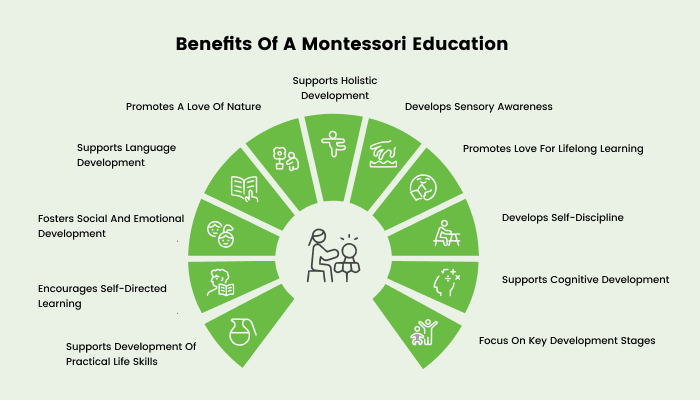
8 Key Benefits of Montessori Education
The benefits children experience depend on the quality of instruction, the suitability of the environment, and individual needs. Research reviews have found positive average effects of Montessori education across several academic and nonacademic outcomes, although results can vary between programs and studies. <Cite refs={[“turn996790search9″,”turn996790search3”]}/>
1. Encourages Independence
Montessori classrooms give children regular opportunities to make choices, manage materials, and complete age-appropriate tasks.
Instead of depending on an adult for every step, children practice deciding what to do, how to begin, and how to finish an activity.
For example, a child may select a puzzle, work through it, check the result, and return it to the shelf.
These everyday experiences can strengthen self-reliance and help children become more comfortable managing responsibilities.
2. Develops Concentration and Attention
Many Montessori activities encourage children to focus on a specific task for a sustained period.
A child might repeatedly arrange objects, build a structure, trace letters, or work through a mathematical exercise.
The ability to repeat an activity at an appropriate level of difficulty may help children practice sustained attention and task completion.
Teachers support concentration by preparing organized spaces, introducing activities carefully, and avoiding unnecessary interruptions.
However, attention develops differently in every child, and Montessori education should not be expected to eliminate all concentration difficulties.
3. Supports Problem-Solving Skills
Montessori materials often encourage children to discover solutions through experimentation and feedback.
If a puzzle piece does not fit, a child can rotate it or try another position. If a sequence is incorrect, the child may notice the mismatch and attempt a different arrangement.
These experiences encourage children to observe results, recognize mistakes, and adjust their approach.
Problem-solving skills can be useful in mathematics, science, creative activities, and everyday situations.
4. Builds Confidence and Self-Discipline
Children can develop confidence when they are given opportunities to complete meaningful tasks and see their progress.
Montessori education often emphasizes internal motivation, persistence, and responsibility rather than depending entirely on prizes or competition.
For example, completing a challenging activity can give a child a sense of achievement. Returning materials to their proper place also reinforces responsibility for shared resources.
Supportive teacher guidance remains important. Children still need encouragement, clear expectations, and assistance when a task becomes too difficult.
5. Encourages Social Skills and Cooperation
Although Montessori classrooms often include independent work, children also learn within a community.
They practice waiting for materials, respecting another person’s workspace, helping classmates, and participating in shared activities.
Mixed-age settings may provide additional opportunities for peer interaction and cooperation.
These experiences can help children develop communication skills, consideration for others, and an understanding of shared responsibilities.
6. Makes Academic Concepts More Concrete
One distinctive benefit of Montessori methods is the use of physical materials to introduce concepts that might otherwise seem abstract.
Children can count objects, compare quantities, arrange shapes, and explore letter sounds before moving toward more symbolic representations.
For instance, using beads to represent quantities can help children visualize how numbers relate to one another.
Research reviews suggest that Montessori education can support academic outcomes, including mathematics and language, although results depend on the program and the quality of the available evidence. <Cite refs={[“turn996790search9″,”turn996790search11”]}/>
7. Supports Creativity and Curiosity
Montessori learning encourages children to explore materials, ask questions, and investigate topics that interest them.
A child interested in plants might spend time observing seeds, comparing leaves, drawing plant structures, or learning how to care for a small garden.
These activities can connect curiosity with observation, language, science, and practical responsibility.
The opportunity to explore at an individual pace may also help children discover interests that they want to develop further.
8. Encourages Responsibility and Everyday Life Skills
Children learn that they have an active role in maintaining their learning environment.
They may care for classroom materials, clean up after activities, organize belongings, or help keep shared spaces tidy.
These routines encourage children to think about how their actions affect other people.
Over time, repeated opportunities to practice responsibility can support independence and participation in family, school, and community life.
Montessori Education vs. Traditional Education
Montessori education and traditional education both aim to help children learn, but they may organize teaching and classroom activities differently.
The comparison below describes common patterns rather than rules that apply to every school.
| Feature | Montessori Education | Traditional Education |
|---|---|---|
| Teaching approach | Often child-centered and activity-based | Often more teacher-directed, depending on the school |
| Learning pace | Allows flexibility for individual progress | May follow a common class schedule or curriculum sequence |
| Classroom materials | Frequently includes hands-on, specialized materials | May use textbooks, worksheets, digital resources, and practical materials |
| Student choice | Children often select from approved activities | Teachers often assign the main activity |
| Classroom organization | May use mixed-age groups and individual workspaces | Often groups students by age or grade |
| Teacher’s role | Observes, demonstrates, and guides individual learning | Often explains concepts and leads lessons, while also supporting individual learners |
| Assessment | May include observation, records of progress, and formal assessments | May include tests, assignments, observation, and other assessments |
Neither approach is automatically better for every child. Traditional classrooms can offer excellent individualized instruction, active learning, and student choice. Montessori programs can also vary in how closely they follow established principles.
Parents should evaluate the actual school, teacher quality, learning environment, curriculum, and support available rather than choosing solely on the basis of a label.
Is Montessori Education Suitable for Every Child?
Montessori education can be a good fit for children who enjoy hands-on activities, opportunities for choice, and learning at an individual pace. However, children’s needs and preferences differ, and no single educational approach is ideal for everyone.
Some children thrive when they have time to explore an activity independently. Others may benefit from more frequent direct instruction, explicit structure, or targeted support.
Children with disabilities or additional learning needs may benefit from Montessori education when the school provides appropriate accommodations, trained staff, and individualized support. The suitability of any program depends on how well it meets the specific child’s needs.
Before making a decision, consider the following questions:
- Does the child feel safe and comfortable in the environment?
- Are teachers warm, attentive, and appropriately trained?
- Does the program support the child’s academic and developmental needs?
- Are there suitable activities for different skill levels?
- How does the school communicate with parents?
- Can the school provide support or accommodations when needed?
- Does the approach align with the family’s educational goals?
Visiting a classroom and speaking with teachers can help parents understand how the approach works in practice.
How to Choose a Good Montessori School
Not every school that uses the Montessori name follows the same practices. Families should look beyond marketing claims and examine the quality of the educational experience.
Check Teacher Training
Ask about teachers’ Montessori training, qualifications, and experience with the relevant age group.
A strong program should have educators who understand Montessori principles and know how to introduce materials, observe progress, and provide appropriate guidance.
Observe the Classroom
If possible, arrange a visit while children are learning.
Look for an organized environment, accessible materials, respectful teacher-child interactions, and opportunities for both independent work and cooperation.
Notice whether children are engaged in meaningful activities and whether teachers provide support without unnecessarily taking over.
Ask About the Curriculum
A Montessori program should support age-appropriate learning across language, mathematics, practical life, social development, and other relevant subjects.
Ask how teachers monitor progress and how the school prepares children for the next stage of education.
Understand Classroom Structure
Ask about class size, age groupings, daily routines, and the length of work periods.
The school should be able to explain how it balances children’s freedom to choose activities with clear expectations and adult guidance.
Review Communication and Support
Families should receive useful information about children’s progress, strengths, and areas where additional practice may help.
Ask how teachers communicate concerns and whether the school can work with families and specialists when a child needs additional support.
Evaluate Safety and Inclusion
Check the school’s safeguarding policies, supervision, hygiene, accessibility, and procedures for responding to children’s needs.
A positive learning environment should respect children’s backgrounds and provide appropriate support for different abilities.
How to Apply Montessori Principles at Home
Parents do not need to recreate a complete Montessori classroom to encourage independence and active learning. Small changes to everyday routines can help children develop useful skills.
Create an Accessible Space
Arrange a small selection of books, toys, and learning materials where your child can reach them safely.
Use low shelves or clearly labeled containers to help the child choose an activity and return materials after use.
Encourage Everyday Independence
Invite children to participate in age-appropriate tasks such as putting away toys, sorting laundry, watering plants, or helping prepare simple snacks with adult supervision.
Allow enough time for them to try rather than completing every task on their behalf.
Offer Meaningful Choices
Give children a limited number of appropriate options.
For example, ask whether they would like to read a book or complete a puzzle. This allows them to practice decision-making while maintaining reasonable boundaries.
Let Children Practice and Repeat
Children often need repeated opportunities to master a new skill.
If your child wants to complete the same puzzle several times or practice pouring water, allow repetition when it is safe and appropriate.
Use Everyday Objects for Learning
Counting fruit, matching socks, sorting buttons, and comparing container sizes can introduce early mathematical concepts.
Simple household activities can provide practical learning opportunities without requiring expensive equipment.
Encourage Effort Rather Than Perfection
When a child makes a mistake, respond calmly and encourage another attempt.
You might say, “You are still working it out. What could you try next?” This approach helps children see mistakes as part of learning rather than as reasons to give up.
What Does Research Say About Montessori Education?
Research on Montessori education has produced encouraging findings, but it is important to interpret them carefully.
A systematic review published in 2023 examined 32 studies and found that Montessori education had modest but meaningful positive effects across a range of academic and nonacademic outcomes compared with conventional education. Outcomes included general academic ability, language, mathematics, social skills, and aspects of children’s experience of school. <Cite refs={[“turn996790search9″,”turn996790search11”]}/>
Another meta-analysis published in 2023 reviewed experimental and quasi-experimental studies and reported positive effects across several areas of development and learning, including cognitive abilities, social skills, creativity, motor skills, and academic achievement. The estimated effects varied by outcome. <Cite refs={[“turn996790search3″,”turn996790search4”]}/>
These findings suggest that Montessori education can be beneficial, but they do not mean that every Montessori school will produce the same results.
Program quality matters. Schools may differ in teacher preparation, classroom practices, learning materials, student populations, and how closely they follow Montessori principles. Families may also choose schools for reasons that influence comparisons between groups of students.
For these reasons, parents should consider research alongside direct observations, school visits, teacher qualifications, and their child’s individual needs.
Frequently Asked Questions About Montessori Education
What is the main purpose of Montessori education?
The main purpose is to support children’s overall development through active learning, independence, purposeful activities, and respect for individual developmental needs. It aims to nurture academic abilities alongside practical, social, and emotional skills.
What are the five principles of Montessori education?
Commonly discussed principles include respect for the child, the prepared environment, hands-on learning, self-directed activity, and freedom within limits. Montessori education also emphasizes observation, independence, and developmentally appropriate guidance.
What age is best to start Montessori education?
Montessori programs exist for different age groups, including infants, toddlers, preschool children, elementary-age students, and older learners. The appropriate starting point depends on the child’s needs, the program available, and the family’s circumstances.
What are the main benefits of Montessori education?
Potential benefits include greater independence, opportunities to practice concentration, problem-solving, hands-on academic learning, social cooperation, confidence, creativity, and responsibility. Outcomes depend on the quality of the program and individual circumstances.
How is Montessori different from traditional schooling?
Montessori education typically emphasizes self-directed activities, hands-on materials, flexible pacing, and prepared environments. Traditional schooling often uses more teacher-led lessons and shared schedules, although many conventional schools also use active learning and individualized instruction.
Is Montessori education better than traditional education?
There is no universal answer. Research suggests that Montessori education can produce positive academic and nonacademic outcomes on average, but the quality of implementation and the child’s individual needs matter. Parents should compare specific schools rather than assuming one approach is always superior.
Do Montessori students learn reading and mathematics?
Yes. Montessori programs commonly include structured language and mathematics activities. Children may use hands-on materials to explore letters, sounds, numbers, quantities, and mathematical operations before progressing toward more abstract skills.
Can Montessori methods be used at home?
Yes. Parents can encourage independence, offer limited choices, organize accessible materials, involve children in everyday tasks, and allow time for practice and exploration. These principles can be adapted to ordinary family routines.
What should parents look for in a Montessori school?
Look for trained educators, an organized and safe classroom, appropriate learning materials, respectful interactions, clear academic goals, communication with families, and suitable support for individual learning needs.
Conclusion
Montessori education offers a distinctive approach to learning by combining child-centered teaching, hands-on materials, purposeful activities, and opportunities for independence. Its core principles encourage children to explore ideas, practice practical skills, develop social relationships, and take an active role in their education.
Understanding Montessori education methods and benefits can help parents make informed decisions about their child’s learning environment. Practical life activities, sensorial materials, individualized guidance, and freedom within limits all contribute to the approach.
Research indicates that Montessori education can support a range of academic and nonacademic outcomes, although results depend on program quality and individual circumstances. Parents should therefore look closely at each school’s teaching practices, staff preparation, learning environment, and ability to meet their child’s needs.
Ultimately, the most suitable educational environment is one where children feel safe, respected, challenged appropriately, and supported as they develop the knowledge and skills needed for continued learning.
Leave a Reply