Effective teaching involves more than explaining a topic and asking students to complete an assignment. Teachers also need to understand what students are learning, identify misunderstandings, and determine which concepts require further explanation. Formative assessment makes this process possible by providing ongoing information about student understanding during instruction.
Using formative assessment strategies for teachers can help educators recognize learning gaps, adjust teaching methods, and provide feedback that guides students toward their learning goals. Instead of waiting until a final examination to discover difficulties, teachers can check understanding throughout a lesson and respond before small misunderstandings become larger problems.
For example, after teaching a mathematics concept, a teacher might ask students to solve one problem independently and explain their reasoning. Their answers can reveal whether they understand the process, need another example, or are ready for a more challenging task.
Formative assessment is useful across subjects, grade levels, and learning environments. It can involve classroom discussions, short quizzes, observation, peer feedback, exit tickets, and student self-assessment. The most important part is not the assessment activity itself, but how teachers and students use the information it provides.
In this article, we explore what formative assessment means, why it matters, practical classroom techniques, examples for different subjects, and ways educators can use assessment evidence to improve teaching and learning.
What Is Formative Assessment?
Formative assessment is an ongoing process of gathering and using evidence about student learning to make informed decisions about instruction and next steps.
It helps teachers answer three important questions:
- What are students expected to learn?
- What do students understand right now?
- What should happen next to help them make progress?
The U.S. Department of Education’s TEAL Center explains that formative assessment provides information about students’ thinking and helps teachers adjust instruction, provide feedback, and identify appropriate next steps.
Unlike an assessment used primarily to assign a final grade, formative assessment is intended to improve learning while it is taking place. It can be informal or structured, brief or detailed, written or spoken.
For example, a teacher may listen to students explain a science concept, review a short written response, or ask learners to identify the most confusing part of a lesson. These activities become formative when the information is used to guide subsequent teaching or learning.
Formative Assessment vs. Summative Assessment
Formative and summative assessments serve different purposes, although the same type of activity can sometimes be used for either purpose.
| Formative assessment | Summative assessment |
|---|---|
| Monitors learning during instruction | Evaluates learning after a period of instruction |
| Identifies misunderstandings and learning needs | Measures achievement against established expectations |
| Guides teaching adjustments and feedback | Often contributes to final grades or formal reporting |
| Encourages improvement and reflection | Summarizes what students have achieved |
| Examples: exit tickets, classroom questioning, practice quizzes | Examples: final examinations, end-of-unit tests, final projects |
For example, a short quiz can be formative if a teacher reviews the responses and reteaches a difficult concept. The same quiz may serve a summative purpose if it is primarily used to determine a student’s final grade.
The distinction depends on how assessment information is used, not simply on the format of the task.
Why Is Formative Assessment Important for Teachers?
Formative assessment helps educators make teaching decisions based on evidence rather than assumptions. It can reveal which students understand a concept, which misconceptions remain, and whether the current instructional approach is working.
Research summarized by the Organisation for Economic Co-operation and Development (OECD) emphasizes the connection between learning goals, evidence of student understanding, feedback, and adjustments to instruction.
1. Identifies Learning Gaps Early
Students may appear to understand a lesson while listening but struggle when they apply the concept independently. Regular assessment helps teachers recognize this difference.
For example, students learning fractions may correctly repeat a rule but make mistakes when comparing fractions with different denominators.
A quick problem or explanation can reveal the misunderstanding before the class moves to a more advanced topic.
Teachers can then revisit the concept, use visual models, provide additional examples, or arrange targeted practice.
Early identification helps prevent students from building new knowledge on an incomplete understanding of earlier material.
2. Helps Teachers Adjust Instruction
Not every lesson will work equally well for every class. Some explanations may be unclear, activities may be too challenging, or students may need more practice than expected.
Formative assessment gives teachers information they can use to adjust their approach.
If many students answer a question incorrectly, the teacher might explain the concept in a different way. If most students demonstrate understanding, the class may be ready for independent work or a more challenging application.
This flexibility allows teachers to respond to actual learning needs rather than following a lesson plan regardless of student progress.
3. Provides Useful Feedback to Students
Feedback helps students understand what they have done successfully and what they should do next.
Effective feedback should be specific, understandable, and connected to the learning objective.
For example, instead of writing “Try harder” on a student’s paragraph, a teacher could write, “Your main idea is clear. Add a supporting example to explain your second point.”
This tells the student what is working and how to improve the next draft.
Feedback is most useful when students have an opportunity to act on it. Teachers should provide time for corrections, revisions, additional practice, or reflection.
4. Supports Different Learning Levels
Students often need different levels of support when learning a new skill. Some may benefit from additional demonstrations, while others are ready to work independently.
Formative assessment helps teachers identify these differences and plan appropriate responses.
For example, after a reading activity, one group may need help identifying the main idea, another may practice finding supporting details, and a third may compare the author’s arguments across two texts.
The groups should remain flexible because student needs can change as learning progresses.
5. Encourages Student Engagement
Students are more likely to participate meaningfully when they understand learning goals and can recognize their own progress.
Short reflection activities, self-assessment, and classroom discussions allow students to express what they understand and identify areas where they need help.
These activities also show students that mistakes are useful sources of information rather than reasons for embarrassment.
A classroom that treats questions and corrections as normal parts of learning can encourage students to seek support when they need it.
10 Effective Formative Assessment Strategies for Teachers
Teachers can use many different techniques to gather evidence of student understanding. The best choice depends on the learning objective, the age of the students, the subject, and the amount of time available.
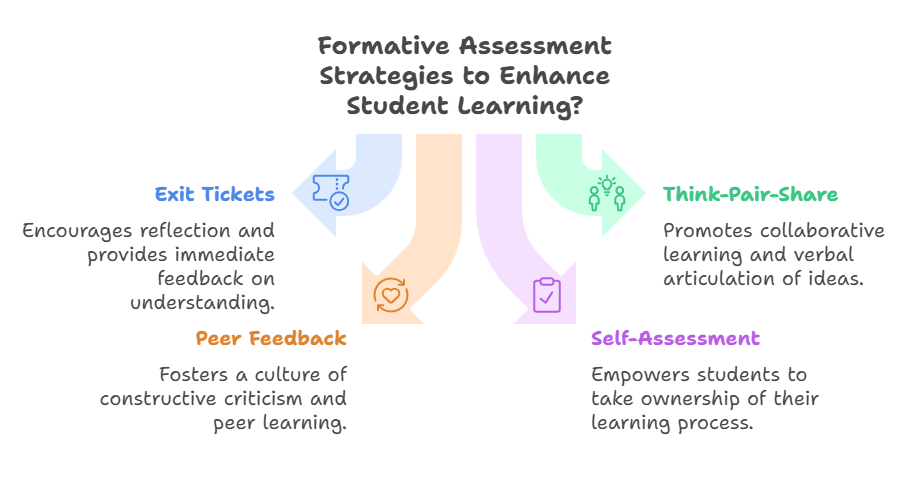
1. Exit Tickets
An exit ticket is a short task students complete near the end of a lesson. It allows teachers to check whether the main learning objective has been achieved.
For example, after a lesson on the water cycle, students might answer:
- What is evaporation?
- How is condensation different from precipitation?
- Which part of the water cycle is still confusing to you?
The responses help the teacher identify common misunderstandings and decide what to review during the next lesson.
Exit tickets work best when questions are directly connected to the lesson’s learning objectives.
2. Classroom Questioning
Thoughtful questioning helps teachers explore students’ understanding during instruction.
Instead of asking only questions that require a one-word answer, teachers can invite students to explain their reasoning.
Examples include:
- How did you arrive at that answer?
- Why do you think this method works?
- Can you explain the concept in your own words?
- What evidence supports your conclusion?
- What might happen if one part of the problem changed?
These questions help teachers identify whether students understand a concept or have simply memorized a response.
Teachers should also provide enough thinking time and use different participation methods so that assessment does not rely only on students who volunteer quickly.
3. Quick Quizzes
Short quizzes can reveal whether students remember key information and can apply a recently taught skill.
A quiz might contain three to five questions, a matching activity, a few multiple-choice items, or one short written response.
For example, after a grammar lesson, students might identify the subject and verb in several sentences.
The teacher can quickly review the answers and determine whether to move forward, provide another example, or organize a short review activity.
When used formatively, quick quizzes should primarily inform learning decisions rather than create unnecessary pressure.
4. Think-Pair-Share
Think-pair-share gives students time to consider a question independently, discuss their ideas with a partner, and share their reasoning with the class.
For example, a science teacher might ask, “Why do some objects float while others sink?”
Students first develop an explanation, compare their ideas with a partner, and then discuss possible answers.
The teacher listens for accurate reasoning, incomplete explanations, and misconceptions.
This method gives more students an opportunity to express their thinking than relying entirely on whole-class questioning.
5. The Traffic-Light Method
The traffic-light method allows students to communicate how confident they feel about a topic.
Students can use colored cards, symbols, or a simple digital response:
- Green: I understand and can complete the task independently.
- Yellow: I understand some of it but need more practice.
- Red: I need help understanding the concept.
Teachers can use the responses to decide whether to provide another explanation, offer guided practice, or move students toward independent application.
However, self-reported confidence should not be the only evidence used. A student may feel confident but still misunderstand a concept, so teachers should combine this method with actual responses or demonstrations.
6. Observation and Anecdotal Notes
Teachers can learn a great deal by observing how students approach classroom tasks.
During group work, reading activities, experiments, or independent practice, teachers can note students’ strategies, common mistakes, participation, and level of independence.
For example, a teacher may notice that a student can solve a multiplication problem with counters but struggles to represent the same problem using numbers.
This observation can guide the next teaching step.
Brief notes are often sufficient. Teachers do not need to record every action; they should focus on evidence relevant to the learning objectives.
7. Student Self-Assessment
Self-assessment encourages students to compare their work with clear learning goals and success criteria.
For example, after writing a paragraph, students might check whether they have included a topic sentence, supporting details, and a concluding sentence.
A simple checklist could ask:
- Have I completed all parts of the task?
- Can I explain my main idea?
- Which part of my work is strongest?
- What should I improve next?
Self-assessment helps students develop reflection and self-monitoring skills.
Teachers should model the process and provide clear criteria so that students evaluate their work realistically rather than simply marking everything as complete.
8. Peer Assessment
Peer assessment allows students to review one another’s work using agreed-upon criteria.
For example, students writing persuasive paragraphs might exchange drafts and identify the main argument, one strong supporting reason, and one area that could be clearer.
This process can help students recognize effective work and think more carefully about their own writing.
Peer assessment should be structured and respectful. Teachers should explain how to provide constructive feedback and monitor the process, especially when students are reviewing unfamiliar or complex work.
9. One-Minute Papers
A one-minute paper asks students to write a brief response to a question at the end of a lesson.
Possible prompts include:
- What is the most important thing you learned today?
- What question do you still have?
- Which example helped you understand the topic?
- How would you explain today’s concept to someone else?
These responses can reveal what students consider important, where confusion remains, and which explanations were helpful.
The activity is particularly useful when teachers want a quick snapshot of student understanding without administering a formal quiz.
10. Concept Maps and Visual Responses
Concept maps allow students to show relationships between ideas through diagrams, labels, and connecting lines.
For example, after studying an ecosystem, students might connect plants, animals, water, sunlight, and other environmental factors.
The connections can reveal whether students understand how different components relate to one another.
Teachers can also use labeled diagrams, timelines, flowcharts, and annotated drawings to assess understanding when a visual representation is appropriate for the learning objective.
How to Use Formative Assessment in Different Subjects
Formative assessment can be adapted to almost any subject. The important step is to select an activity that provides useful evidence of the specific skill or concept being taught.
Formative Assessment in Mathematics
Mathematics teachers can use short problems, worked examples, oral explanations, and error analysis to understand student reasoning.
For example, after teaching equivalent fractions, ask students to write two fractions that represent the same value and explain why they are equivalent.
A correct answer with a clear explanation provides stronger evidence of understanding than a correct answer alone.
If students make similar mistakes, the teacher can revisit the concept using fraction strips, diagrams, or additional worked examples.
Formative Assessment in Reading and English
Reading teachers can check understanding through summaries, vocabulary questions, main-idea exercises, and discussions about a text.
For example, after reading a passage, students might identify its main idea and provide two supporting details.
The teacher can use the responses to determine whether students need help distinguishing important information from minor details.
In writing lessons, reviewing a draft against specific criteria can reveal whether students need more support with organization, grammar, evidence, or sentence structure.
Formative Assessment in Science
Science teachers can ask students to make predictions, explain observations, interpret simple data, or describe the results of an experiment.
For example, before investigating which objects float, students might predict what will happen to several objects placed in water and explain their reasoning.
After the experiment, students compare their predictions with their observations.
This process allows teachers to assess scientific thinking, not simply whether students can remember a definition.
Formative Assessment in Social Studies
Social studies teachers can use timelines, map activities, source analysis, short written responses, and classroom discussions.
After studying a historical event, students might explain one cause and one consequence.
Their answers can help the teacher identify whether they understand the relationship between events or have only memorized dates and names.
A Practical Example of Formative Assessment in a Lesson
Consider a 40-minute mathematics lesson on equivalent fractions.
Learning objective: Students will identify equivalent fractions and explain why they represent the same value.
Success criteria: Students can identify at least two equivalent fractions, represent them visually, and explain the relationship between them.
Lesson sequence
1. Warm-up — 5 minutes
Students answer a question about the meaning of numerators and denominators. The teacher checks whether they remember the necessary foundational knowledge.
2. Teacher explanation — 10 minutes
The teacher demonstrates equivalent fractions using diagrams or fraction strips and asks students to explain what they notice.
3. Guided practice — 10 minutes
Students solve two examples with teacher support. The teacher asks students to explain their methods and identifies common errors.
4. Independent check — 10 minutes
Students solve a short set of questions independently. Their responses help the teacher identify who understands the concept and who needs further guidance.
5. Exit ticket — 5 minutes
Each student writes one pair of equivalent fractions and explains why they are equivalent.
How the teacher uses the results
If many students struggle, the teacher may revisit the concept with additional visual models. Students who understand the basics but make occasional errors may benefit from guided practice. Students who demonstrate secure understanding can move to more complex problems.
The next lesson should reflect this evidence. This is what makes assessment formative: the results influence what happens next.
How Teachers Can Provide Effective Feedback
Assessment becomes more useful when it leads to feedback that students can understand and apply.
Effective feedback focuses on the learning task, explains what needs improvement, and gives students a realistic next step.
Make Feedback Specific
General comments such as “Good work” or “Needs improvement” provide limited information.
More useful feedback identifies a particular strength or area for development.
For example:
- Instead of “Improve your answer,” say, “Explain why your evidence supports the main idea.”
- Instead of “Incorrect,” say, “Check the denominator and compare the fractions using a diagram.”
- Instead of “Write more,” say, “Add one example that supports your argument.”
Specific comments help students understand how to improve.
Give Feedback at a Useful Time
Feedback should arrive when students can still use it to improve their work or understanding.
For example, comments on a draft are more useful when students have time to revise the draft. Feedback after a mathematics exercise can help students correct an error before practicing the same skill again.
The appropriate timing depends on the task, but teachers should avoid providing feedback so late that students cannot connect it with their learning.
Allow Time to Act on Feedback
Students need opportunities to use the information they receive.
Teachers can include time for corrections, rewriting, additional practice, or a second attempt at a problem.
This creates a feedback cycle in which students receive information, make adjustments, and demonstrate their learning again.
Feedback should not be treated as complete simply because the teacher has written comments on a page.
How Formative Assessment Supports Differentiated Instruction
Formative assessment and differentiated instruction work well together.
Formative assessment helps teachers identify what students currently understand, while differentiated instruction helps them respond to the needs revealed by that evidence.
For example, after a reading comprehension check, a teacher might identify three temporary groups:
- Students who need guided practice identifying the main idea.
- Students who are ready to identify the main idea and supporting details independently.
- Students who are ready to compare the main ideas of two texts.
The teacher can provide appropriate tasks and reassess students during the activity.
These groups should remain flexible. Students should be able to move between tasks as their understanding develops.
Assessment evidence should guide instructional decisions rather than become a permanent label of a student’s ability.
Common Mistakes Teachers Should Avoid
Formative assessment is most effective when it leads to meaningful decisions. Several common mistakes can reduce its value.
Assessing Without a Clear Objective
A quiz or question should measure something connected to the intended learning goal.
Before choosing an assessment method, teachers should identify what students need to demonstrate and select a task that provides suitable evidence.
Asking Questions Only to Volunteers
If teachers rely only on students who raise their hands, they may overlook misunderstandings among other learners.
Strategies such as think-pair-share, written responses, response cards, and short independent tasks can provide information from more students.
Treating Every Mistake as a Failure
Mistakes can reveal how students are thinking and which concepts require further instruction.
Teachers should investigate the reasoning behind an error and use it to guide the next teaching step.
Collecting Results Without Acting on Them
An assessment does not automatically improve learning. Teachers must interpret the evidence and decide whether to reteach, provide feedback, change activities, or offer additional challenge.
Giving Vague Feedback
Comments that do not explain what students should do next are unlikely to guide meaningful improvement.
Feedback should be connected to clear success criteria and provide a practical next step.
Using Too Many Assessments
Frequent testing can take time away from instruction and create unnecessary pressure.
Teachers should choose short, purposeful checks that provide useful information. One well-designed question may reveal more than a lengthy quiz that does not directly measure the learning objective.
How to Improve Your Formative Assessment Practice
Teachers can strengthen their assessment routines by making small, consistent changes.
Start with clear learning goals. Explain what students should learn and what successful work looks like.
Choose an appropriate assessment method. Select questions or tasks that reveal the intended knowledge or skill.
Gather evidence from different students. Use written responses, discussion, observation, and independent tasks rather than relying on one source.
Look for patterns. Identify common misconceptions and distinguish them from individual mistakes.
Respond to what you discover. Adjust explanations, provide targeted support, or offer more challenging work as appropriate.
Encourage student reflection. Help learners recognize their progress, understand feedback, and identify their next steps.
Review the impact. Check whether the changes you made have helped students develop a stronger understanding.
These practices turn formative assessment into a regular part of teaching rather than an additional task performed only at the end of a lesson.
Frequently Asked Questions About Formative Assessment Strategies for Teachers
1. What are formative assessment strategies for teachers?
Formative assessment strategies are techniques teachers use to gather evidence of student understanding during instruction. Examples include exit tickets, classroom questioning, short quizzes, observation, peer assessment, self-assessment, and concept maps.
Teachers use the results to provide feedback and decide what students need next.
2. What is the main purpose of formative assessment?
The main purpose is to improve learning while it is taking place. Formative assessment helps teachers identify learning gaps, adjust instruction, and provide feedback that guides students toward their learning objectives.
3. What are the five main formative assessment strategies?
A widely used framework emphasizes five connected practices: clarifying learning intentions and success criteria, eliciting evidence of learning, providing feedback that moves learning forward, helping students learn from one another, and helping students take responsibility for their own learning.
These practices combine teacher assessment, feedback, peer learning, and student reflection.
4. What is the difference between formative and summative assessment?
Formative assessment is used to monitor learning and guide next steps during instruction. Summative assessment is used to evaluate achievement after a period of learning, often for grading or reporting. The same activity can serve either purpose depending on how the results are used.
5. How often should teachers use formative assessment?
Teachers can use brief assessment checks throughout lessons whenever they need evidence of student understanding. The frequency should depend on the learning objective, the complexity of the topic, and the decisions the teacher needs to make.
6. Can formative assessment improve student performance?
Formative assessment can support better learning when teachers use the evidence to adjust instruction and provide useful feedback. Simply collecting answers or scores is not enough; students need opportunities to address misunderstandings and apply what they learn from feedback.
7. What are examples of formative assessment in primary classrooms?
Examples include picture-based questions, matching activities, oral explanations, thumbs-up or thumbs-down responses, short quizzes, drawing and labeling diagrams, and exit tickets. Teachers should choose activities appropriate for students’ ages, abilities, and learning objectives.
8. How does formative assessment support differentiated instruction?
It helps teachers identify which students need additional explanations, guided practice, independent work, or extension tasks. This information allows educators to adjust instruction and group students flexibly according to their current learning needs.
9. Does formative assessment have to be graded?
No. Many formative assessments are ungraded because their main purpose is to provide information for improvement. Teachers can use descriptive feedback, observations, checklists, and short practice activities without assigning a formal score.
Conclusion
Formative assessment helps teachers improve learning by making student understanding visible throughout the teaching process. It allows educators to identify misconceptions, provide meaningful feedback, adjust lesson activities, and support students as they work toward clear learning objectives.
The most effective formative assessment strategies for teachers include exit tickets, classroom questioning, short quizzes, observation, student self-assessment, peer feedback, and concept mapping. Each technique can provide valuable information when it is connected to a specific learning goal.
The key is to use assessment evidence to make informed decisions. Teachers should review student responses, identify patterns, provide actionable feedback, and give learners opportunities to improve their work.
By making formative assessment a regular part of classroom instruction, educators can respond more effectively to student needs, strengthen understanding, and create a learning environment where progress is continuously monitored and supported.
Leave a Reply